
France Medical Cannabis Reimbursement Plans Signal A New European Phase
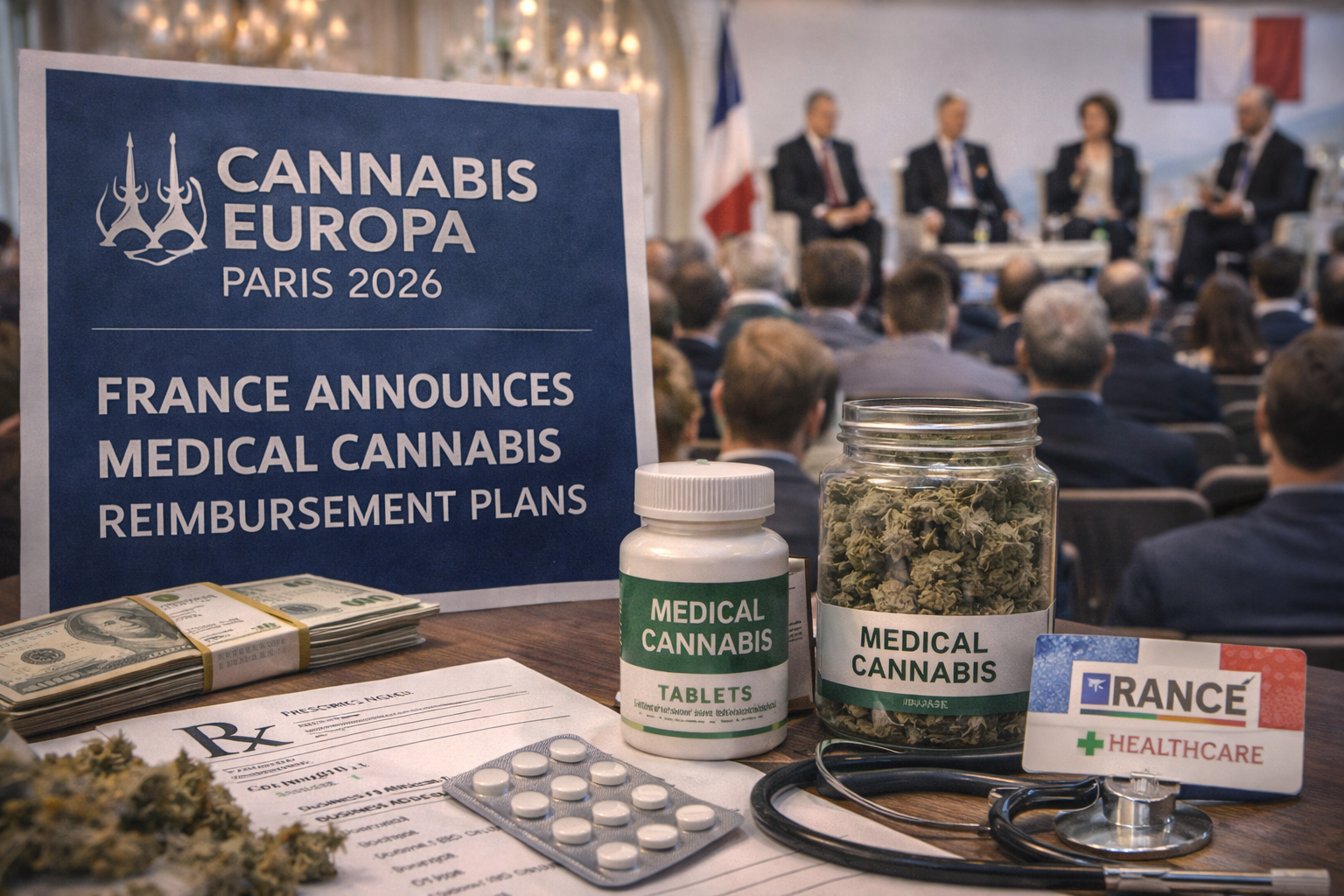
Conference panel on French medical cannabis reimbursement plans with medical cannabis tablets and flower in the foreground
France is moving closer to a medical cannabis model where the question is not just can patients access it, but who pays for it and under what standards. That is why France medical cannabis reimbursement is a big deal for 2026. Reimbursement turns a medical program into a real healthcare lane, with rules that reward consistency, evidence, and trust building instead of hype.
Quick facts
• French authorities presented a first draft reimbursement framework to stakeholders on February 18, 2026, ahead of Cannabis Europa Paris 2026
• The draft describes tiered reimbursement rates tied to the Haute Autorité de Santé evaluation of therapeutic benefit, with tiers shown as 65 percent, 30 percent, 10 percent, or 0 percent
• France’s medical cannabis experiment began in March 2021 and has been extended through March 31, 2026 for existing patients, with no new patient inclusion since March 27, 2024
• HAS is evaluating cannabis based medicines authorized by ANSM in view of potential health insurance coverage, and highlights that a decree is needed to define the final evaluation procedure
• HAS describes a pharmaceutical style approach that centers on defined pharmaceutical forms and excludes the smoked route for cannabis based medicines
If France reimbursement planning affects your product roadmap, Start with our quick Cannashield intake form so you can map market access risk, documentation needs, and partner expectations before you spend money on the wrong path.
Why Reimbursement Changes The Medical Game
Legal access is one thing. Reimbursed access is another planet.
When a health system reimburses, it signals that regulators want medical cannabis to behave like medicine. That pushes the whole ecosystem toward outcomes, patient follow up, controlled dosing, and professional accountability. It also changes buyer behavior. Patients treat reimbursed products differently than cash only products. Prescribers take it more seriously. Distributors demand tighter documentation.
Universal operator lesson: the fastest way to lose in medical is to sell it like adult use. Medical markets reward consistency, quality control, and education that holds up when someone asks for proof.
What France Put On The Table At Cannabis Europa Paris 2026
The headline from the conference is the economic model itself. According to reporting from the event, the draft reimbursement structure is tiered based on HAS assessment of each product’s therapeutic benefit, and pricing is organized by product categories with a single price applied across each category.
That category pricing point matters. If there is limited ability to differentiate on price inside a category, operators cannot win by being louder. They win by being more reliable, more scalable, and easier to integrate into a clinical workflow. The reporting also describes prices being fixed for a defined period, with the possibility of revision if new clinical evidence emerges.
This also signals the shape of the buyer. France operates a single payer style system, and the conversation becomes a negotiation with public health decision makers, not a retail shelf war.
If you are evaluating European partnerships, Complete our Cannashield questionnaire to pressure test your product positioning, labeling discipline, quality controls, and distribution exposure before you pitch to pharma style buyers.
The Operator Playbook For A Reimbursement Market
If you want to play in a reimbursement environment, think like a regulated healthcare supplier. Here is the playbook that travels across Europe.
Start with evidence and traceability. You need clean batch records, stability thinking, and an approach to pharmacovigilance style reporting, even if your current home market never asked for it.
Next, build dosing clarity. Reimbursement systems do not like chaos dosing. They want predictable administration, measured formats, and education that helps clinicians and patients use products responsibly.
Then tighten your education language. You can educate without making promises. Focus on dosing approach, onset expectations, contraindication awareness, and safe storage. Keep it clean and defensible.
Finally, plan for registration and evaluation gates. France’s system involves HAS evaluation and ANSM involvement for medicines in the program, and that comes with a higher standard for documentation and product specification than most consumer markets.
Universal operator lesson: reimbursement is a systems game. Operators who treat compliance as the product will outlast operators who treat it as paperwork.
What This Means For US Operators With International Ambitions
Even if you never sell in Europe, this matters. International standards tend to become global reference points. Investors use them to benchmark seriousness. Regulators borrow language. Partners ask for the same documents because they have seen them elsewhere.
In the US, the federal government still keeps medical cannabis outside normal prescription reimbursement channels, so state medical markets behave differently. That is exactly why France is worth watching. It shows where international medical is maturing: closer to traditional healthcare economics, closer to formal evaluation, and closer to reimbursement models that can scale patient access through the system rather than through cash.
If you need a practical reimbursement readiness checklist you can use for Europe focused conversations, use the Cannashield intake form to request it so your team can standardize documentation, training, and product decisions.
Conclusion
France moving toward a reimbursement framework is a signal that regulated medical cannabis access is gaining formal economic support outside North America. The operator opportunity in 2026 is positioning: tighter compliance, better education, clearer product logic, and a documentation stack that can survive evaluation. The operators who build trust systems now will be the ones ready when reimbursement and registration gates fully open.
What To Do This Week
• Assign an owner to track France reimbursement and HAS timeline updates monthly
• Audit your top medical focused SKUs for dosing clarity and repeatability
• Build a one page documentation pack template for batch records, testing, and stability notes
• Review your labeling and education language to remove anything that implies guaranteed outcomes
• Identify one EU capable distribution or pharmacy pathway partner type and define your minimum documentation standard
• Create a conservative timeline model that assumes evaluation and registration gates take time
FAQ
What does medical cannabis reimbursement mean in practice
It means a public health system may cover all or part of the cost if a product meets defined standards and evaluation thresholds.Who is HAS and why does it matter
HAS is the French body that evaluates medicines and advises on coverage decisions under the public health system.Is France already running a medical cannabis program today
France has run a controlled medical cannabis experiment and extended continuity for existing patients through March 31, 2026.What kind of product strategy does reimbursement reward
Consistency, quality management, dosing clarity, documentation, and education that fits a clinical workflow.Does this matter for US operators
Yes, because international medical standards influence investment expectations, partnership requirements, and future regulatory language, even if the US remains constrained at the federal government level.What is the universal operator lesson from France
Medical markets mature toward trust systems, and reimbursement accelerates that shift. Build for evidence, consistency, and defensible documentation.