

Cannabis Officially Moves to Schedule III Under Federal Law
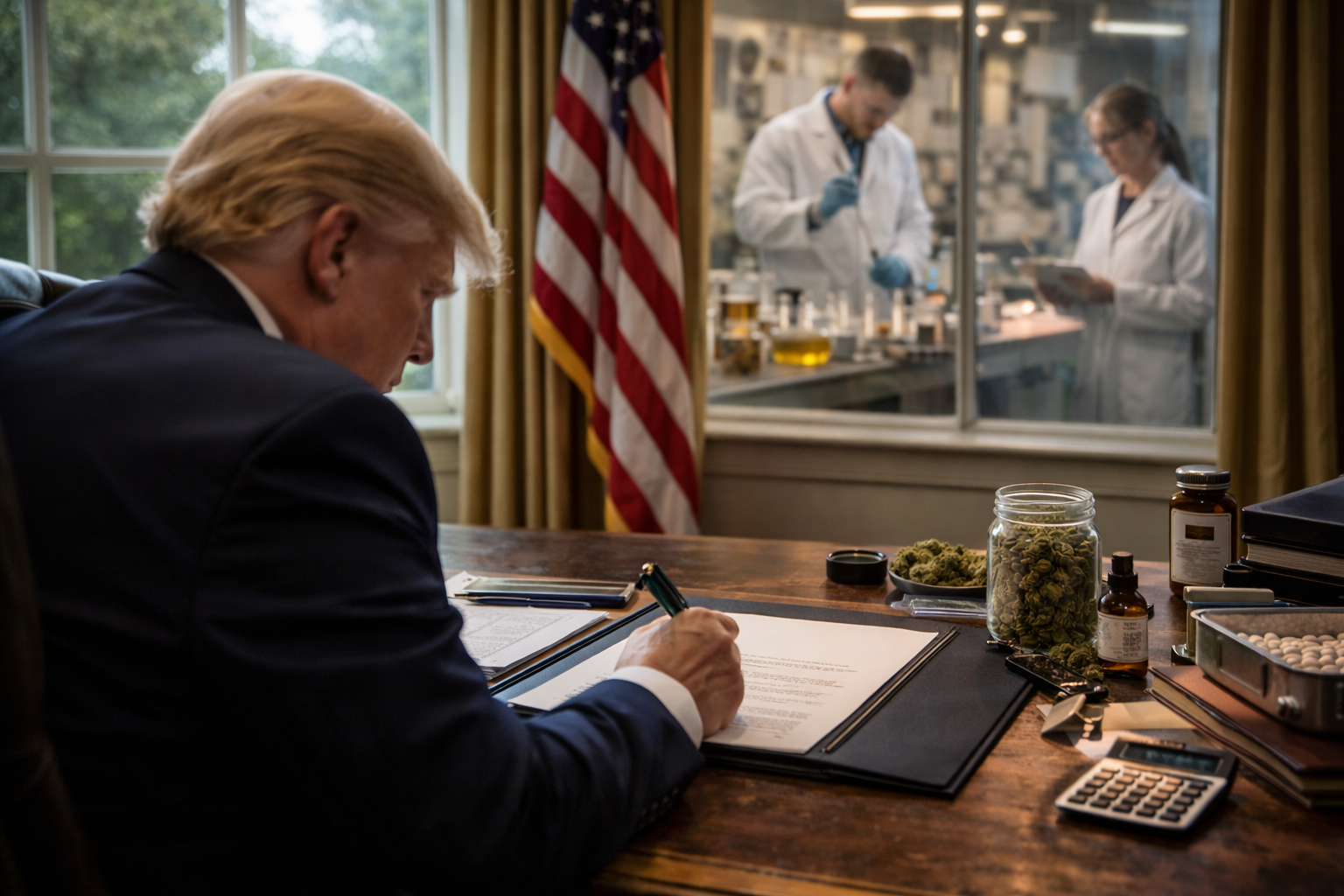
President Donald Trump signing an executive order reclassifying cannabis to Schedule III with laboratory researchers visible in the background.
The cannabis industry has reached a moment many once thought was years away. The United States has officially moved cannabis from Schedule I to Schedule III under federal law. President Trump signed an executive order directing federal agencies to carry out the reclassification, marking one of the most consequential federal cannabis policy shifts in modern history.
While cannabis remains federally illegal, this change fundamentally alters how the federal government views the plant. Schedule III status acknowledges accepted medical use and lowers several regulatory barriers that have limited research, healthcare integration, and industry operations for decades.
For operators, investors, and service providers, this is not just symbolic progress. It is a structural shift that will shape the next phase of the cannabis industry.
If your business operates in cannabis, hemp, or cannabinoid products, now is the time to reassess compliance and insurance readiness. Start with our quick Cannashield intake form to prepare for what comes next.
What Schedule III Status Really Means
Schedule I classification treated cannabis as having no accepted medical use. That designation conflicted with reality as medical programs expanded across the country. Moving cannabis to Schedule III aligns federal policy more closely with how states, patients, and researchers already view it.
This change does not legalize cannabis nationwide. States will continue to control licensing, retail rules, and enforcement. Interstate commerce remains restricted. However, the federal posture has shifted in meaningful ways.
Schedule III places cannabis alongside regulated substances that are used in medical treatment and subject to oversight rather than outright prohibition. That distinction matters for research, healthcare, and business operations.
Expanded Research and Medical Pathways
One of the most immediate effects of Schedule III status is expanded access to research. Under Schedule I, federal approval processes discouraged large scale clinical studies and limited institutional participation.
With reclassification, researchers may find it easier to:
• Conduct federally supported clinical trials
• Establish dosage standards and safety profiles
• Explore therapeutic applications
• Develop pharmaceutical grade cannabinoid treatments
This opens the door for FDA reviewed products and greater medical clarity. It also strengthens the foundation for evidence based healthcare decisions.
If your business works with medical products or research partners, Complete our Cannashield questionnaire to understand how regulatory changes could affect your risk profile.
Potential Impact on Banking and Insurance
While Schedule III does not automatically grant full banking access, it reduces one of the primary risk flags that has kept major financial institutions cautious. Over time, this could lead to broader participation from banks, insurers, and payment providers.
Possible improvements include:
• Greater willingness from banks to open accounts
• Expanded lending and credit options
• Improved payment processing stability
• More standardized insurance underwriting
Insurers may also revisit coverage terms as federal alignment improves. However, increased access often comes with higher expectations around documentation and compliance.
Tax Relief and Operational Stability
Another significant change tied to Schedule III status is the potential reduction of tax burdens. Cannabis businesses have long faced limitations on deducting ordinary operating expenses.
Reclassification could allow operators to apply standard tax treatment, improving margins and freeing up capital for reinvestment. For many companies, this could be the difference between survival and growth.
This change benefits businesses of all sizes, not just large operators.
What Schedule III Does Not Change
It is important to be clear about the limits of this decision.
• Cannabis remains federally illegal
• Adult use legality remains state specific
• Interstate commerce is not automatically permitted
• State licensing frameworks remain in control
Schedule III is not full legalization. It is a recalibration that removes some of the most restrictive barriers while keeping a regulated structure in place.
Understanding this distinction helps businesses plan realistically.
If enforcement or compliance uncertainty affects your operation, Fill out our Cannashield intake form to build a proactive protection strategy.
Why This Matters for CBD and Healthcare Integration
Schedule III status may also influence how federal agencies approach cannabidiol oversight. With cannabis acknowledged as having medical value, clearer guidance around CBD products could emerge.
This creates potential pathways for:
• Expanded healthcare coverage discussions
• Clearer FDA involvement
• More consistent product standards
• Integration into mainstream wellness and medical systems
Some analysts believe this could eventually support limited Medicare or insurance coverage for certain cannabinoid based therapies.
Preparing for a More Structured Federal Environment
Reclassification raises expectations. As barriers fall, oversight often increases. Businesses should prepare for a more formal regulatory environment.
Preparation includes:
• Strengthening compliance programs
• Organizing financial and operational records
• Reviewing insurance coverage
• Aligning practices with medical grade standards
• Planning for increased scrutiny
Companies that prepare now will adapt more smoothly than those who wait.
Conclusion
The official move of cannabis to Schedule III marks a historic shift in federal policy. While cannabis remains federally illegal, the decision acknowledges medical use and reduces barriers that have limited research, healthcare integration, and industry stability.
For cannabis businesses, this moment is not about speculation. It is about preparation. Federal change rewards operators who are organized, compliant, and protected.
At Cannashield, we help cannabis and hemp businesses navigate policy transitions with insurance solutions, compliance guidance, and risk strategies designed for an evolving federal landscape.
Complete our full intake form here to protect your business and stay ready as federal cannabis policy continues to evolve.