
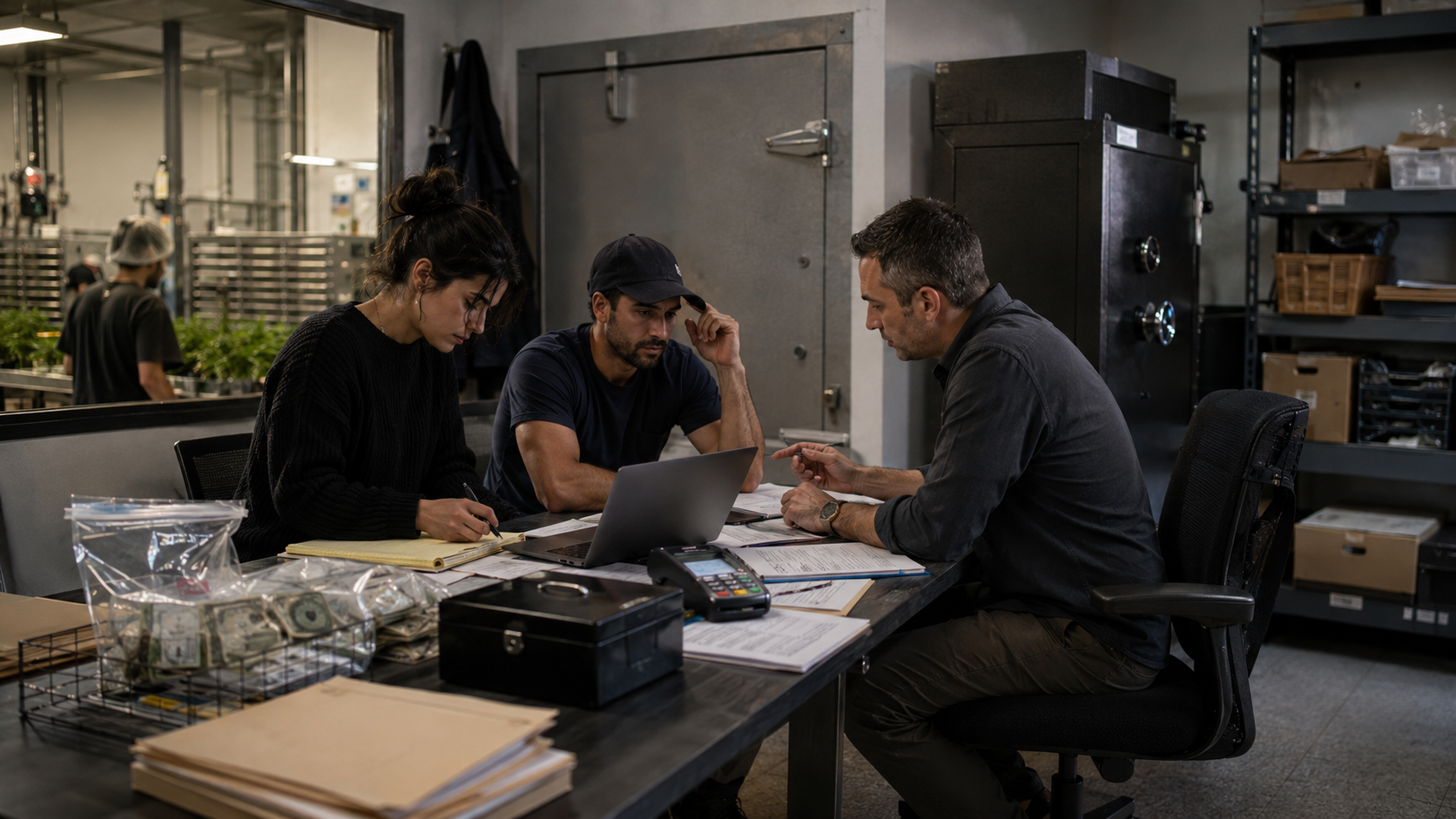
Cannabis team reviewing banking and payment risks
California cannabis operators are still facing basic banking problems years into legalization. Marijuana Moment reports that State Treasurer Fiona Ma announced a hearing titled “Continuing the Conversation: Advancing Safe and Legal Banking for California’s Cannabis Industry” to examine banking access challenges affecting cannabis businesses, workers, and communities. The hearing will bring together state and local officials, financial institutions, and cannabis business representatives to review remaining barriers and practical steps toward safer, more transparent financial access. For operators, retailers, manufacturers, investors, lenders, and compliance teams, this is a reminder that the state federal conflict is still shaping daily business risk.
Quick facts
• California Treasurer Fiona Ma announced a cannabis banking access hearing
• The hearing is titled “Continuing the Conversation: Advancing Safe and Legal Banking for California’s Cannabis Industry”
• The hearing is scheduled for Wednesday, July 29, 2026
• Participants are expected to include state and local officials, financial institutions, and cannabis business representatives
• The hearing comes nearly a decade after California launched a Cannabis Banking Working Group
• Cannabis businesses still face barriers to affordable and reliable financial services because of the conflict between state and federal law
• Limited banking access can increase cash handling, security costs, payment friction, lending problems, and tax compliance challenges
• The universal operator lesson is simple: cannabis banking is not just a finance issue, it is an operations, safety, compliance, and insurance issue
If cannabis banking friction is affecting your operation, complete our quick Cannashield intake form so you can map cash handling, security, payments, lending, and insurance exposure before financial access problems create larger risk.
Why this hearing matters
This hearing matters because California is one of the largest legal cannabis markets in the world, yet many operators still face banking problems that would be unusual in most other regulated industries. Some businesses have access to banks or credit unions, but often with higher fees, additional documentation, limited payment tools, reduced lending options, and ongoing account review. Other operators still rely heavily on cash.
That creates real risk. Cash heavy businesses are harder to manage, harder to insure, and more attractive targets for theft. Payroll, vendor payments, taxes, rent, armored transport, internal controls, and daily deposits become more complicated when banking access is limited or expensive.
The hearing is not a full solution by itself. But it keeps pressure on one of the industry’s most persistent infrastructure problems.
Why state action can only go so far
California can convene hearings, encourage financial institutions, gather testimony, and look for practical steps, but the biggest problem remains federal law. Marijuana Moment noted that federal illegality continues to make many banks reluctant to serve cannabis companies. FinCEN’s 2014 guidance gives financial institutions a compliance framework for serving cannabis businesses, but it does not eliminate federal risk.
That is why cannabis banking reform keeps returning to Congress. Bipartisan lawmakers have repeatedly introduced cannabis banking legislation, and the American Bankers Association recently urged Congress to pass federal protections. But until federal law provides clearer protections, many financial institutions will remain cautious.
This is the universal operator lesson. State legalization does not guarantee normal financial access when federal risk still sits above the market.
Why cash handling affects security and insurance
Limited banking access changes the risk profile of a cannabis business. More cash means more exposure during storage, transport, employee handling, point of sale activity, and tax payment. It can increase internal theft risk, robbery risk, recordkeeping risk, and claims complexity.
That matters for insurance. Carriers and brokers may ask harder questions about vaults, safes, cameras, alarms, armed transport, cash logs, segregation of duties, employee screening, and written controls. A business that cannot show clear cash handling procedures may face higher costs, narrower coverage, or claim disputes after a loss.
Retailers should review cash limits, deposit frequency, armored carrier relationships, dual control procedures, and incident reporting. Manufacturers and distributors should also review vendor payment systems, accounts payable controls, and payment documentation.
Why lenders and investors should watch this
Banking access also affects growth. A cannabis company with limited banking options may pay more for basic services, struggle to access credit, and rely on expensive private capital. That can reduce expansion, delay equipment purchases, and make cash flow harder to stabilize.
Investors and lenders should watch whether California’s hearing produces practical recommendations around transparency, regulatory comfort, credit access, payment processing, and local coordination. Even small improvements can matter in a market where operators already face tax pressure, price compression, local fees, and compliance costs.
If you need to organize banking, security, payment, and insurance records before a lender, insurer, or regulator asks for them, use the Cannashield intake form to identify weak points and build a cleaner financial access file.
Conclusion
California’s cannabis banking hearing is a sign that basic financial access remains unfinished business for the legal market. Operators need banking, payment processing, lending, insurance, and cash management tools that match the scale of the regulated industry.
For operators, retailers, manufacturers, investors, lenders, and compliance teams, the message is simple. Banking friction is not a back office inconvenience. It affects safety, security, tax compliance, claims, financing, and daily operations. Until federal law changes, California businesses need stronger internal controls and better documentation to manage the risk.
Educational note: This article is for education only and is not legal, regulatory, tax, financial, lending, security, employment, or insurance advice.
What to do this week
• Review current bank accounts, fees, account review requirements, and backup banking options
• Update cash handling procedures, deposit schedules, armored transport plans, and vault controls
• Confirm payment processor rules and avoid workarounds that could create account termination risk
• Review lender, investor, and insurer requests for financial transparency and security documentation
• Train staff on cash logs, dual control procedures, robbery response, and incident reporting
• Build a short internal memo on banking access, cash risk, payment processing, and insurance exposure
FAQ
What did California Treasurer Fiona Ma announce?
She announced a hearing on banking access challenges for California’s legal cannabis industry.
When is the hearing scheduled?
The hearing is scheduled for Wednesday, July 29, 2026.
Who is expected to participate?
The hearing is expected to bring together state and local officials, financial institutions, and cannabis business representatives.
Why do cannabis businesses still have banking problems?
Many financial institutions remain cautious because cannabis is legal under state law but still carries federal legal and compliance risk.
Why does limited banking access matter?
It can force businesses to handle more cash, raise security costs, complicate payments, limit lending, and create insurance and tax compliance challenges.
What is the biggest operator takeaway?
Cannabis banking access is an operational risk issue, so operators need strong cash controls, payment documentation, banking backups, and insurance review.

Cannabis staff managing cash and financial records in California
You might also like


SOURCES
Marijuana Moment, California Treasurer Announces Hearing On Marijuana Business Banking Access Issues
https://www.marijuanamoment.net/california-treasurer-announces-hearing-on-marijuana-business-banking-access-issues/
California State Treasurer, News Releases, Statements and Speeches
https://www.treasurer.ca.gov/news/releases
FinCEN, BSA Expectations Regarding Marijuana Related Businesses
https://www.fincen.gov/resources/statutes-regulations/guidance/bsa-expectations-regarding-marijuana-related-businesses

Trulieve and Cronos have each gained roughly 27 percent in 2026 while reporting stronger operating results. The broader signal is that public market attention is increasingly rewarding cash generation, improving margins, liquidity, and measurable revenue growth.