

Canada Cannabis Market Signals For 2026: Sales, GDP, Exports, And Compliance
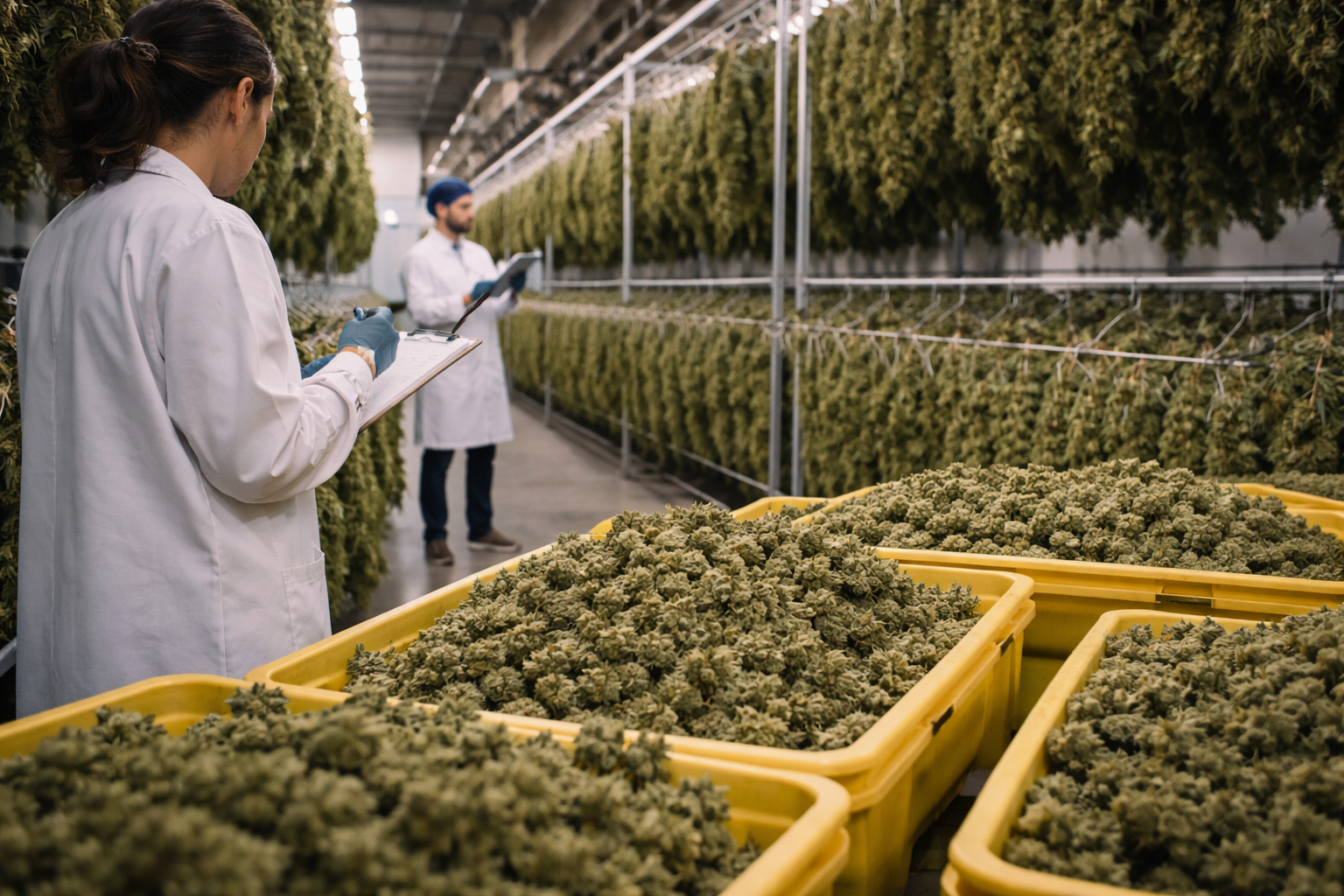
Indoor cannabis processing facility in Canada with workers checking dried flower quality during production scale up
Canada keeps sending the same message to operators and investors: the legal market is still expanding, but it is maturing into an execution game. New figures show government earnings from recreational cannabis reached $2.5 billion in the fiscal year ending March 31, 2025, while overall recreational cannabis sales reached $5.5 billion in that same period.
If these Canada market signals affect your 2026 plan, Start with our quick Cannashield intake form so you can map exposure and build a realistic compliance and supply chain strategy.
Quick facts
• Government earnings from recreational cannabis were $2.5 billion for the fiscal year ending March 31, 2025
• Recreational cannabis sales reached $5.5 billion in 2024/25
• The cannabis industry contributed nearly $11.6 billion to Canada’s GDP in 2025, led by licensed producers
• Germany imported 201,094 kg of cannabis in 2025, with Canada supplying 93,006 kg
Sales Growth Continues, But Price Pressure Stays Real
The Canada story is not “demand disappeared.” It is “demand is shifting and prices are tight.” StatsCan’s release shows cannabis sales rose while alcohol earnings fell year over year, and it also notes a small price decline for recreational cannabis from March 2024 to March 2025. That is the classic mature market combo: steady traffic, more competition, and thinner spread on every sale.
Operator lesson that travels: when prices compress, you do not win by guessing demand. You win by controlling your cash cycle. That means tighter purchasing, tighter inventory turns, and fewer surprises in packaging and hardware inputs.
Product Mix Is Telling You Where The Margin Battle Is Headed
Canada’s category mix is changing in a way that matters operationally. Dried flower still leads, but market share is edging down, while inhaled extracts keep gaining share and reached roughly one third of sales in the 2024/25 fiscal year.
This matters because extracts and inhalable products are supply chain intensive. Hardware, packaging, testing cadence, and consistent production specs become the deciding factor. When the market shifts toward categories that require more components, your vendor discipline becomes a profit lever.
If product mix shifts are changing your packaging, hardware, testing, or vendor setup, Complete our Cannashield questionnaire to pressure test your documentation and controls before they get stress tested in the market.
Operator lesson that travels: when consumers move toward higher processing categories, the winners are the operators who can keep quality and consistency stable while costs move around.
GDP Contribution Is A Proof Point For Institutional Maturity
The GDP number is not just a headline for Canadian pride. It is a signal that the sector is now a meaningful slice of the formal economy. StratCann’s summary of StatsCan data shows the cannabis industry contributed nearly $11.6 billion to Canada’s GDP in 2025, with licensed producers making up the bulk of that contribution and licensed retailers contributing just under $1 billion.
There is also a blunt reality inside the same data: unlicensed activity still contributes meaningful GDP. That is a reminder that legalization is not a magic wand. Legal channels win over time when they stay price competitive, accessible, and trustworthy.
Operator lesson that travels: GDP scale attracts attention. Attention brings scrutiny. If you want to survive the next phase, your documentation and internal controls need to look like you deserve to be part of the “real economy.”
Germany Imports Confirm The Export Lane Is Not A Side Quest
The international demand signal is hard to ignore. Germany imported 201,094 kg of cannabis in 2025, more than doubling the prior year, and Canada remained the largest supplier at 93,006 kg.
Even if you are not exporting, this matters. Germany’s medical market has a regulated, pharmacy oriented backbone. That environment rewards reliable supply, repeatable quality, and audit ready processes. Canada’s continued role as a top supplier is a reminder that global growth is concentrating in markets where regulators and payers demand structured standards.
Operator lesson that travels: exports are not “extra revenue.” Exports are a different operating model. If you want that lane, you build for it early with quality systems, traceability, and contracts that survive scrutiny.
If you want an international readiness checklist that covers documentation, lab oversight, and supply chain controls, use our Cannashield intake form to request it.
Compliance Is Getting More Specific, Not More Relaxed
As markets mature, regulators rarely get less detailed. A good example is Health Canada’s guidance on cannabis facility tours, which reinforces restrictions on access to operations and storage areas and emphasizes protections related to young persons and promotions.
Zoom out and the operator takeaway is simple: the market is professionalizing. Tours, marketing, product visibility, and promotional conduct are treated as compliance issues, not “community engagement.”
Operator lesson that travels: the fastest way to lose trust in a regulated market is to treat rules as optional. The operators who last build systems that assume rules will get sharper over time.
Conclusion
The Week in Weed roundup captures what matters most right now: Canada’s legal market is still growing, the sector’s GDP contribution is meaningful, exports to Germany are scaling, and compliance expectations continue to tighten.
For operators, the play is not complicated. Treat this phase like an execution era. Build clean documentation, tighten vendor discipline, and plan for a market where demand is real but mistakes get expensive fast.
Educational note: This article is for education only and is not legal, tax, or financial advice.
What To Do This Week
• Pull your last 90 days of sales by category and calculate average selling price and gross margin for flower versus extracts
• Identify your top 10 supply chain inputs by cost and risk and add a second supplier option for each
• Tighten COA and batch record storage so you can retrieve any document in under 5 minutes during an audit or partner request
• Review your product mix strategy and decide which two extract or inhaled categories you will standardize for consistency and fewer SKUs
• Build a simple export readiness folder even if you are not exporting yet: quality records, traceability notes, and a one page product spec sheet per SKU
• Add a monthly compliance check to your calendar for promotions, facility access, and visitor controls so you are not reacting when rules tighten
FAQ
What does the $2.5B figure represent in Canada
It refers to government earnings from recreational cannabis for the fiscal year ending March 31, 2025, based on Statistics Canada reporting.What does “cannabis contributed nearly $11.6B to GDP” actually mean
It means cannabis activity, especially licensed production, is now a measurable part of Canada’s formal economy, which usually brings more institutional scrutiny and expectations.Why does rising extract share matter for operators
Extract and inhaled categories tend to require tighter hardware, packaging, and testing discipline, so costs and vendor reliability become a bigger part of your profit equation.What does Germany’s import growth signal for the global market
It signals that regulated medical demand is scaling in a pharmacy style system, which rewards consistent quality and audit ready documentation.If I want to explore exports later, what is the first practical step
Build a documentation stack now: batch records, COAs, traceability notes, and consistent product specs. That foundation is what partners and regulators will ask for first.What is the universal operator lesson from Canada’s maturity phase
Sales can grow while margins tighten, so the winners are the teams that control cash cycle, reduce SKU complexity, and keep compliance documentation clean every day.