
Federal seizures can still hit state legal cannabis operators
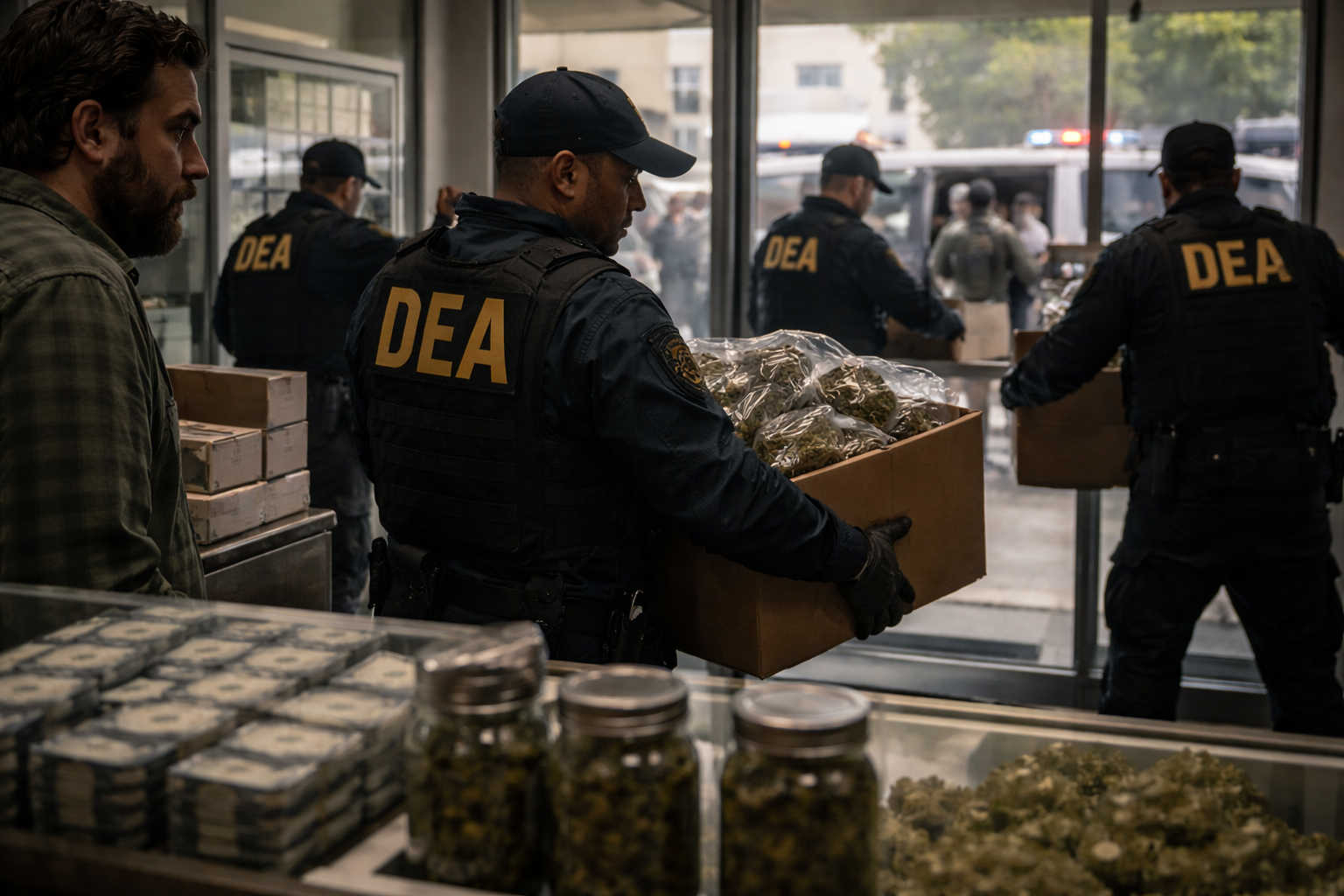
Federal agents seizing boxed cannabis inventory during an enforcement action involving a state licensed operator.
If you are running a licensed cannabis business, you already know the game is not just sales and margins. It is compliance, paperwork, inspections, and staying ahead of whatever new rule drops next.
But there is a harder truth that a lot of operators learn the ugly way.
Being compliant with state rules does not guarantee you are safe from federal enforcement.
That is why this story matters. Lawmakers are pressing federal agencies to explain why cannabis products are still being seized even when businesses are operating legally under state or tribal frameworks. It is a reminder that the gap between state legalization and federal posture is still real, and when your product touches the wrong channel or jurisdiction, you can get clipped.
If you want a quick reality check on where federal friction could show up in your operation, Start with our quick Cannashield intake form
Why federal seizures happen even when you are “legal”
From the operator view, this is the core issue.
State legalization creates permission inside state lines. It does not erase federal authority.
Federal agencies can still treat cannabis as illegal under federal law, and that becomes a problem the moment your product interacts with federal space, federal enforcement zones, or situations where federal rules control the outcome.
Common flashpoints include:
Movement near borders or checkpoints
Shipping or transport methods that trigger federal oversight
Transfers involving tribal jurisdictions, ports of entry, or federal corridors
Poor documentation that makes products look untraceable even if they are licensed
Confusion around hemp versus cannabis products and how they are classified in the field
This is why operators say, “We did everything right,” and still end up dealing with seizures, holds, or inventory loss.
Compliance is still necessary. It is just not a shield against every type of enforcement.
What lawmakers are demanding and why that is a big deal
When lawmakers start asking pointed questions, it usually means something is causing real business damage.
In this case, congressional leaders included language tied to federal spending and oversight that pushes for a briefing on cannabis seizures involving products held, sold, or transferred in compliance with state or tribal law.
That matters for two reasons.
First, it forces the issue into the sunlight. Agencies have more room to operate quietly when nobody is tracking patterns, locations, volume, and justification. Oversight changes behavior.
Second, it validates what operators have been saying for years. Federal enforcement does not always match state market reality, and that mismatch creates financial risk even for licensed businesses.
For the market overall, it is another sign we are still operating in a two system environment. State regulated markets are real. Federal posture still creates friction. Both are true at the same time.
Where operators get exposed most often
If you want to stay out of the blast radius, you need to know where the weak points usually live.
These are the areas that tend to trigger problems:
Distribution and transport: Routes, handoffs, storage, and third party logistics. If chain of custody is not clean, it looks suspicious fast.
Paperwork discipline: Inventory manifests, invoices, lab results, and licensing documentation. If a driver cannot show it in minutes, you are already behind.
Product labeling and classification: Anything that can be misread as non compliant, misbranded, or improperly categorized invites scrutiny.
Multi jurisdiction operations: Tribal law, state law, and federal enforcement do not always line up cleanly.
Speed over structure: Moving too fast with messy processes. The market rewards speed, but regulators punish sloppiness.
If you want a checklist that flags the most common exposure points, Complete our Cannashield questionnaire
How to reduce federal friction without slowing the business
You cannot control federal policy. You can control how prepared you are when friction shows up.
Here is the operator friendly playbook.
1. Map your “federal touch” points
List every place your product interacts with higher scrutiny: borders, airports, shipping methods, storage locations, handoffs, and any special jurisdictions.
2. Build a transport ready documentation pack
Every shipment should have a consistent packet, digital or physical, that includes licenses, manifests, lab documentation, invoices, and contact info for compliance leadership.
3. Tighten chain of custody
If multiple parties touch product, write it down. Who touched it, when, where, and under what authority. This is boring until it saves you.
4. Train drivers and handlers like they are compliance staff
Most enforcement issues start with someone on the ground not knowing what to say, what to show, or who to call.
5. Pressure test your risk planning
This is where most operators are exposed. Seizure risk is not just operational. It is financial. If inventory gets taken, you need to understand what that means for cash flow, contracts, and insurance positions. No promises, no magic coverage, just clarity on what is actually in place and what is not.
Conclusion
This is not fear mongering. It is the current reality of regulated cannabis.
Lawmakers pushing for answers is important, but operators cannot wait for politics to catch up. The smarter move is building a business that stays compliant and stays prepared for federal friction, especially when products move through channels or jurisdictions that raise federal attention.
At Cannashield, we help operators identify risk before it becomes a loss event, and build cleaner systems that hold up under scrutiny.