
Federal Charges In Kansas Signal Rising Risk For Hemp THC Retailers
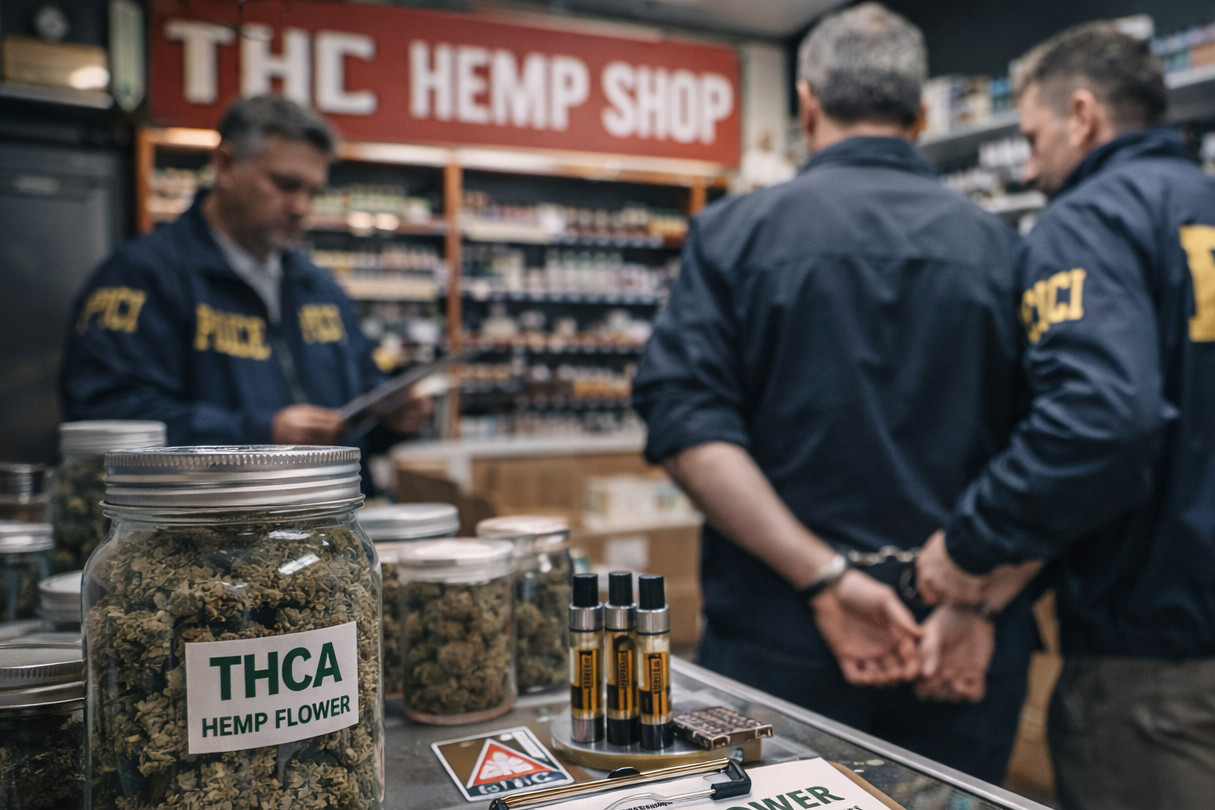
Hemp THC retail counter with THCA flower jars and documents as federal agents conduct an enforcement action
A federal government enforcement action in Kansas is a loud signal for anyone selling intoxicating hemp derived THC products under Farm Bill protection arguments. Federal prosecutors in Kansas say a Wichita area store owner was indicted on drug trafficking and firearms related charges tied to alleged cannabis sales from multiple retail locations.
Quick facts
• Federal prosecutors say Justin Lane, 36, of Maize, Kansas was indicted by a federal grand jury
• The US Attorney’s Office says the charges include conspiracy to distribute a controlled substance, maintaining drug premises, distribution counts, and firearms related counts
• Prosecutors say the alleged conduct involved six retail locations in the Wichita area, described as commercial properties connected to the business
• Industry reporting describes the case as a rare escalation tied to a hemp THC retailer selling THCA flower and similar intoxicating products while claiming Farm Bill protection
• The Justice Department notes that an indictment is an allegation and defendants are presumed innocent unless proven guilty beyond a reasonable doubt
If federal enforcement uncertainty affects your hemp derived THC business model, Start with our quick Cannashield intake form so you can map exposure and plan for multiple outcomes.
Why This Case Matters Beyond Kansas
Kansas is a restrictive market for regulated cannabis access, which is exactly the environment where hemp derived alternatives have grown fast. That matters because enforcement risk tends to rise when intoxicating products are sold in markets with no clear regulated adult use lane.
This is the operator lesson that travels to every state: when the rules are unclear and demand is strong, regulators eventually choose a lane. Sometimes that lane starts with civil warnings. Sometimes it starts with raids and criminal charges. Either way, it forces every operator to prove what they sell, how it is tested, how it is labeled, and how it stays within the law as interpreted by the agencies actually enforcing it.
Universal operator lesson: if your entire model depends on a legal interpretation that regulators are actively challenging, your business risk is not theoretical.
What The Indictment Signals About Enforcement Priorities
The most important detail is not the company name or the headlines. It is the structure of the charges described by prosecutors.
The District of Kansas press release lists multiple drug distribution related counts along with firearms and unregistered firearm counts. That combination matters because it shows how quickly a retail case can become a broader criminal exposure story when investigators believe controlled substances and weapons overlap.
For operators, the takeaway is practical: enforcement pressure on intoxicating hemp products is not only about product chemistry. It is about public safety framing, community complaints, and whether authorities view a storefront as operating outside the permitted system.
The Farm Bill Protection Argument Is Getting Stress Tested
Industry reporting frames this as a serious example of a hemp THC operator claiming Farm Bill protections while selling intoxicating products such as THCA flower. That framing is a reminder that “hemp compliant” marketing language is not a shield if federal or state authorities believe the actual product is controlled or the sales are unlawful in that jurisdiction.
This is where operators get trapped: the consumer market sees hemp derived THC as normal, but enforcement agencies can treat specific products very differently depending on how they interpret total THC, isomers, and intended use. When those interpretations shift, the supply chain feels it immediately. Distributors pause. Retailers pull product. Payment partners get nervous. Landlords ask questions. Insurance underwriters get cautious.
If you sell THCA flower or other intoxicating hemp products, Complete our Cannashield questionnaire to pressure test your documentation, labeling, and age controls before regulators do.
What This Means For Operators Who Want To Stay Standing
This is not the moment to guess outcomes. It is the moment to tighten your operating system.
Start with product proof. Make sure every SKU has a clean paper trail: supplier invoices, batch records, COAs, and a clear explanation of what the product is and how it is represented to customers. In enforcement moments, what you can prove matters more than what you believe.
Next, tighten retail controls. Age verification must be strict and consistent. Packaging and labeling should be clear and not designed to appeal to minors. Staff should know what to say and what not to say, especially around medical claims or “legal everywhere” language.
Then, build a scenario plan. If a federal government crackdown accelerates, what SKUs get pulled first. What revenue exposure you have by category. What you would replace them with. If you cannot answer those questions today, you do not have a plan, you have a hope.
Universal operator lesson: the winners are the teams that treat compliance like infrastructure, not like a checklist.
If you need a simple enforcement readiness checklist your managers can run weekly, use our Cannashield intake form to request the Hemp THC Retail Compliance Sweep pack.
Conclusion
Federal charges against a Kansas hemp THC retailer are a clear escalation signal for the broader intoxicating hemp market. Prosecutors say the case involves alleged cannabis sales from multiple retail locations and includes firearms related counts, while industry reporting frames it as a rare federal government move against a THCA focused retailer.
The practical takeaway is simple: if your business touches intoxicating hemp products, now is the time to tighten documentation, staff training, vendor discipline, and scenario planning. This is how you protect the operation when the legal interpretation of “hemp compliant” is being tested in real courtrooms.
Educational note: This article is for education only and is not legal advice.
What To Do This Week
• Inventory your intoxicating hemp SKUs and rank them by enforcement and regulatory exposure
• Centralize COAs, invoices, and batch records so you can produce proof fast
• Retrain staff on strict age verification and claims safe product education
• Review supplier agreements for indemnity, recalls, and documentation delivery timelines
• Create a two path plan for the next 90 days, one where enforcement pressure rises and one where it stays stable
• Build a simple incident log process for customer complaints, returns, and product questions
FAQ
What happened in the Kansas case
Federal prosecutors say a Wichita area business owner was indicted on drug distribution and firearms related charges tied to alleged cannabis sales.Is an indictment the same as a conviction
No. The Justice Department notes an indictment is an allegation and defendants are presumed innocent unless proven guilty.Why does this matter to hemp derived THC operators
Because industry reporting frames it as a rare federal government escalation against a retailer selling intoxicating products while claiming Farm Bill protection.What is the universal operator lesson
If your compliance posture depends on a contested interpretation, you need stronger documentation and scenario planning than the market average.What will retailers feel first when enforcement rises
Product pulls, vendor freezes, customer questions, and tighter scrutiny on age verification and documentation.What should operators do now without overreacting
Tighten COA handling, vendor records, staff training, and build a practical plan for product substitution if key SKUs become non viable.