

Minnesota Cannabis Tax Delinquency Posting List Creates A No Delivery Rule
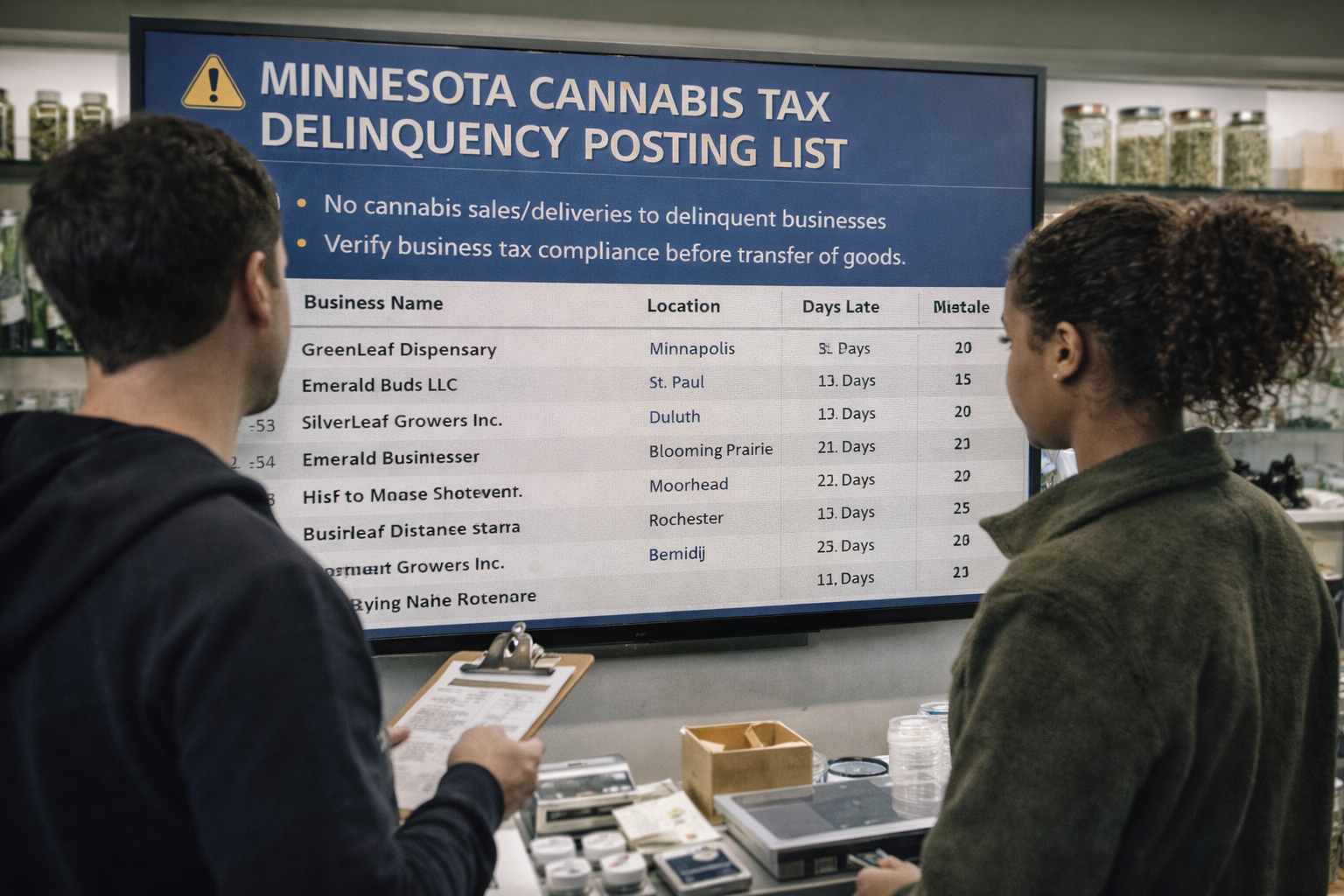
Minnesota cannabis tax delinquency list compliance check before cannabis product delivery
Minnesota’s cannabis tax delinquency posting system is a supply chain rule disguised as a tax notice. If a cannabis related business is 10 or more days late on certain tax filings or payments, the state can place it on a public list. Starting the third business day after the posting, licensed cannabis suppliers are prohibited from selling or delivering product to that listed business.
Quick facts
• The list identifies businesses that are 10 or more days delinquent on certain taxes and fees, including cannabis tax related obligations.
• Beginning the third business day after posting, covered cannabis suppliers may not sell or deliver product to a listed taxpayer.
• The Department of Revenue says the list is updated daily by noon and includes sections for newly posted, previously posted, and recently removed businesses.
• Revenue says it provides at least 10 days notice before placing a business on the list.
• To be removed, Revenue says the business must pay in full using secured funds and notify the state, with removal typically within two business days after full payment is received.
If Minnesota tax posting risk affects your revenue or vendor relationships, Start with our quick Cannashield intake form so you can map buyer screening controls and document a compliant delivery workflow.
What The Posting List Really Does
This is not a symbolic list. It creates an eligibility checkpoint that suppliers are expected to follow before any transfer of product. Minnesota law makes it clear that once the third business day hits, a wide set of licensed cannabis supplier types may not sell or deliver product to any taxpayer included on the posted list.
The practical impact is immediate. A listed buyer can be fully licensed and still become unshippable. That can freeze inventory replenishment, disrupt planned promotions, and create real cash pressure within days, especially for businesses that depend on frequent deliveries.
Universal operator lesson: in regulated cannabis, taxes can function like a switch that turns a buyer on or off, so tax status becomes part of operational due diligence, not an accounting footnote.
How The Third Business Day Rule Changes Daily Operations
The timeline is tight by design. The statute sets the trigger at the third business day after the list is posted, and the Revenue guidance emphasizes the same timing.
That means a weekly habit is not enough. If you only check once a week, you can easily ship to a buyer who became restricted midweek. The cleanest control is a two step check.
Check once before you confirm the order.
Check again before you ship.
Then log the check so you can prove you did it. This is the difference between an operational pause you can explain and a compliance problem you cannot.
Who Has The Duty To Stop Deliveries
Minnesota is explicit about which supplier categories are covered. The statute and Revenue guidance include cannabis cultivators, manufacturers, microbusinesses, mezzobusinesses, medical cannabis combination businesses, wholesalers, and industrial hemp growers as defined in state law.
The reason this matters is liability. Minnesota law includes a penalty provision that ties violations of the no sale rule to penalties under other sections of the cannabis statute framework. You do not want your fulfillment team improvising on a day when a truck is already loaded.
What A Listed Business Has To Do To Get Unblocked
Revenue’s removal instructions are blunt. To avoid being placed on the list, or to be removed from it, the business must pay its tax liability in full using secured funds and notify the Department of Revenue after payment. Revenue says it has two business days to remove the business after receiving full payment, and it warns that failure to notify can delay removal.
A key detail operators miss: Revenue says payment agreements are not available if your business is subject to cannabis tax. That means “I will catch up over time” is not the default fix in this lane.
If you want to pressure test your buyer screening process and create a proof trail that holds up during audits, Complete our Cannashield questionnaire so you can tighten the workflow before a missed check turns into a bigger issue.
The Supplier Playbook That Prevents Accidental Violations
You do not need fancy systems to comply, but you do need repeatable steps.
Assign an owner for list checks
One person owns updating the internal blocked list daily.Create a single source of truth
A simple Buyer Eligibility field in your CRM or order system with three statuses: Clear, Blocked, Review.Put a hard stop in fulfillment
If Buyer Eligibility is Blocked, labels do not print. No exceptions without written approval and a documented recheck.Keep proof of each check
Save the dated list you checked or log the list update timestamp, then record who checked it and when.
This builds a defensible story if anyone ever asks how you prevented prohibited deliveries.
If you want a copy and paste SOP for Minnesota posting checks, blocked buyer workflows, and documentation storage, use the Cannashield intake form to request the Minnesota Posting Control Pack.
Conclusion
Minnesota’s cannabis tax delinquency posting list creates a direct compliance gate across the supply chain. Starting the third business day after posting, suppliers must stop selling or delivering to listed businesses, and the fastest way to stay safe is to treat tax status like buyer eligibility and build a documented check into every shipment.
Educational note: This article is for education only and is not legal or tax advice.
What To Do This Week
• Assign one owner for daily posting list checks and blocked list updates
• Add a Buyer Eligibility field to your CRM or order system and enforce it at shipping
• Implement a two step check before order confirmation and before shipment pickup
• Create a proof folder that stores the dated list and a simple check log
• Draft a calm customer message for blocked buyers explaining the posting rule and reactivation process
• Train sales and fulfillment staff on the third business day rule so nobody improvises under pressure
FAQ
What triggers placement on Minnesota’s cannabis posting list
Revenue says businesses on the list are 10 or more days delinquent in filing or paying certain taxes and fees, including cannabis related obligations.When does the no delivery rule start
Beginning the third business day after the list is posted.Who is prohibited from selling or delivering to listed businesses
Covered supplier types include cannabis cultivators, manufacturers, microbusinesses, mezzobusinesses, medical cannabis combination businesses, wholesalers, and industrial hemp growers.How often is the list updated
Revenue says the cannabis posting list is updated daily by noon.How does a business get removed from the list
Revenue says the business must pay its tax liability in full using secured funds, notify the state, and then it is generally removed within two business days after full payment is received.What is the universal operator lesson
Treat tax status like a compliance checkpoint and keep proof of checks, because supply holds can happen fast and the supplier carries responsibility too.