
Minnesota Lab Testing Delay Signals A Compliance Bridge For THC Seltzers
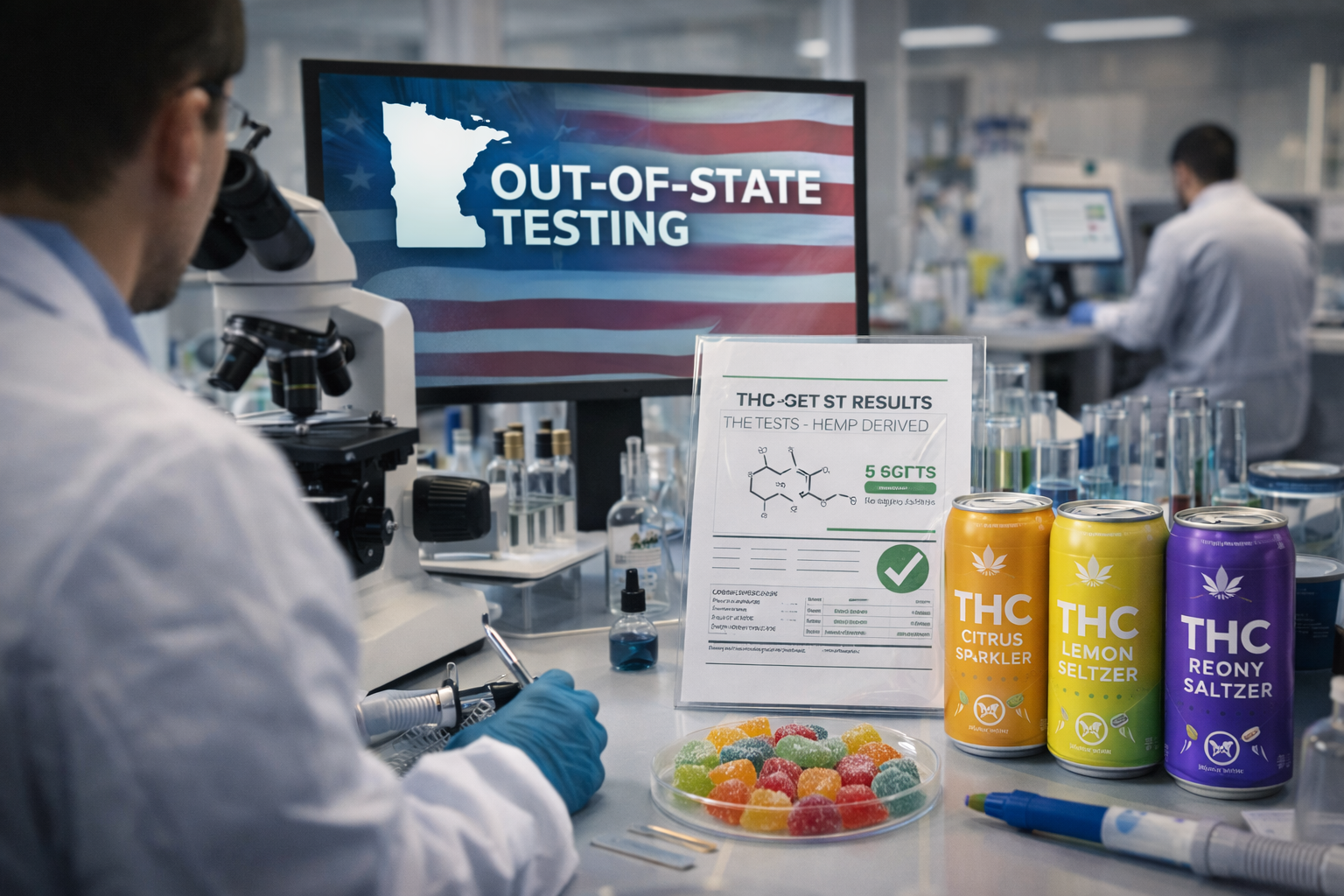
Minnesota lab bench with microscope test documents THC drink cans and gummies during compliance review
Minnesota’s THC seltzer testing requirement is turning into a real business bottleneck, and lawmakers are looking at a practical workaround. The issue is simple: demand for hemp derived THC drinks and gummies is growing, but Minnesota’s in state lab capacity is still catching up. A bill moving at the Capitol would allow accredited labs outside Minnesota to keep testing certain products for a limited period, so production does not stall while the state builds out licensing and oversight.
Quick facts
• Minnesota lawmakers are weighing a delay tied to in state testing requirements for low dose THC seltzers and gummies.
• Senate File 3670 would extend the window for testing lower potency hemp edibles using ISO accredited labs through May 31, 2027.
• Minnesota’s Office of Cannabis Management states that after January 1, 2026, licensed hemp businesses must test products using a testing facility located in Minnesota and licensed by the office.
• Axios reported only two labs are currently running for regulated products, with wait times that can reach several weeks.
• The bill is positioned as a temporary bridge, not a rollback of testing or safety expectations.
• Axios also flagged broader federal government uncertainty that could disrupt low dose hemp derived products later this year.
If Minnesota testing timelines are affecting your production schedule, Start with our quick Cannashield intake form so you can map exposure and build a compliant lab plan.
Why Testing Capacity Became The Bottleneck
Testing is not a paperwork step. It is a production gate. Brewers and edible makers do not want to can, label, or ship until they have results that confirm the batch meets spec. When turnaround time stretches from days to weeks, the entire supply chain slows down.
Axios described the operational reality clearly: limited lab capacity has created long waits, and that delay hits both sides of the market. Regulators get pressure because compliance deadlines are approaching. Operators get pressure because inventory sits idle and cash gets trapped.
This is the kind of constraint that can quietly reshape competition. Large operators can sometimes absorb delays by carrying more inventory or spreading production across facilities. Smaller operators cannot. That is why temporary policy adjustments like this usually get framed as market stabilization rather than market expansion.
Universal operator lesson: when compliance infrastructure lags demand, the winners are the businesses that plan around bottlenecks instead of reacting to them.
What Senate File 3670 Would Change
Senate File 3670 is a targeted extension tied to laboratory testing rules. It amends Minnesota’s cannabis testing requirements to allow testing of lower potency hemp edibles using laboratories accredited under ISO standards through May 31, 2027.
The important point for operators is what it does not do. It does not remove testing. It does not invite untested products. It keeps the expectation that products meet standards established by the Office of Cannabis Management. The change is about where testing can occur while Minnesota scales up in state capacity.
This also intersects with Minnesota’s current rule posture. The Office of Cannabis Management has stated that licensed hemp businesses must test in state through a testing facility located in Minnesota and licensed by the office after January 1, 2026. That is the pressure point lawmakers are trying to relieve, because building a lab sector takes time, staff, and specialized expertise.
Universal operator lesson: a compliance deadline is only as realistic as the infrastructure behind it.
If uncertainty is affecting how you plan or negotiate, Complete our Cannashield questionnaire to pressure test your testing workflow, documentation, and labeling readiness.
The Market Signal For 2026: Minnesota Is Managing A Transition
Minnesota is not just regulating hemp derived products. It is also building a broader adult use cannabis system at the same time. That matters because testing capacity is a shared resource. When a state is building multiple regulated lanes at once, priorities get real. Labs tend to focus on the products that are most heavily regulated first, and regulators tend to allocate attention where the risk and visibility are highest.
Axios quoted state leadership supporting the extension as a short term fix that provides clarity and eases pressure on testing facilities while maintaining quality control. That framing matters. It suggests Minnesota is willing to adjust timelines to keep the compliant market functioning, rather than forcing businesses into a production freeze that creates shortages and pushes consumers toward unregulated options.
Universal operator lesson: in mature and emerging markets, regulators often choose continuity over chaos when the compliant channel is at risk.
Federal Government Uncertainty Makes Flexibility A Survival Skill
Minnesota’s lab debate is also happening under a national cloud. Axios pointed to federal government uncertainty that could impact low dose hemp derived drinks and edibles later this year. Even if Minnesota solves the testing bottleneck, federal changes could still reshape what products can be sold, how they are defined, and what compliance expectations look like across state lines.
For operators, that is the real posture shift for 2026: build a plan that survives more than one outcome. You need a testing strategy, but you also need a product and distribution strategy that can pivot if definitions tighten or enforcement priorities shift.
Universal operator lesson: the most resilient operators treat policy risk as part of operations, not as a surprise.
If you want a ready template for batch records, COA storage, and vendor documentation, use the Cannashield intake form to request our lab transition pack.
Conclusion
Minnesota’s proposed testing extension is a clear example of regulators adjusting timelines to balance access and quality assurance. For operators, the takeaway is not to wait for the final vote. The takeaway is to prepare: map your lab dependencies, tighten documentation, and build a plan that works whether testing stays in state, shifts temporarily out of state, or gets reshaped by broader federal government moves.
What To Do This Week
• List your hemp derived THC beverage and gummy SKUs and identify which require third party testing before packaging
• Call your current lab partners and document real turnaround times plus capacity limits
• Set a testing calendar tied to production runs so batches are not waiting for results
• Standardize COA storage and batch record naming so you can produce proof fast during inspections
• Build a second lab option plan in case capacity tightens again
• Create two scenarios for late 2026 planning, one with tighter federal government rules and one without
FAQ
What is Minnesota lawmakers main idea here
They are considering a temporary extension that would allow certain products to keep using accredited labs outside Minnesota while in state lab capacity ramps.What problem is the bill trying to solve
Long lab wait times can stall production and cause shortages, even when products are otherwise compliant.What does Senate File 3670 extend
It extends the testing provision timeline through May 31, 2027 for lower potency hemp edibles using ISO accredited labs.Does this remove testing requirements
No. Testing is still required and products must meet standards established by the Office of Cannabis Management.Why is in state testing hard to enforce right now
Because lab capacity is still limited and operators report long turnaround times.What is the universal operator lesson
Compliance depends on infrastructure. If a state is building multiple regulated lanes at once, bottlenecks are predictable and planning around them becomes a competitive advantage.