
Texas Hemp Lawsuit Targets Total THC Rule Shift
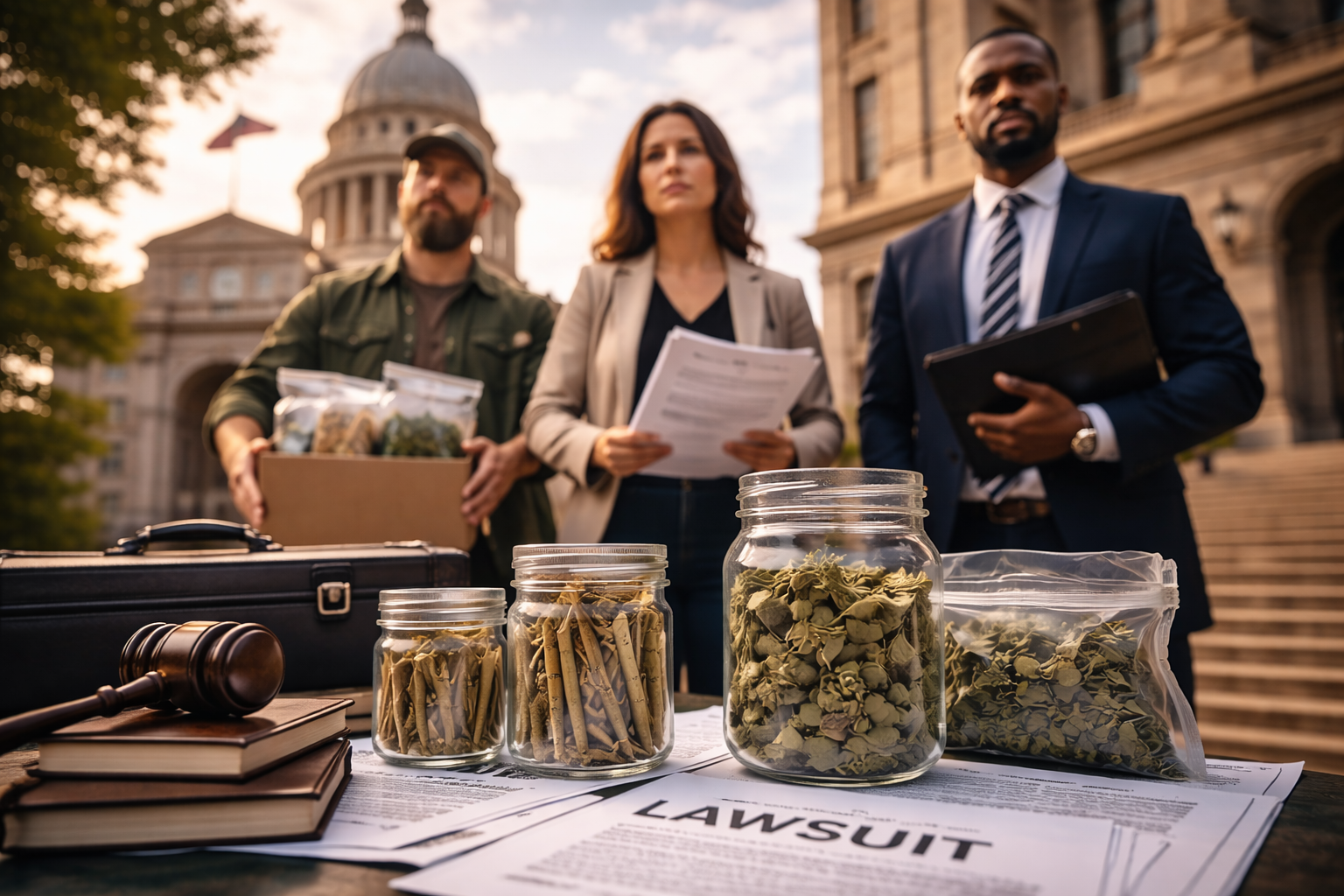
Texas hemp lawsuit scene showing business owners, legal papers, and smokable hemp products outside the Capitol.
Texas hemp compliance just became a live courtroom fight. On April 8, the Texas Hemp Business Council, Hemp Industry and Farmers of America, and a group of Texas hemp businesses announced that they filed suit in Travis County district court seeking to block new state consumable hemp rules that took effect on March 31. The core dispute is simple but high stakes. Plaintiffs say state agencies replaced the Legislature’s delta 9 THC framework with a broader total THC approach that pulls THCA into the math, which they argue effectively bans popular smokable hemp products such as THCA flower and pre rolls. The bigger operator lesson is not just about one product type. It is about how fast a rule change can redraw an entire revenue lane.
Quick facts
• Texas says the adopted consumable hemp rules were published for adoption in the March 20, 2026 Texas Register and became effective March 31, 2026.
• The official rule text defines total THC using a formula that includes THCA and THC.
• The official rules require testing for delta 9 THC, total delta 9 THC, and total THC before products are sold at retail, distributed, or otherwise introduced into commerce in Texas.
• According to the plaintiffs’ April 8 announcement, the lawsuit challenges the total THC rewrite, transport limits on hemp materials, fee increases, and daily penalty exposure.
• The adopted rules set manufacturer license fees at $10,000 per facility and retail registration fees at $5,000 per location.
• The enforcement rules say each day a violation continues or occurs counts as a separate violation when calculating an administrative penalty.
If these Texas hemp rules are affecting your product mix or inventory strategy, Start with our quick Cannashield intake form so you can map testing, labeling, and sell through exposure before enforcement pressure makes the decision for you.
What the lawsuit is actually challenging
This is not a broad anti regulation message, at least not the way the plaintiffs frame it. In their April 8 filing announcement, they say the suit targets specific provisions that they believe go beyond lawful implementation and instead rewrite Texas hemp law. According to that announcement, the challenged provisions include the move from a delta 9 THC standard to a nonstatutory total THC formula, restrictions on bringing hemp plants and materials into Texas for processing, steep fee increases, and daily penalty treatment that they say undermines notice and cure protections. The plaintiffs are asking the court for a temporary restraining order and broader injunctive relief.
The official rule text helps explain why this fight matters. Texas now defines total THC as the potential total tetrahydrocannabinol content derived from the sum of all THC isomers and THCA content, using the formula Total THC equals 0.877 times THCA plus THC. The rules also require testing before a consumable hemp product is sold at retail, distributed, or introduced into commerce in Texas. That means the legal pressure is not only about what is on the label. It is about what the lab report says before the product ever reaches the shelf. Internal read suggestion: Texas hemp retail compliance checklist.
If you want to pressure test how your COAs, labels, and inventory files would look under a strict total THC review, Complete our quick Cannashield intake form and request a hemp documentation review.
What the official rules changed on the ground
The official Texas rules did more than change the testing math. They also tightened market access and raised the cost of staying in the game. The adopted rules say products that exceed the acceptable hemp THC level must not be sold at retail or otherwise introduced into commerce in Texas. They also say a person selling out of state consumable hemp products in Texas must comply with Chapter 300 and show, upon request, that those products were processed or manufactured in compliance with qualifying federal, state, tribal, or foreign legal frameworks. In plain English, Texas did not just tighten the shelf. It tightened the supply chain too.
The fee side is just as important. The rules set manufacturer fees at $10,000 per facility and retailer registration fees at $5,000 per location, with added delinquency fees for late renewals. On top of that, the enforcement section says each day a violation continues can count as a separate violation when calculating an administrative penalty. Texas also kept a limited retailer protection in the rule text, requiring notice and an opportunity to resolve unintentional or negligent violations for retailers. But that does not erase the basic business point. Compliance got more expensive, and enforcement leverage got stronger. Internal read suggestion: Hemp product file review.
Why this matters beyond THCA flower
The obvious product story is THCA flower and pre rolls. The larger business story is whether a state agency can change the chemistry that defines a viable product class without a new statute from lawmakers. Plaintiffs say that is exactly what happened here after lawmakers debated hemp restrictions in 2025 but did not change the statutory standard the way agencies now have by rule. That is their legal theory, not a court finding. But the business impact question is immediate even before a judge answers it. If your store, processor, or supplier depends on smokable hemp, out of state sourcing, or thin margins, a rule change like this is not an abstract policy issue. It is a survival math issue.
Universal operator lesson: if your revenue only works under a permissive testing interpretation, that revenue is not stable. It is conditional. Smart operators should already be separating products by testing risk, supply chain risk, and enforcement risk instead of treating hemp as one clean category. Internal read suggestion: Smokable hemp risk audit.
If uncertainty around Texas testing rules, transport limits, or fee pressure is affecting how you plan, Complete our quick Cannashield intake form so you can identify weak spots before the court or the state makes your next move for you.
Conclusion
The Texas hemp lawsuit is bigger than one trade fight over flower. It is a direct challenge to how far agencies can go when lawmakers leave a market unsettled. The official rules already changed testing, fees, out of state product compliance, and enforcement structure. Now the court fight will help determine whether that rulemaking stands. For operators, the takeaway is simple. When compliance definitions move, the shelf moves with them.
Educational note: This article is for education only and is not legal, regulatory, tax, or insurance advice.
What To Do This Week
• Pull every smokable hemp SKU and review the latest COA for delta 9 THC, total delta 9 THC, and total THC.
• Separate products that depend on THCA heavy formulations from lower risk inventory.
• Review whether any out of state inputs or finished products could trigger extra Texas compliance exposure.
• Rework your fee and margin assumptions using the current $10,000 manufacturer and $5,000 retail numbers.
• Build one clean file for each high risk SKU with label, COA, supplier record, and intended sales channel.
• Track court developments daily if Texas is a meaningful part of your hemp revenue.
FAQ
What did the Texas hemp businesses file?
According to the plaintiffs’ April 8 announcement, they filed suit in Travis County district court and asked for a temporary restraining order and injunctive relief against the new rules.
What is the biggest legal issue in the case?
The plaintiffs say Texas agencies replaced the Legislature’s delta 9 THC framework with a broader total THC formula that includes THCA, effectively changing the law by rule. That is an allegation, not a court ruling.
What do the official Texas rules say about THC testing?
They require testing for delta 9 THC, total delta 9 THC, and total THC, and they define total THC using a formula that includes THCA.
Do the rules affect out of state products too?
Yes. The rule text says a person selling out of state consumable hemp products in Texas must comply with Chapter 300 and provide compliance evidence upon request.
How much did the fees increase under the rules?
The adopted rules set manufacturer license fees at $10,000 per facility and retail registration fees at $5,000 per location.
Why does this matter outside Texas?
Because it shows how testing definitions, transport rules, and fee structure can remake a hemp market without a full new statute. That is an inference based on the Texas rule text and the claims in the lawsuit.