
Rumors Rise That a Future Trump Administration May Reschedule Cannabis — What It Could Mean for the Industry
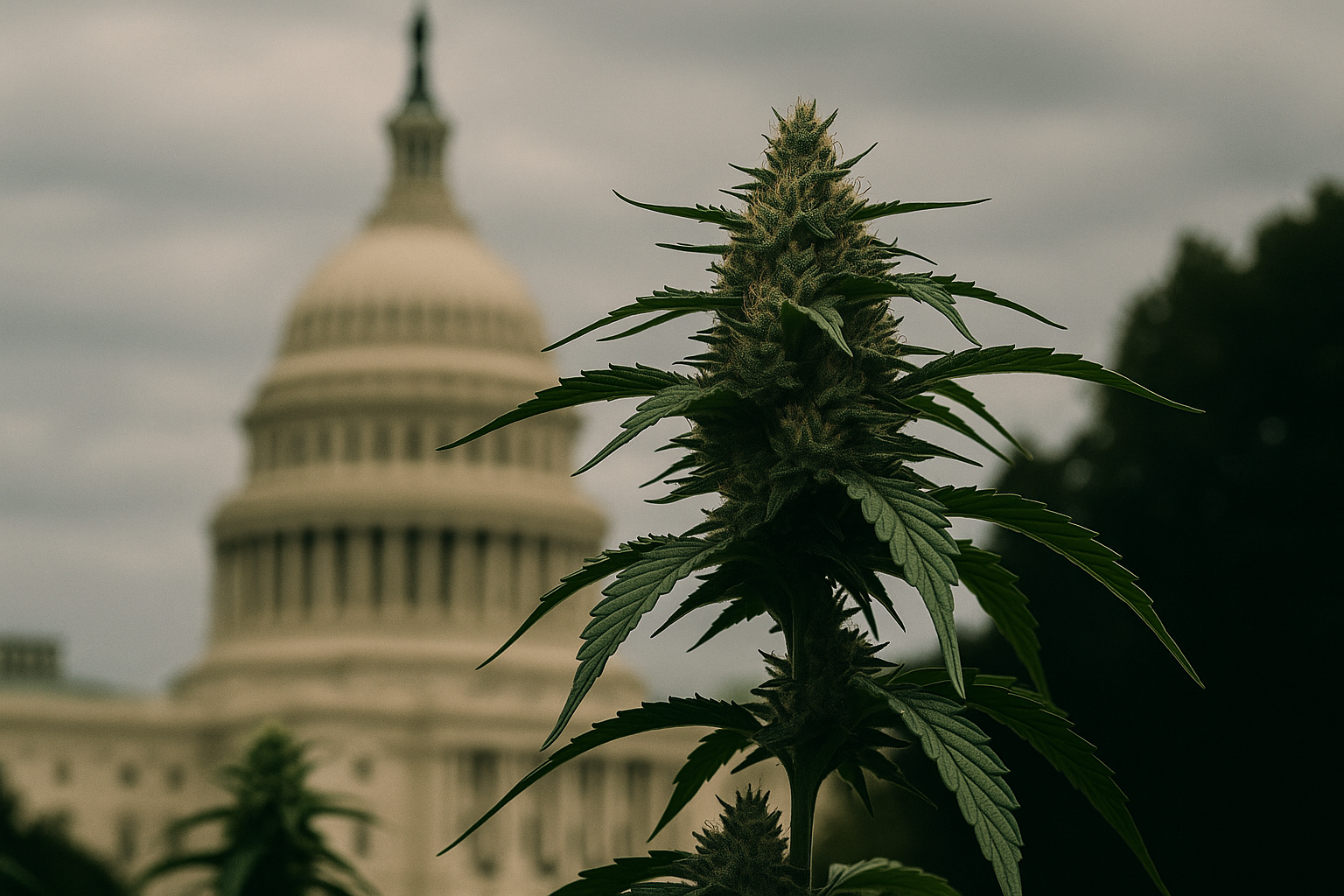
A lone cannabis plant rises before the U.S. Capitol, hinting at a major shift as Washington debates whether a future Trump administration could move to reschedule cannabis and reshape banking, insurance, and interstate commerce.
There’s growing chatter in Washington, D.C. that a second Trump administration may push aggressively to reschedule cannabis under federal law. While nothing is official, multiple insiders, policy strategists, and lobbyists are quietly preparing for what could be one of the biggest federal pivots the cannabis industry has ever seen.
If rescheduling does happen, it won’t just be a political headline — it will reshape banking, insurance, interstate commerce, taxation, federal research, and long-term funding across the entire ecosystem.
If your cannabis business wants to be positioned correctly ahead of potential federal changes, now is the time. Start with our quick Cannashield intake form to assess risks, strengthen compliance, and prepare for the next era of cannabis regulation.
What Rescheduling Would Actually Do
In most conversations, cannabis rescheduling gets thrown around casually. But rescheduling is not the same as legalization, and operators need to understand the difference.
Under federal law, cannabis is still a Schedule I substance, grouped with heroin and LSD. Rescheduling — particularly to Schedule II or Schedule III — would immediately impact:
1. Banking Access
Rescheduling could finally open the doors to:
Traditional banking
Lines of credit
Business loans
Payment processing beyond cash
Stronger fraud protection
This alone would revolutionize how operators manage cash flow and capital.
2. Insurance Requirements & Availability
A rescheduled cannabis market would trigger:
Expanded insurance options
Lower premiums in some categories
Higher requirements in others
More scrutiny for cultivation, extraction, and manufacturing safety
Nationalized underwriting standards
Insurance would become both more accessible — and more important.
3. 280E Tax Relief
If cannabis moves to Schedule III, Section 280E disappears for state-legal businesses.
This single change would transform profitability overnight.
4. Interstate Commerce (Eventually)
Rescheduling won’t immediately legalize interstate trade, but it opens the door for:
Federal agencies to regulate transport
National supply chains
Consolidation of regional wholesalers
New competition from low-cost grow states
This will disrupt pricing, brand strategy, and logistics.
5. Federal Research & FDA Pathways
Rescheduling allows:
Federally funded cannabis research
Pharmaceutical-grade cannabinoid studies
Faster product innovation
More regulatory oversight
This will elevate the professionalism of the industry — but it will also raise compliance expectations.
If your business needs a federal-readiness risk assessment, Complete our Cannashield questionnaire to prepare before the landscape shifts.
Why Trump Might Push for Rescheduling
People forget this: during his first administration, Trump showed little interest in targeting state cannabis markets. Several insiders have said the campaign views federal cannabis reform as:
A bipartisan win
A business-friendly policy
A way to strengthen rural economies
A strategic move to energize younger voters
A chance to reshape the industry toward American manufacturing
Rescheduling, in particular, requires no act of Congress — only a coordinated effort between DOJ and HHS. That makes it politically fast and clean.
Industry leaders also believe rescheduling aligns well with Trump’s pro-business messaging. Opening banking, credit, and interstate efficiency creates economic expansion without a federal legalization battle.
What This Would Mean for Cannabis Operators
If cannabis is rescheduled to Schedule III, the industry will enter a new era — one where professionalism, compliance, and insurance become central to survival.
1. Compliance Expectations Will Skyrocket
Think:
Full GMP standards
FDA-style manufacturing
Aggressive facility inspections
Documentation required at every stage
Operators who “wing it” or cut corners will be left behind.
2. Insurance Will Become Mandatory
Rescheduling triggers:
Formalized insurance requirements
Higher liability expectations
Stronger product safety standards
More recalls and litigation
More underwriting oversight
This is where most operators are currently unprepared.
3. The Market Will Divide Into “Ready” and “Not Ready”
Those who have:
Proper SOPs
Traceability
Compliance documentation
Insurance
Clean facilities
Reliable financials
Strong safety programs
…will get banking access, better partnerships, and long-term investment opportunities.
Those who don’t will struggle against better-capitalized rivals.
To avoid falling behind during federal reform, Fill out our Cannashield intake form for a full compliance and insurance readiness plan.
The Bigger Picture: A Federal Shift Could Reset the Entire Industry
Whether the policy change comes from a Trump administration or another political wave, one thing is clear: federal cannabis reform is no longer theoretical — it’s inevitable.
The industry is too large, too visible, and too nationally relevant.
The question isn’t if reform happens.
It’s who benefits from it.
Businesses that invest now in compliance, risk management, worker safety, SOPs, and insurance will be positioned to thrive under a formalized national regulatory system.
Those relying on loopholes or outdated processes won’t survive federal scrutiny.
Conclusion
The rumors circling D.C. about a Trump-led rescheduling effort are more than political noise — they’re a sign that federal cannabis reform may finally be on the horizon. Rescheduling would reshape banking, insurance, taxes, research, and interstate commerce, pushing the industry toward a more regulated, more competitive, and more professional future.
For operators, the smartest move is to prepare now. Federal reform rewards readiness.
At Cannashield, we help cannabis businesses transition from “state-legal chaos” to professional-grade operation with insurance, compliance strategy, and risk management designed for national-level oversight.
Complete our full intake form here to future-proof your business before federal reform becomes reality.