

Washington Home Cultivation Bill Signals A Policy Inflection Point In 2026
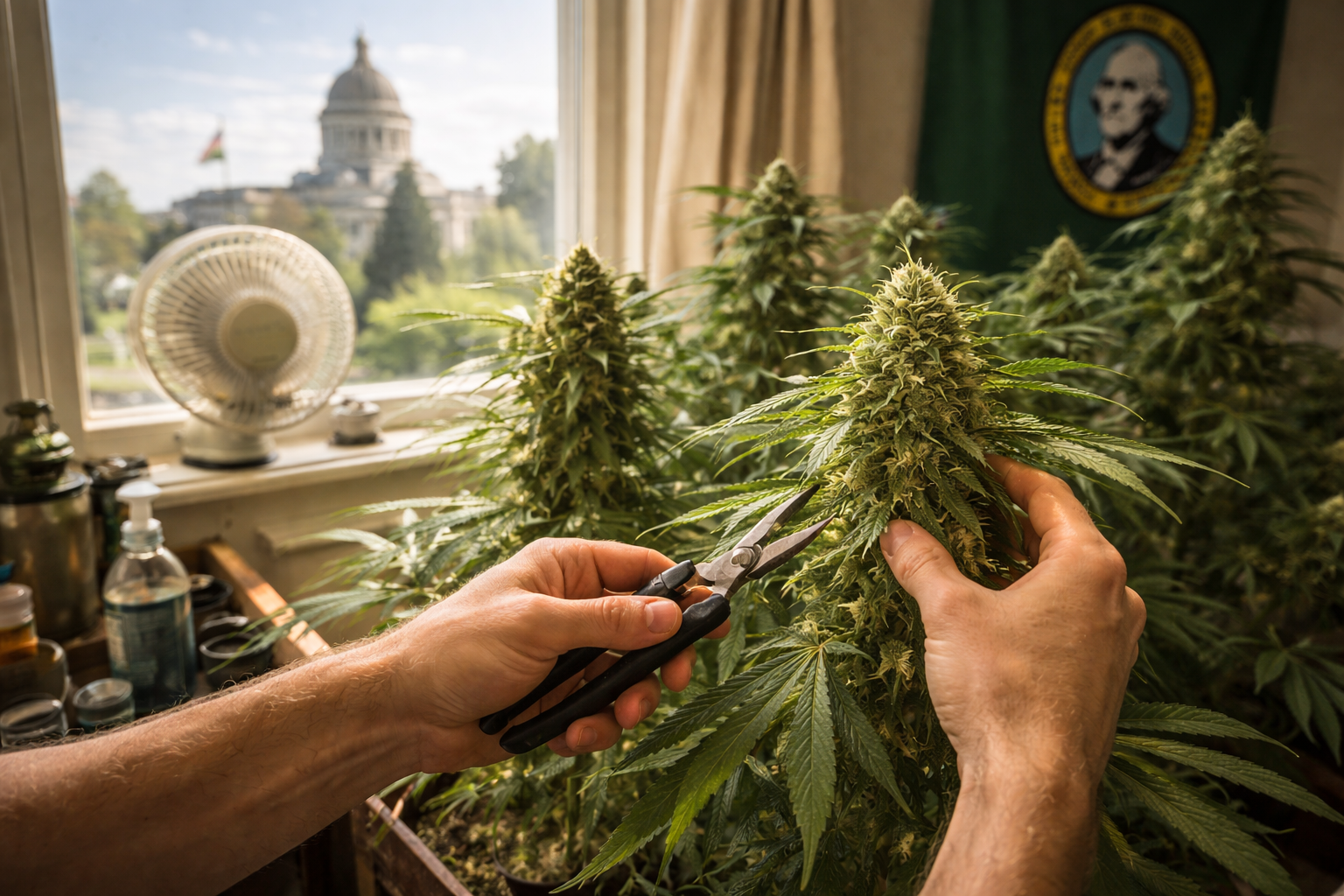
Home cannabis trimming setup near a capitol window as lawmakers debate legal home cultivation
Washington lawmakers are weighing a Washington home cultivation cannabis bill that would allow adults to grow cannabis at home for personal use. In a mature market where adults can buy from licensed retailers but cannot legally grow at home outside medical rules, that is a real policy turn. If this shifts, it changes consumer behavior, enforcement posture, and how operators think about compliance and demand in 2026.
Quick facts
• Bill: Senate Bill 6204 would legalize home cultivation of cannabis for adults 21 and older
• Plant limits: up to 6 plants per adult, with a cap of 15 plants per housing unit
• Odor and visibility rule: a civil infraction applies if plants or derived cannabis can be readily smelled from a public place or the private property of another housing unit, or visible within ordinary public view
• Fine signal: a class 3 civil infraction has a default monetary penalty of $50, not including statutory assessments
• Exceeding limits: more than 6 but fewer than 16 plants is a class 1 civil infraction, and 16 or more plants is a class C felony
• Enforcement: the Liquor and Cannabis Board would not investigate or enforce home cultivation, and law enforcement may seize and destroy plants produced or possessed in excess of the authorized amount
• Property rules: the authorization would not apply in a family day care or foster family home, and property owners can prohibit cultivation by renters through lease or contract terms
If Washington timing affects your growth plan, Start with our quick Cannashield intake form so you can map exposure and plan for multiple outcomes.
Why Home Cultivation Is A Real Shift In A Mature Market
Home cultivation is not just a lifestyle change for consumers. It is a structural change in how a market behaves. It can pull a slice of demand away from entry level flower purchases, especially for price sensitive consumers who are willing to trade convenience for savings. At the same time, many consumers will still prefer tested products, variety, and predictable potency from licensed retailers, which means the demand impact is real but not uniform.
The bigger change is compliance and enforcement. When home cultivation is prohibited, enforcement is simpler to describe even if it is not always consistent. When it is allowed, rules shift from a bright line to a set of thresholds and conditions. Odor, visibility, plant counts, and household limits become the new friction points. That can increase neighbor complaints and local attention, even while personal cultivation becomes legal.
Universal operator lesson: when a legacy market relaxes a long standing restriction, demand, enforcement, and public expectations all move at the same time.
What SB 6204 Would Allow And Where The Lines Are
The core permission in SB 6204 is straightforward: adults 21 and older could produce and possess up to six cannabis plants at their housing unit, with an overall cap of fifteen plants per housing unit regardless of how many adults live there.
Where operators should pay attention is the line drawing. The bill creates a class 3 civil infraction if the plants or derived cannabis can be readily smelled from a public place or the private property of another housing unit, or if they are visible within ordinary public view. In Washington’s civil infraction schedule, a class 3 infraction carries a default monetary penalty of $50, not including statutory assessments.
The bill also raises the stakes for higher plant counts. Producing and knowingly possessing more than six but fewer than sixteen plants would be a class 1 civil infraction. Producing and knowingly possessing sixteen or more plants would be a class C felony. The bill report also notes that the Liquor and Cannabis Board would not investigate or enforce the home cultivation provisions, and that law enforcement may seize and destroy plants in excess of the authorized amount.
If this bill would change how you think about diversion risk, neighbor complaints, or retail demand, Complete our Cannashield questionnaire to pressure test your exposure and tighten your controls before renewals.
Operator Impact: Retail Demand, Enforcement, And Local Friction
For retailers, home cultivation is a signal to compete harder on reliability. Home grown cannabis varies. Licensed product is tested and consistent. That is the wedge. Operators who lean into education, product consistency, and clear guidance on responsible use tend to hold loyalty even when some customers experiment with growing.
For operators with multiple locations, the bigger impact is planning. Home cultivation can change purchasing patterns seasonally, especially after harvest cycles, and it can change which categories perform. If you rely heavily on low priced flower volume, you should be watching this closely. If your mix includes concentrates, edibles, and other tested formats, your moat is stronger, but you still need to anticipate traffic and basket shifts.
For enforcement and compliance, the odor and visibility rule is the quiet trigger. It creates a clear pathway for complaints to turn into tickets. Operators should expect more public conversation about what is acceptable, especially in dense housing. Landlords will likely tighten lease language, and the bill report explicitly notes that property owners can prohibit cultivation by renters through lease or contract terms. That matters for employee housing, management housing, and any operator tied to multi unit properties.
Universal operator lesson: whenever rules change in a way that touches the home, the real enforcement engine becomes neighbors, property owners, and local complaints.
What To Watch Next In 2026
This is a Washington story, but it belongs in every operator’s policy watchlist. Mature markets are still evolving to match adult use reality, and the most important shifts are often the quiet ones that change behavior at scale.
If you operate in Washington, build scenarios now. If you operate in other states, treat this as a preview: home cultivation debates tend to resurface when markets mature and price sensitivity rises. The operators who win are not the ones who guess the outcome. They are the ones who stay ready for either outcome.
If you want a Washington home cultivation impact checklist for retail, compliance, and location planning, use our Cannashield intake form to request it so your team can align policies, staff training, and renewal timelines.
Conclusion
SB 6204 is a policy inflection point because it would change the rules of personal access in a mature market. For operators, the smart move is to treat it like a planning event. Track the bill, model the demand impact, and tighten the basics that protect your business when public expectations and enforcement posture shift.
What To Do This Week
• Add SB 6204 to your policy watchlist and assign an owner to track changes weekly
• Build two demand scenarios for flower and basket size if home cultivation is allowed
• Review your customer education approach and tighten language around tested consistency and responsible use
• Update your internal diversion controls and inventory documentation to stay clean if scrutiny increases
• Review any lease or property agreements tied to your business for cultivation restrictions and nuisance language
• Align your 2026 calendar so licensing, compliance, and insurance renewals do not stack in the same month
FAQ
What is Washington considering right now
Legislation that would allow adults 21 and older to grow cannabis at home for personal use under SB 6204.How many plants would be allowed
Up to six plants per adult, with a cap of fifteen plants per housing unit.What happens if odor or visibility becomes an issue
The bill creates a class 3 civil infraction if plants or derived cannabis can be readily smelled from certain places or visible within ordinary public view.What is the fine amount for a class 3 civil infraction
Washington law sets the default monetary penalty for a class 3 civil infraction at $50, not including statutory assessments.Would the Liquor and Cannabis Board enforce home cultivation rules
The bill report states the Liquor and Cannabis Board would not investigate or enforce the home cultivation provisions.What is the universal operator lesson from this debate
Policy changes that affect home behavior can shift demand, complaints, and enforcement patterns quickly, so operators should plan scenarios instead of reacting late.