
EFSA CBD Safe Intake Level Sets A Global Baseline For Hemp Products
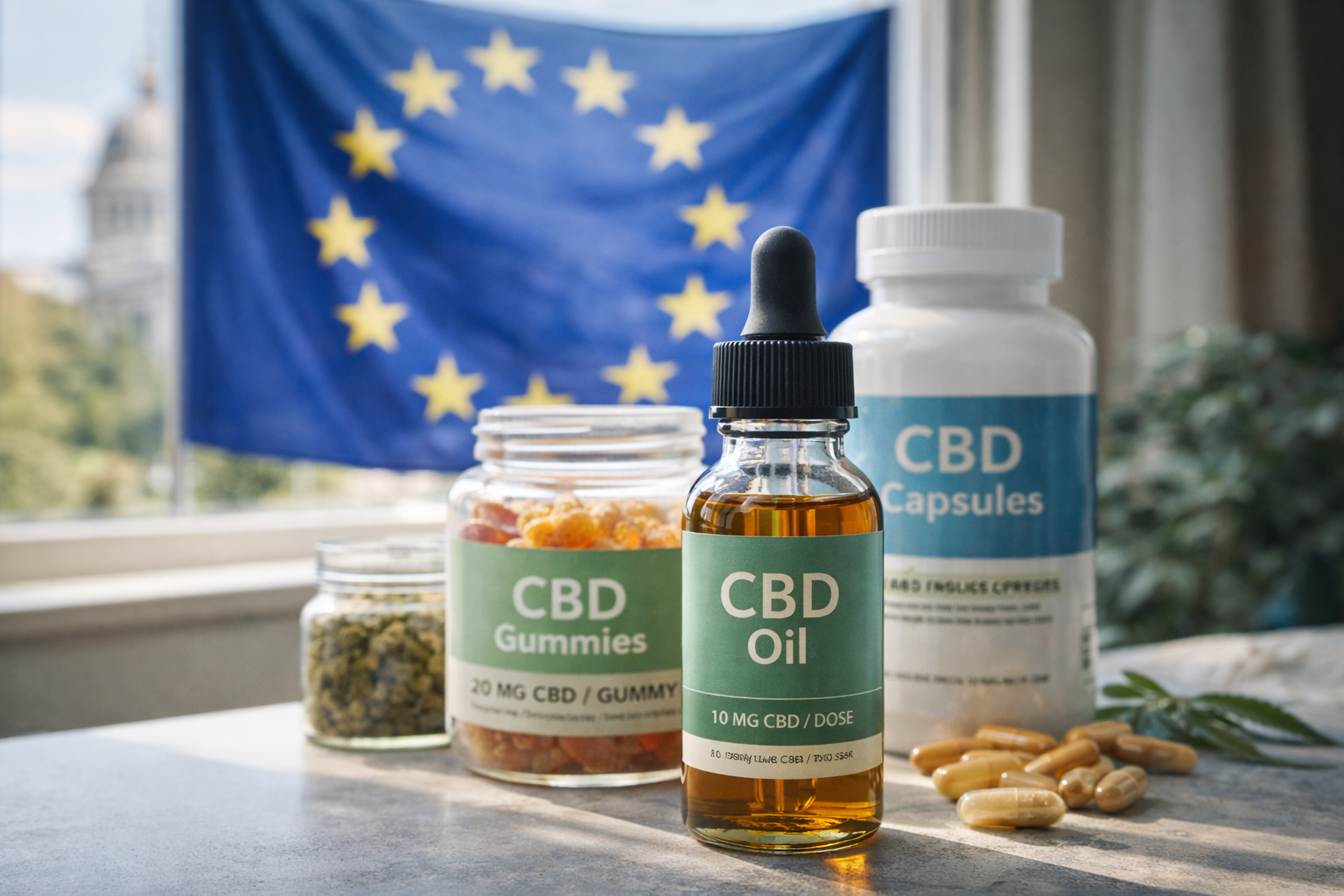
Hemp derived CBD supplements beside an EU flag symbolizing compliant labeling and intake limits
Europe just put a number on the table that CBD operators should take seriously. The European Food Safety Authority, EFSA, published a provisional safe intake level for hemp derived CBD used in food supplements. If you care about CBD labeling compliance, market access, or export planning, this is the kind of international benchmark that can shape expectations far beyond the European Union.
Quick facts
• Provisional safe intake level: 0.0275 milligrams per kilogram of body weight per day, about 2 milligrams per day for a 70 kilogram adult
• Scope: applies only to food supplement formulations with CBD purity of at least 98 percent and without nanoparticles
• Population limits: safety cannot be established for people under 25, pregnant or lactating women, and people taking medication
• EFSA position: persistent data gaps remain and the provisional level will be reviewed when more toxicology or human data becomes available
If international CBD rules could affect your next launch, Start with our quick Cannashield intake form so you can map market access risk and compliance prioritie
What EFSA Did And Why It Matters
EFSA did not approve CBD products. It set a cautious threshold it believes can be concluded to pose no risk of adverse effects for adults, based on the evidence reviewed. EFSA calls it provisional because the evidence base is incomplete, and it added a safety factor to protect health despite uncertainty. EFSA also notes that the European Commission treats CBD as a novel food when it meets the conditions of EU novel food rules, which is another reminder that food and supplement pathways are moving toward stricter review.
Universal operator lesson: when a respected authority publishes a conservative number, it becomes the reference point that buyers, regulators, and lawyers will use in the next conversation.
The Ripple Effect On Labels, Dosing, And Partnerships
Even if you only sell in the United States today, global benchmarks tend to travel through supply chains. Reuters noted the EFSA level is much lower than guidance used in several other countries, which signals a conservative baseline for international discussions.
Is your daily use guidance defensible
Is CBD per serving and per package easy to find
Do you separate product education from medical claims
Do you have a clear plan for higher risk groups like pregnancy or medication use
This is where product identity turns into risk management. The goal is not to sound clinical. The goal is to be clear, consistent, and boring in the best way.
Product Strategy In A Low Threshold World
A safe level of about 2 milligrams per day is far below what many CBD gummies, tinctures, and capsules provide per serving. That does not mean every product disappears tomorrow. It means the market is shifting toward dose discipline and cleaner logic.
Three moves matter.
First, simplify dosing architecture. Offer a true low dose option and explain why each tier exists without leaning on hype.
Second, tighten quality control and documentation. EFSA tied its provisional level to highly pure CBD supplement formulations and excluded nanoparticles. Purity, ingredient integrity, and consistent testing are now part of the sales process, not just the lab process.
Third, make your label do real work. Clear serving size, total CBD per serving, suggested use, and plain language warnings reduce confusion and reduce complaints.
If uncertainty is affecting how you plan or negotiate, Complete our Cannashield questionnaire to pressure test your label, dosing logic, and contract exposure before you scale distribution.
2026 Planning For Export And Compliance Tightening
If you are eyeing Europe, EFSA’s threshold is a gating factor for product design and partner confidence. Even if you are not exporting, international guidance can influence what large retailers and risk teams expect from your documentation.
Treat this as an operations project. Assign an owner to review your top SKUs against a conservative daily intake assumption. Create a one page dosing rationale per SKU. Update staff training so they can explain use without making claims. Track complaints and adverse events consistently, because safety discussions always come back to documentation.
If you want a practical CBD compliance readiness checklist for labeling, documentation, and partner requirements, use the Cannashield intake form to request it.
Conclusion
EFSA’s provisional safe intake level does not settle the CBD debate. It raises the bar on dosing clarity, purity, and education. Operators who build systems for consistency and documentation will be better positioned if standards tighten in 2026.
What To Do This Week
• Write down CBD per serving and suggested daily use for your top 10 SKUs
• Build a one page dosing rationale for each SKU, including who it is for and who it is not for
• Confirm purity specs, testing cadence, and documentation storage so you can hand it to a retailer or distributor
• Review labels for clarity and remove language that implies medical outcomes
• Create a simple complaint and adverse event log and train staff to capture it consistently
• Add EU novel food and safety guidance to your 2026 policy watchlist and review it monthly
FAQ
What is EFSA and why does it matter for CBD operators
EFSA is the European Union’s food safety authority, and its safety thresholds often influence how regulators and large buyers think about acceptable risk.What intake level did EFSA publish
EFSA set a provisional safe intake level of 0.0275 milligrams per kilogram of body weight per day, about 2 milligrams per day for a 70 kilogram adult.Does this apply to every CBD product on the market
EFSA stated the provisional level applies to food supplement formulations with at least 98 percent CBD purity and without nanoparticles.Who was excluded from EFSA’s safety conclusion
EFSA said safety could not be established for people under 25, pregnant or lactating women, and people taking medication.What does novel food mean here
EFSA notes that the European Commission considers CBD a novel food when it meets the conditions of EU novel food rules, which can affect how products are assessed for market access.What should operators do now
Treat this as a documentation and dosing project: clarify serving guidance, tighten quality records, and make labels easier to defend in a safety conversation.