2026 Farm Bill Draft Could Lower Industrial Hemp Compliance Costs
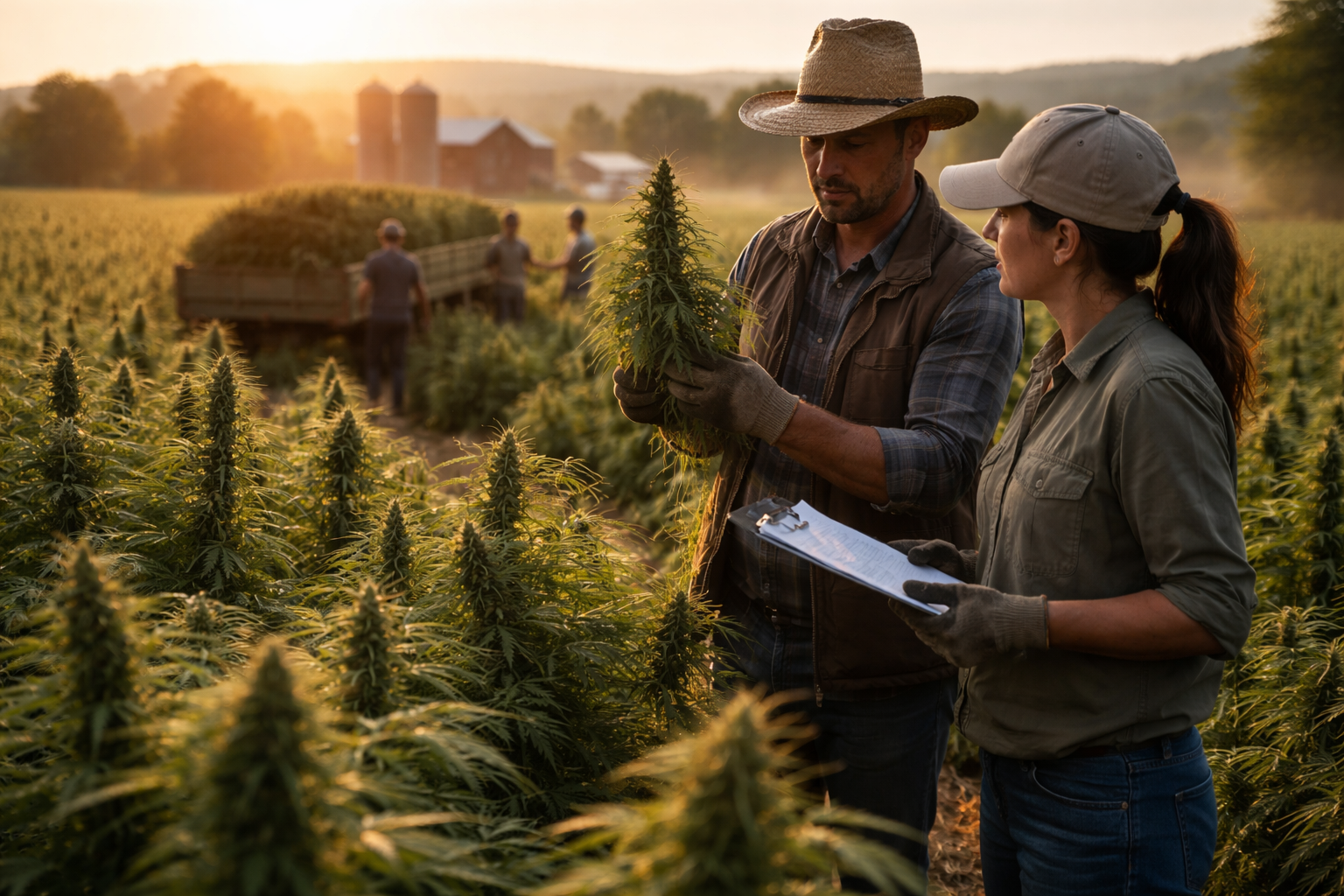
Industrial hemp field inspection at sunrise with workers reviewing crop health and compliance
The 2026 Farm Bill hemp testing requirements conversation is shifting in a way industrial hemp producers should not ignore. At the federal government level, the draft Farm, Food, and National Security Act of 2026 proposes changes that could reduce testing friction for fiber and grain producers while tightening how hemp is defined and verified.
Quick facts
• The draft Farm, Food, and National Security Act of 2026 is filed as H.R. 7567 and includes hemp program updates.
• The draft would require hemp producers to designate their production type as only industrial hemp or hemp grown for any purpose other than industrial hemp.
• State, tribal, and federal hemp plans could use lower burden sampling approaches for industrial hemp producers, including visual inspections, performance based sampling, and certified seed when developing sampling plans.
• The draft shifts the testing standard to total THC, including THCA, not more than 0.3 percent in the plant.
• The draft adds a USDA lab accreditation process for hemp testing, created in consultation with the Drug Enforcement Administration.
• USDA has already delayed enforcement of the DEA registered lab testing requirement until December 31, 2026 due to capacity constraints.
If the 2026 Farm Bill could affect your hemp plan, Start with our quick Cannashield intake form so you can map exposure and plan for multiple outcomes.
What The Draft Changes For Industrial Hemp Producers
The most operator relevant change is the new separation between industrial hemp and other hemp purposes. The draft would require a producer to declare what they are growing and for what use. That matters because it creates a compliance lane that is designed for fiber and grain production where diversion risk is viewed differently than cannabinoid production.
In practical terms, the draft lets state and tribal plans, and the USDA plan, design sampling and testing rules that are less burdensome for industrial hemp producers. Instead of assuming every field must follow the same lab pathway, the draft contemplates alternatives like documentation supported inspections and sampling plans that use certified seed or performance based approaches. That can reduce cost, reduce scheduling chaos, and reduce harvest timing risk when lab turnaround slows.
Universal operator lesson: when the rulebook starts separating production types, your paperwork becomes part of your product. The fastest growers will be the ones who can prove intent and execution cleanly.
Why Testing Rules And Lab Capacity Still Drive Real Economics
Testing is not just a compliance step. It is a cost center and a timing risk. The reason this matters in 2026 is simple. USDA has repeatedly acknowledged lab capacity constraints, including the challenge of requiring hemp to be tested by DEA registered laboratories. USDA is currently delaying enforcement of that requirement through December 31, 2026, citing inadequate capacity.
The farm bill draft responds by adding a lab accreditation process that USDA would establish in consultation with the Drug Enforcement Administration. The operator takeaway is not that testing disappears. The takeaway is that the system is trying to become more scalable and less bottlenecked.
If your margins are tight, fewer delays and fewer mandatory lab hurdles can be the difference between a stable harvest cycle and a painful cash crunch. This is especially true for industrial hemp where the unit economics often hinge on large acreage, predictable harvest timing, and downstream processing capacity.
If uncertainty is affecting your operational planning, Complete our Cannashield questionnaire to pressure test your compliance workflow and documentation before you commit capital to acreage, contracts, or processing equipment.
The Bigger Signal: Total THC And Clearer Lane Definitions
The draft also tightens the definition side of the equation by shifting the testing standard to total THC including THCA, not more than 0.3 percent in the plant. For operators, that is a clear signal that the federal government wants the hemp definition to be harder to game and easier to enforce.
This matters beyond any single farm. It influences how contracts get written, how processors set specs, and how buyers think about compliant supply. It also affects the broader cannabis ecosystem because it pushes the market toward clearer separation between regulated cannabis channels and hemp as an agricultural commodity.
Universal operator lesson: when definitions tighten, the winners are the operators who can meet specs consistently and document it without drama.
How This Plays Out In High Impact States And Emerging Hemp Regions
The draft gives states and tribes flexibility in how they implement hemp plans, which means outcomes will still vary market by market. In high impact hemp states where fiber and grain infrastructure is already being built, a lighter testing regime could accelerate acreage expansion because it reduces friction for growers who are not chasing cannabinoid margins.
In emerging hemp regions, the opportunity is more basic. Repurpose idle industrial sites, build processing partnerships, and use clear contracting to turn hemp into a predictable input stream. That is where the new designation and documentation expectations become useful. If you can show intent and stay aligned with industrial production, you give local partners and lenders a cleaner story.
Universal operator lesson: federal policy may set the lane, but local execution and documentation decide whether you can scale.
If you want a practical farm bill readiness checklist for industrial hemp documentation, sampling strategy, and vendor contracts, use the Cannashield intake form to request it.
Conclusion
The draft 2026 Farm Bill is a compliance and economics signal for industrial hemp producers. It points toward a world where fiber and grain hemp may face fewer testing burdens if intent is clear and documented, while definitions and standards become stricter and more explicit. Operators who win in 2026 will treat compliance as an operating system, not a last minute paperwork sprint.
What To Do This Week
• Identify whether your current model is industrial hemp, cannabinoid hemp, or a mix
• Build a documentation pack that proves intent, including seed tags, contracts, and harvest plan
• Review your testing workflow and lab relationships for turnaround risk in peak season
• Update contracts to reflect total THC spec language and clear acceptance criteria
• Track state and tribal plan updates that could change sampling rules locally
• Create a cash buffer plan for harvest timing and potential compliance delays
FAQ
What is the main change for industrial hemp producers in the draft farm bill
A clearer industrial hemp designation with the option for lower burden sampling approaches when intent and documentation support it.Does the draft eliminate hemp testing
No. It allows alternative sampling approaches for industrial hemp in certain plans, but testing and documentation still matter.What does total THC mean here
It means THC measurement includes THCA and the threshold is not more than 0.3 percent in the plant.Why is lab capacity a big issue
Because testing delays can disrupt harvest timing and cash flow, and USDA has already delayed enforcement of DEA registered lab requirements due to capacity constraints.What is the universal operator lesson
When the rules separate production types, you must document intent and run consistent processes to stay in the right lane.How should emerging market operators respond
Build partnerships and documentation early so expansion is driven by readiness, not last minute scrambling.