
California 10mg Beverage Cap Puts a Growth Lane at Risk
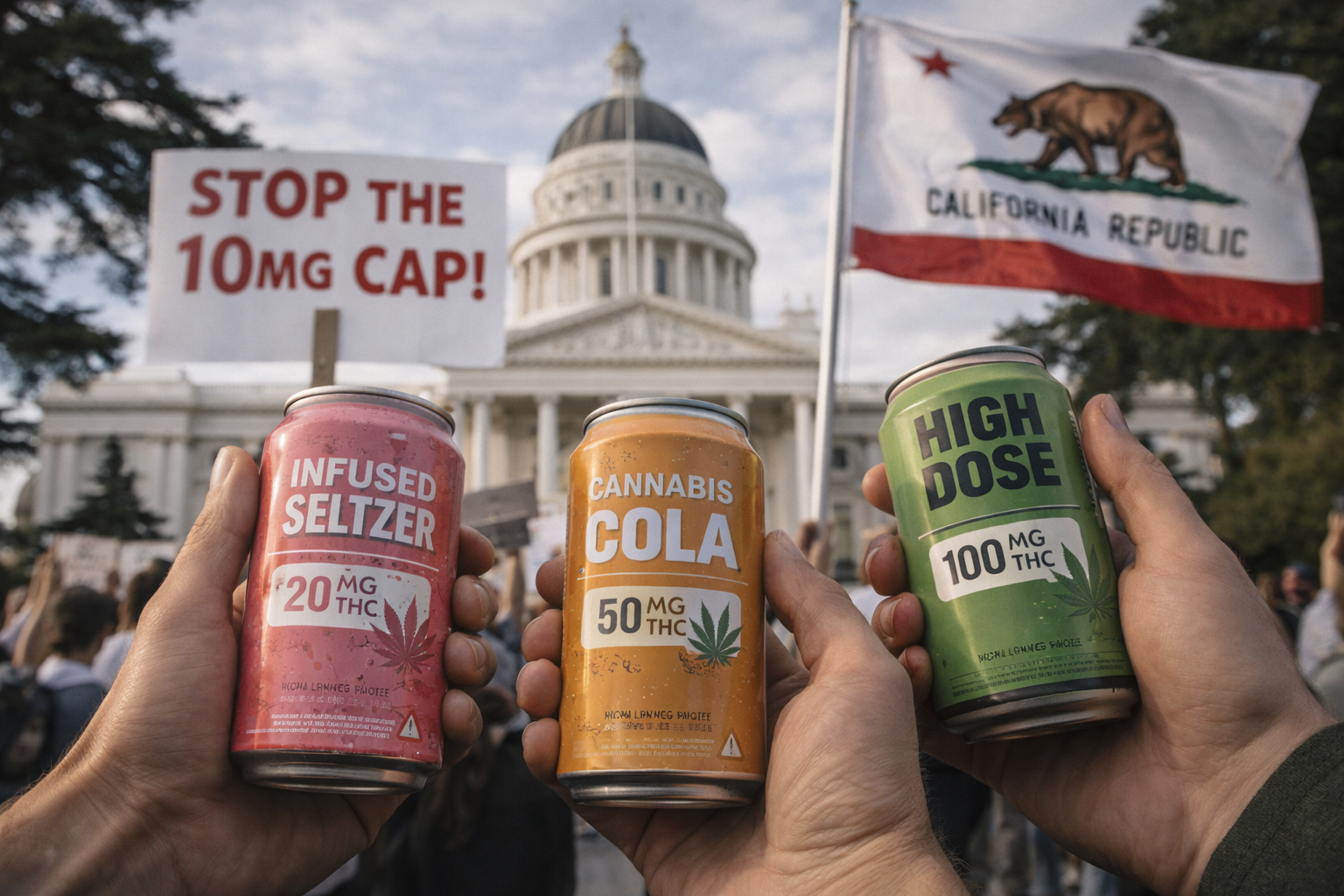
Cannabis beverage cans with higher THC labels shown in front of California government symbols to illustrate opposition to AB 2532.
California cannabis beverage compliance could change fast under AB 2532. The bill was amended on April 6 and is set for an Assembly Business and Professions Committee hearing on April 14. Official bill text shows two key changes: cannabis beverage labels would have to include the national Poison Help line, and cannabis beverage containers would be capped at 10 milligrams of THC per container, with an exception for certain medicinal tinctures. For operators, this is bigger than a label update. It is a category design fight that could decide whether California keeps a multiserving beverage lane or shrinks it hard.
If AB 2532 could affect your product mix, Start with our quick Cannashield intake form so you can map labeling, inventory, and reformulation exposure before the hearing.
Quick facts
• AB 2532 was amended in the Assembly on April 6, 2026, and the official status page lists an Assembly Business and Professions Committee hearing for April 14, 2026.
• The bill would require labels and inserts for edible cannabis products and cannabis beverages to include the toll free number for the national Poison Help line.
• The bill would prohibit a cannabis beverage container from containing more than 10 milligrams of THC per container, except that a medicinal cannabis tincture would not count as a cannabis beverage for this provision.
• In an April 7 opposition letter, industry signers said products over 10 milligrams make up 93.2 percent of current beverage sales, that 100 milligram beverages account for $66 million or 83.6 percent of category revenue, and that the proposal could remove $73.6 million in yearly sales and roughly $21 million in annual state level revenue. Those figures are claims from the opposition letter, not a state fiscal analysis.
This is not just a warning label bill
The easy mistake is to treat AB 2532 like a minor packaging cleanup bill. It is not. California law already requires cannabis packages and labels not to be made attractive to children and already requires extensive warning language, potency disclosures, and other label information. AB 2532 adds the Poison Help line for edible products and cannabis beverages, but the real commercial change is the move from a 10 milligram per serving rule to a 10 milligram per beverage container limit. That is what puts current multiserving formats directly in the crosshairs.
Why operators say this hits the category so hard
The opposition letter frames the bill as a direct threat to one of the few cannabis product segments still showing real growth. The signers told lawmakers that a 10 milligram container cap would effectively wipe out most legal cannabis beverage sales because so much of the current category sits above that threshold. They also argued the loss would hit tax receipts, storefront sales, and one of the few formats that can be clearly portioned by the consumer. Those are advocacy claims, not neutral government findings, but they are the core reason this bill is getting real pushback.
If your beverage strategy depends on multiserving formats, Complete our quick Cannashield intake form to request a reformulation and labeling review before the committee makes the lane narrower.
What lawmakers appear to be trying to solve
The bill itself points to a safety first logic. The Poison Help line requirement puts emergency information directly on labels for edible products and beverages. The 10 milligram container cap appears aimed at making a cannabis beverage function more like a single dose item than a higher potency shared or staged use product. Whether that is the best answer is the fight. But the policy direction is clear. Sacramento is looking at potency, packaging, and consumer safety together, not as separate issues.
That creates the real operator lesson. In cannabis, dosage rules can kill a category faster than a tax increase because they change the product itself, not just the margin. Once lawmakers redefine what a compliant beverage is, inventory, manufacturing runs, labels, shelf strategy, and consumer behavior all have to move with it. That is an inference based on the bill text and the market exposure described in the opposition letter.
What the industry is asking for instead
The opposition letter does not just say no. It asks lawmakers to reject the 10 milligram cap and focus instead on targeted measures such as stronger serving disclosures, standardized warning labels, child resistant container standards, restrictions on single serve style marketing, and consumer education. That is a more surgical approach. It tries to keep the beverage category alive while tightening how consumers understand dose and use. Whether lawmakers buy that argument is the next real question heading into April 14.
If you sell beverages, this is the week to identify which products survive a lower cap, which ones need reformulation, and which ones become dead inventory if the bill moves.
Conclusion
AB 2532 is a live example of how fast cannabis policy can move from safety language to category reshaping. California may decide the public health tradeoff is worth it, or lawmakers may decide a hard cap goes too far. Either way, operators should treat this as a serious business signal now, not after the hearing.
Educational note: This article is for education only and is not legal, regulatory, tax, or insurance advice.
What To Do This Week
• Pull every cannabis beverage SKU and sort it by total THC per container.
• Identify which products would become noncompliant under a 10 milligram container cap.
• Review labels for potency disclosures, serving guidance, and emergency information.
• Build a reformulation plan for any product that depends on a multiserving format.
• Check how much beverage revenue your store or portfolio would lose if higher potency cans disappear.
• Track the April 14 committee hearing and prepare a clean impact memo for management.
FAQ
What does AB 2532 do?
It would add the national Poison Help line to edible cannabis product and cannabis beverage labels and would cap cannabis beverages at 10 milligrams of THC per container, with an exception for certain medicinal tinctures.
Is the bill already law?
No. The official status page shows it is still an active bill in committee process.
When is the next hearing?
The California Legislature status page lists an Assembly Business and Professions Committee hearing for April 14, 2026.
Why are operators opposing it?
In their April 7 opposition letter, the signers said most current beverage sales are above 10 milligrams per container and argued the bill would wipe out most of the category and cut state revenue.
Would all cannabis beverages be limited to 10 milligrams?
Under the amended bill text, yes for cannabis beverage containers, except that a medicinal cannabis tincture would not be treated as a cannabis beverage for that container cap provision.
What is the operator lesson here?
Do not underestimate packaging and dosage bills. They can redraw an entire product category faster than most operators expect. That is an inference based on the current bill and the industry response.