
Cannabis scale compliance is becoming a bigger retail risk

Cannabis staff review scale compliance, inventory records, and labeling documents.
Cannabis scale compliance is the kind of issue operators ignore until a small number turns into a big problem.
The National Institute of Standards and Technology published a 2026 report on the suitability of scales used for selling cannabis products. The report is technical, but the operator lesson is simple. If your dispensary, delivery operation, processor, or packaged product workflow depends on weight, your scale records are part of the risk file.
NIST says state and local weights and measures officials are debating what requirements should apply to scales used for cannabis sales, including accuracy, scale division, auxiliary indications, minimum capacity, and recommended minimum load. The report does not make one final rule for every state. It gives regulators technical guidance to help evaluate scale requirements.
The bigger lesson is not that every operator needs to become a metrology expert. The bigger lesson is that weights, labels, receipts, inventory, customer trust, and compliance records all connect.
Need help reviewing your cannabis insurance file before a product compliance issue, retail inspection, customer dispute, renewal, or expansion?
Quick facts box
Story classification: Federal government
What happened: NIST published NIST SP 2200 08: Suitability of Cannabis Scales 2026 Edition on June 29, 2026.
Primary issue: The report addresses technical questions around scales used for cannabis sales, including accuracy classification, verification scale interval, monetary value per scale division, auxiliary indication, minimum capacity, and recommended minimum load.
Why it matters: NIST says cannabis products are unique compared with traditional commodities because they can involve high value, moisture variation, air buoyancy concerns, and different measurement expectations.
Regulatory backdrop: The National Conference on Weights and Measures Cannabis Task Group lists scale suitability, method of sale, package and labeling, inspector safety, and moisture loss of prepackaged product as areas for uniform guidance.
Insurance angle: Scale records can affect cannabis compliance, product liability, customer disputes, inventory shrink, theft questions, recall documentation, and cannabis renewal review.
Universal operator lesson: If weight affects the sale, weight records belong in the file.
What cannabis scale compliance means for operators
The universal operator lesson is simple: a scale is not just equipment. It is a control point.
Retail operators use scales to price product, verify prepackaged weights, support inventory reconciliation, and answer customer questions. Cultivation and manufacturing teams use weight data to track product movement, production output, loss, waste, packaging, transfers, and batch records.
If the scale is off, the issue does not stay in one lane. It can affect customer receipts, state inventory systems, product labels, tax records, vendor disputes, internal theft investigations, and insurance questions.
That is the risk mechanism operators need to understand.
A customer complaint about short weight can become a product complaint. A mismatch between point of sale data and inventory logs can become an audit problem. A poor calibration file can make it harder to explain shrink. A labeling issue can become a product liability issue. A repeated measurement gap can raise questions about procedures, training, supervision, and recordkeeping.
From a cannabis insurance standpoint, this is not about promising that a policy will respond. It is about making sure the operation can explain the controls behind the numbers. Underwriters, landlords, lenders, regulators, and claims reviewers all care about records when something goes sideways.
A clean scale file tells a better story than a manager trying to remember when the scale was last checked.
What to do this week checklist
☐ Identify every scale used in retail, delivery, cultivation, manufacturing, packaging, receiving, transfer, waste, and inventory workflows.
☐ Confirm which scales are used directly for customer sales and which are used only for internal operations.
☐ Pull purchase records, model numbers, serial numbers, location assignments, service records, calibration records, inspection records, and repair notes.
☐ Confirm whether each scale meets current state and local requirements for cannabis sales or inventory use.
☐ Review whether staff know when to stop using a scale, report an issue, reweigh product, document a discrepancy, or escalate a customer complaint.
☐ Compare point of sale records, inventory system records, package labels, batch records, transfer records, and customer receipts for weight consistency.
☐ Review SOPs for deli style sales, prepackaged product checks, receiving, repackaging, waste, shrink, returns, and customer disputes.
☐ Confirm who is responsible for scale maintenance and how often records are reviewed.
☐ Review product liability, property, crime, cyber, inventory, and claims notice procedures with your insurance advisor.
☐ Add scale compliance records to the cannabis renewal review folder before an underwriter, regulator, or customer forces the issue.
FAQ
1. Why should cannabis operators care about a federal scale report?
Because federal technical guidance can influence how states and local weights and measures officials think about inspections, scale suitability, method of sale, packaging, labels, and moisture loss. Operators do not need to memorize the report, but they should understand that weighing cannabis is becoming a more formal compliance issue.
2. Does the NIST report create a new rule for every dispensary?
No. NIST says the publication is intended to provide technical guidance for decision making, not one final recommendation for every scale or every state. Operators still need to follow their state and local requirements.
3. What is the biggest operational risk with scales?
The biggest risk is a mismatch between what the customer receives, what the label says, what the point of sale shows, and what the inventory system records. That mismatch can create customer complaints, audit issues, product questions, and documentation problems.
4. How can scale issues affect insurance conversations?
Scale issues can connect to product liability, inventory shrink, employee theft concerns, customer disputes, recall records, regulatory inquiries, and claims notice procedures. The insurance file should show that the operator has controls, training, records, and escalation steps.
5. What records should be kept for scale compliance?
Operators should keep scale purchase records, serial numbers, location assignments, calibration records, inspection records, repair notes, service vendor information, internal checks, staff training records, and customer complaint documentation.
6. What is the practical takeaway for smaller dispensaries?
Do not wait for an inspection or angry customer to organize scale records. Build a simple folder now so weights, labels, inventory, receipts, and insurance documentation tell the same story.
Cannashield helps cannabis operators review the operating details behind the insurance file, including product controls, inventory records, vendor contracts, customer complaints, claims history, security procedures, and renewal documentation.
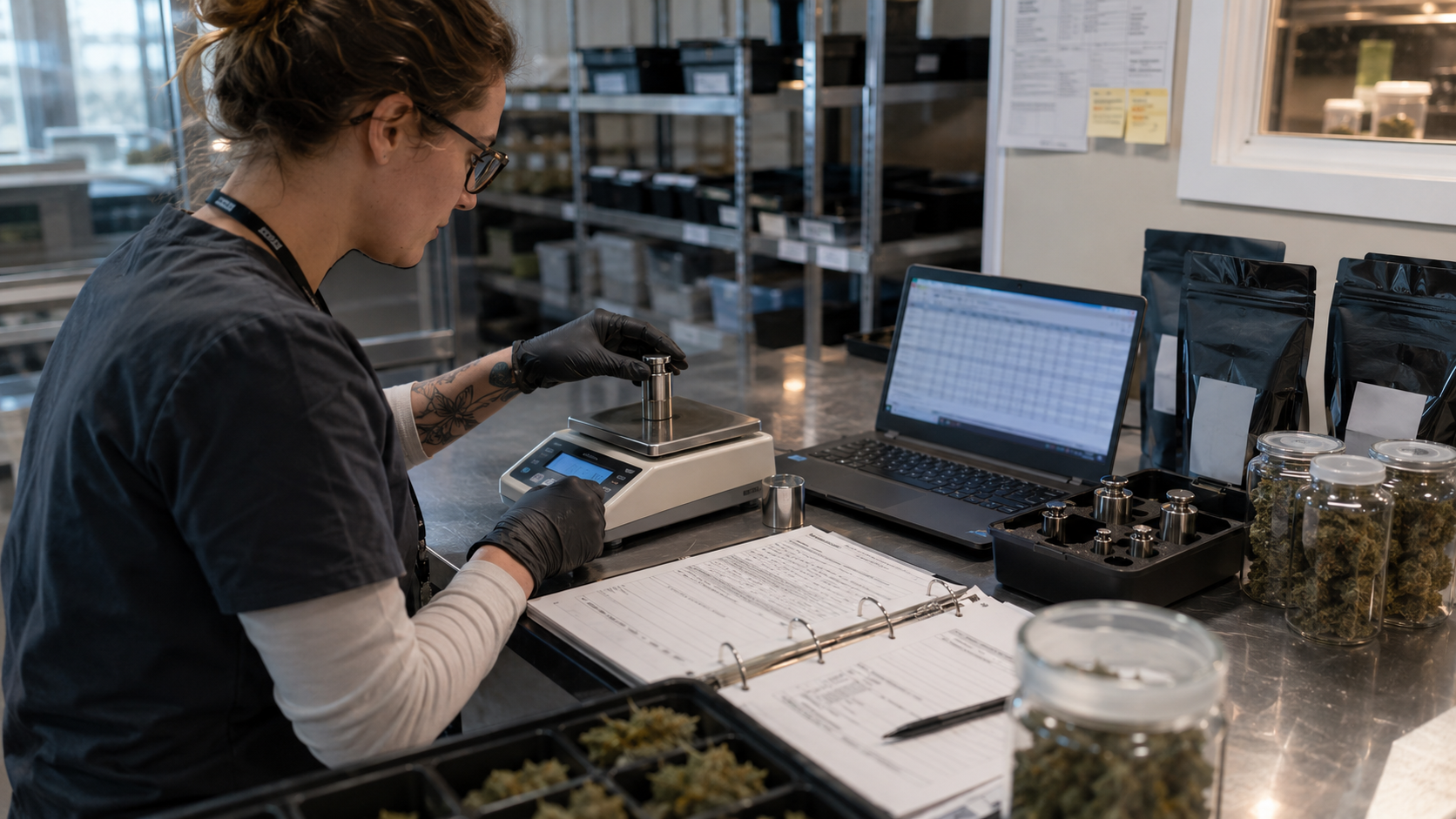
Cannabis employee checks scale accuracy with calibration weights and compliance records.
Educational note
This article is for educational purposes only. It is not legal, tax, regulatory, financial, product safety, or insurance coverage advice. Cannabis operators should speak with qualified legal, compliance, tax, product, and insurance professionals before making decisions.
You might also like


SOURCES
Primary source: NIST SP 2200 08, Suitability of Cannabis Scales 2026 Edition
https://www.nist.gov/publications/nist-sp-2200-08-suitability-cannabis-scales-2026-ed
Supporting source: Marijuana Moment coverage, July 7, 2026
https://www.marijuanamoment.net/new-federal-report-analyzes-scales-used-to-weigh-marijuana-offering-advice-for-state-officials/
Supporting source: National Conference on Weights and Measures Cannabis Task Group
https://www.ncwm.com/cannabis-task-group

Trulieve and Cronos have each gained roughly 27 percent in 2026 while reporting stronger operating results. The broader signal is that public market attention is increasingly rewarding cash generation, improving margins, liquidity, and measurable revenue growth.