

Cannabis Equities Watchlist Signal: Tilray, Canopy Growth, And Aurora
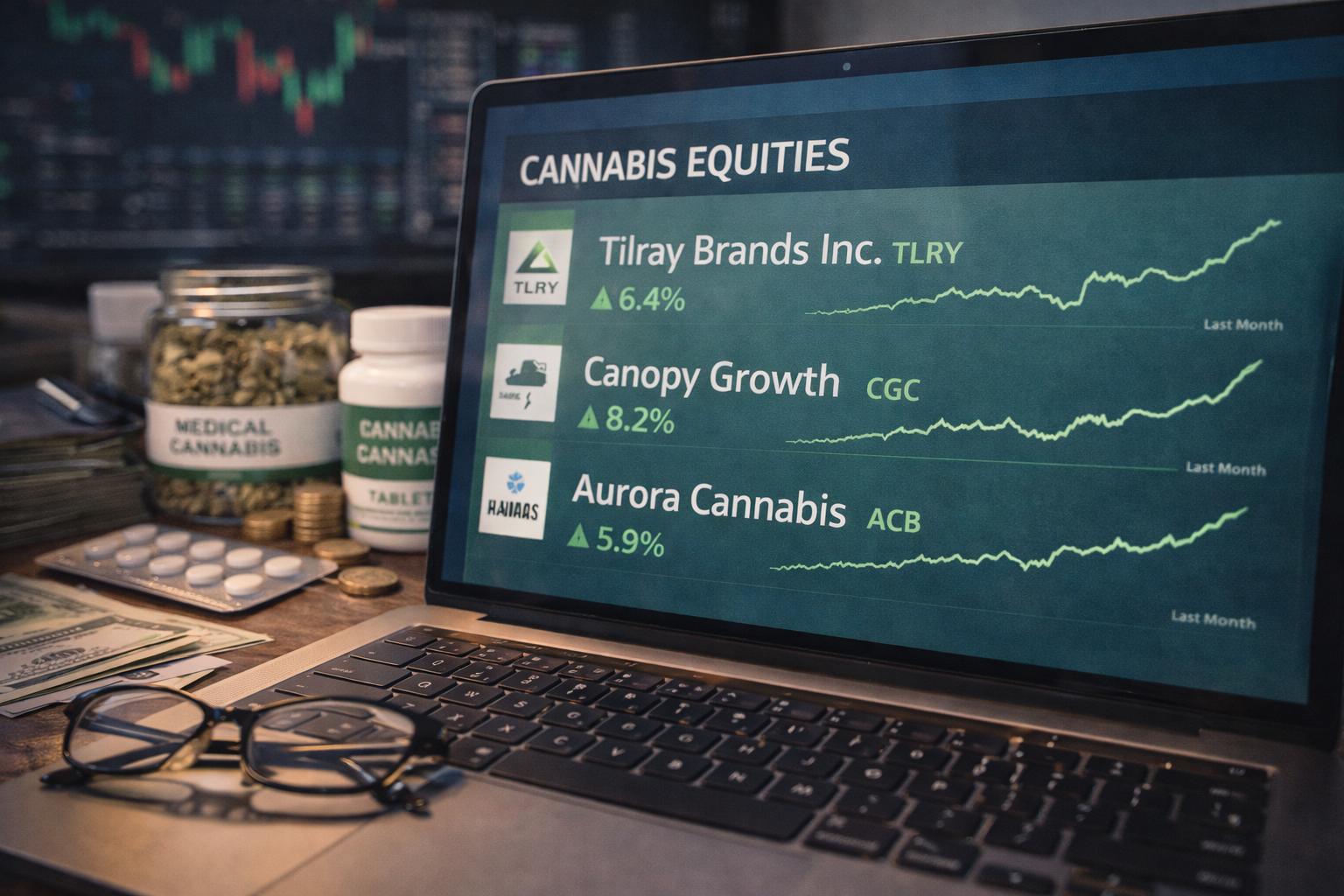
Trading desk with cannabis stock charts for TLRY CGC and ACB displayed on a laptop beside gummies oil and cash
If you are building a cannabis stocks watchlist in 2026, the real question is not which ticker looks exciting today. The real question is what rising attention in cannabis equities signals about capital flows, regulatory expectations, and where operators may see consolidation next. MarketBeat’s stock screener recently highlighted Tilray Brands, Canopy Growth, and Aurora Cannabis as names drawing elevated interest, which is a useful sentiment indicator in a sector that can swing fast on policy, pricing, and liquidity.
Quick facts
• MarketBeat highlighted Tilray Brands, Canopy Growth, and Aurora Cannabis based on the highest recent dollar trading volume among cannabis equities.
• MarketBeat noted cannabis equities remain highly volatile and sensitive to regulation and legalization shifts.
• MarketBeat’s company summaries describe Tilray as internationally active in medical cannabis, Canopy as operating multiple segments including international markets, and Aurora as operating Canadian and European cannabis segments.
• Tilray’s public filings describe a diversified operating footprint across cannabis, beverages, and wellness categories, with revenue reported in more than 20 countries.
If cannabis equities momentum affects your growth plan or partnership timing, Start with our quick Cannashield intake form so you can map exposure and plan for multiple outcomes.
Why Cannabis Equities Heat Up In Waves
Cannabis equities do not move like normal consumer stocks. They move like a mix of policy bet, supply cycle bet, and liquidity bet. When attention rises, it is often because investors are repositioning around a handful of themes:
First is federal government uncertainty. Even without a single definitive change, the market reacts to the probability of change. That can include enforcement posture, tax treatment discussions, and the general direction of national politics. The key is that uncertainty itself becomes a catalyst.
Second is the mature market supply story. Price compression and oversupply punish weak balance sheets and reward operators that can survive long enough to benefit from consolidation. When investors sense the market may be finding a floor, they hunt for liquid names that can capture the next cycle.
Third is international optionality. Europe and other regulated medical frameworks continue to pull serious interest because they look more like formal healthcare channels than retail hype. Investors often use global exposure as a proxy for durability, even when near term execution is hard.
Universal operator lesson: when capital markets get active, operators that run tight systems tend to become the acquisition targets, the partners, or the survivors.
What Screeners And Dollar Trading Volume Really Tell You
A stock screener is not a prediction machine. It is a spotlight. MarketBeat’s note that these names were selected because they had the highest recent dollar trading volume is important because dollar volume is a reality check. It tells you where attention is actually concentrated, not where people are simply talking.
For operators and service providers, the practical value is this:
High attention can signal higher sensitivity. The more a name is watched, the more it reacts to policy headlines, earnings misses, dilution, or sector wide sentiment shifts. That volatility is not only a trader problem. It affects investor conversations, vendor confidence, and even the story that decision makers tell themselves about the sector’s health.
It also signals that investors are in comparison mode. When money rotates back into cannabis equities, people start ranking companies by survivability, diversification, international scale, and ability to operate under tighter rules. That is why a watchlist moment can be useful even if you are not buying shares.
If uncertainty is affecting how you plan, negotiate, or communicate risk to partners, Complete our Cannashield questionnaire to pressure test your exposure and tighten your documentation.
How To Read Tilray, Canopy, And Aurora Without Getting Emotional
Treat these names as three different “theses” investors often chase in cannabis.
Tilray is frequently framed as diversification plus international reach. Public filings describe operations across cannabis, beverages, and wellness categories, which can matter in a sector where pure play revenue can be choppy.
Canopy is often read as a structured segments story, with MarketBeat summarizing multiple operating segments including international markets.
Aurora is often read through a medical and international lens, with MarketBeat describing segments that include European cannabis.
The operator takeaway is not to copy their exact strategy. The takeaway is to understand what investors reward in this phase: clear operating logic, repeatable execution, and a narrative that can survive scrutiny.
What This Signals For Operators In 2026
When cannabis equities attention rises, three operator realities usually follow.
One, more inbound noise. More “opportunity” conversations, more loose partnership pitches, and more advisors sliding into your inbox. The winners are the teams that can say no fast and only pursue deals that match a clear plan.
Two, more emphasis on defensible operations. Investors and partners get picky when they believe the next phase is consolidation. They want clean records, clear controls, and predictable performance.
Three, more policy watching. States still drive real market access, but federal government direction can shift the tone of capital fast. You do not need to predict outcomes, but you do need a watchlist and a scenario plan.
If you want a simple investor readiness and market watchlist template for 2026, use the Cannashield intake form to request it so your team can stay ahead without chasing headlines.
Conclusion
MarketBeat highlighting Tilray Brands, Canopy Growth, and Aurora Cannabis is less about a guaranteed outcome and more about a sentiment signal. It shows where attention is clustering and reminds operators that capital cycles can return quickly in cannabis, especially when investors believe mature markets may be stabilizing. Use the signal the right way: tighten documentation, plan scenarios, and make sure your operation looks trustworthy when the next wave of capital starts asking harder questions.
What To Do This Week
• Build a simple cannabis equities watchlist and track volume, not just price
• Read at least one recent filing for any company you reference in investor conversations
• Write a one page risk narrative for your business that covers compliance, supply chain, and cash cycle
• Review your vendor and partner documentation so it is inspection ready and diligence ready
• Map three policy catalysts that could move sentiment in your core markets
• Set a rule for capital planning that assumes volatility, not smooth growth
FAQ
Why do cannabis equities swing so hard
They are highly sensitive to policy uncertainty, market supply cycles, and liquidity shifts.What does dollar trading volume tell me
It shows where attention and liquidity are concentrated, which often correlates with bigger short term reactions to news.Does a watchlist article mean these stocks will outperform
No. It signals attention, not outcomes. Treat it as a starting point for research, not a finish line.What is the operator lesson from rising equity interest
Be ready for scrutiny. Clean documentation and consistent execution become more valuable when capital starts circling.Why does international exposure matter so much in cannabis
Regulated medical markets outside North America can offer more structured channels and long term demand signals, which investors often view as durability.How should I use this signal if I am not an investor
Use it to time readiness work: tighten controls, clarify your story, and prepare for partnership and acquisition conversations.