
White House CBD Meetings Put Federal Compliance Back In Play
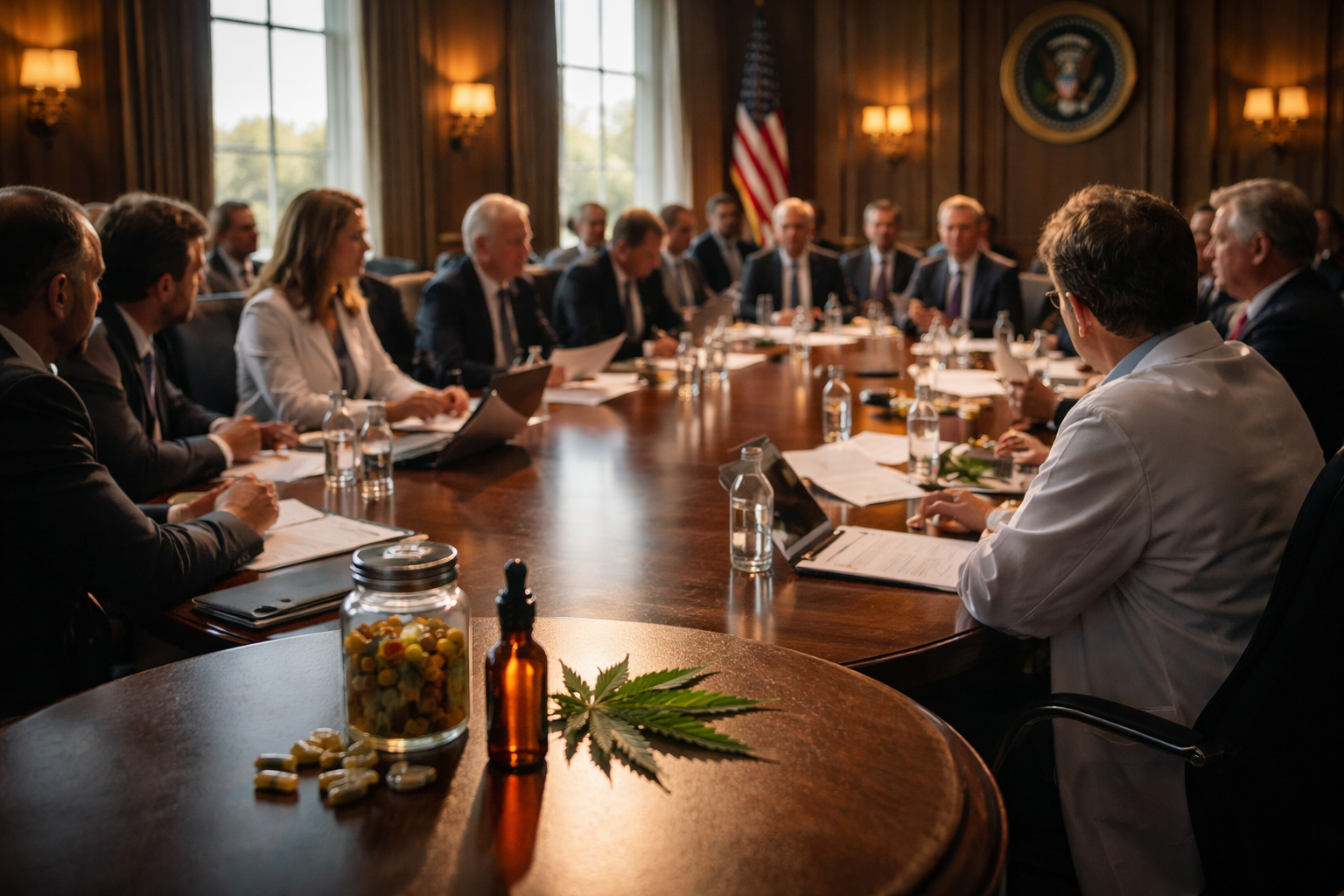
White House CBD policy meeting scene showing regulators, stakeholders, and CBD products during a federal compliance review.
Federal CBD compliance is moving from background noise to active federal review. The White House Office of Information and Regulatory Affairs is reviewing an FDA item titled Cannabidiol (CBD) Products Compliance and Enforcement Policy, which Reginfo shows was received on March 13, 2026. OIRA has now scheduled four stakeholder meetings for April 1 and April 2. That does not tell the market what the final policy will say, but it is a real federal government signal that CBD compliance and enforcement planning is moving again. For operators, the issue is practical: labels, claims, product files, and distribution decisions may face sharper scrutiny once the federal posture becomes clearer.
Quick facts
• Reginfo lists the FDA item under RIN 0910 ZC82 and classifies it as a notice stage review pending at OIRA.
• OIRA has four scheduled meetings on this item: April 1 at 3:00 PM, April 1 at 3:30 PM, April 2 at 10:00 AM, and April 2 at 11:00 AM.
• The listed requestors are David Heldreth, Trent Woloveck, Earl Ramey, and Story Cannabis requestor Mackie Barch.
• FDA said in 2023 that existing food and dietary supplement pathways were not appropriate for CBD and that a new regulatory pathway was needed.
• FDA also said possible safeguards could include clear labels, prevention of contaminants, CBD content limits, and measures to reduce child access.
If federal CBD compliance uncertainty is affecting your product mix or distribution plan, Start with our quick Cannashield intake form so you can map labeling, claims, and channel exposure before the federal government makes the next move.
Why This Matters Before The Policy Is Public
At the federal level, process matters because process is where priorities start turning into enforceable posture. OIRA review means this issue has moved into formal White House review instead of staying stuck in general agency discussion. The four scheduled meetings also show that outside stakeholders are actively trying to shape the outcome before the policy is finalized. The operator lesson is simple: when Washington starts scheduling multiple meetings around an enforcement policy, smart companies clean up the file before the memo lands.
This matters because the policy title itself is about compliance and enforcement, not expansion. That does not automatically mean the federal government will shut the door on CBD products, but it does mean operators should not assume this process is about opening a wider lane. A more realistic reading is that the federal government is working through how it wants to supervise product quality, labels, claims, and market behavior. That final sentence is an inference based on the official policy title and FDA’s earlier public statements about safeguards and oversight. [CBD Labeling and Claims Checklist] [Retail Product File Review]
What FDA Has Already Told The Market
FDA’s 2023 statement still matters because it is the clearest public marker of the agency’s last formal position on CBD. The agency said it concluded that existing frameworks for foods and dietary supplements were not appropriate for cannabidiol, that it did not intend to pursue rulemaking allowing CBD in dietary supplements or conventional foods under the existing framework, and that a new regulatory pathway was needed. FDA also said it would continue taking action against CBD and other cannabis derived products when appropriate.
That earlier statement tells operators what federal reviewers have already been worried about for years. FDA pointed to labels, contaminants, CBD content limits, and measures to reduce child access as possible tools in a future pathway. In plain English, the federal issue has never been just access. It has been access plus controls. [Cannabis Documentation Controls] [CBD Distribution Risk Review]
If you want to pressure test labels, claims, and supplier records before federal priorities get sharper, use our Cannashield questionnaire and request a CBD documentation review.
The Real Exposure Is Labels Claims And Distribution
Most companies hear “CBD enforcement policy” and think about warning letters or product seizures. The bigger exposure is operational. What does the label say. What claims are on the website. What records sit behind each product. Which channels are carrying the inventory. A clearer federal enforcement posture could reshape how companies think about what can be sold, where it can be sold, and how aggressively it can be marketed. That is an inference based on the pending enforcement policy title and FDA’s earlier focus on labels, contaminants, content limits, and child access.
This is the universal operator lesson. If a product only works commercially because the rules are blurry, it is sitting on unstable ground. Operators that separate clean files from messy files now will usually be in a stronger position than operators who wait for the federal government to explain everything for them. That is practical guidance inferred from the current OIRA review and FDA’s prior public position. [Retail Compliance Checklist] [CBD Channel Risk Review]
What Smart Operators Should Do Now
Strong operators are not waiting for a public policy document to start acting. They are reviewing labels, health and wellness claims, ingredient disclosures, test records, packaging, age gating, and channel strategy right now. They are also making sure sales teams and retail partners are not promising more than the documentation can support. That is practical guidance inferred from FDA’s stated concerns and the current White House review process.
If uncertainty around CBD claims, labels, or distribution is affecting how you plan inventory or sales channels, Complete our quick Cannashield intake form so you can identify weak spots before the federal government sets a clearer enforcement line.
Conclusion
The White House meetings do not create new CBD rules by themselves. But four scheduled OIRA meetings in two days around a pending FDA compliance and enforcement policy are a real federal government signal that the CBD file is moving again. Operators should treat that signal for what it is: a chance to tighten labels, claims, and product records before federal clarity arrives on someone else’s timeline.
Educational note: This article is for education only and is not legal, regulatory, or insurance advice.
What To Do This Week
• Pull your top CBD products and review each label line by line.
• Flag any health, wellness, or therapeutic claim that is hard to support.
• Confirm you have current test records, supplier files, and ingredient details for every major product.
• Separate products by sales channel so you know exactly what is sold where.
• Review packaging for age concerns, child appeal, and unclear serving information.
• Build a simple response file for regulators, retail partners, or distributors.
FAQ
What happened at the White House level?
OIRA scheduled four meetings on April 1 and April 2 to discuss the FDA item titled Cannabidiol (CBD) Products Compliance and Enforcement Policy.
Does this mean new CBD rules are final?
No. The official record shows a pending review and scheduled meetings, not a final public policy.
Why should operators care now?
Because a clearer federal compliance and enforcement posture could affect labels, claims, distribution choices, and product documentation. That is an inference based on the policy title and FDA’s prior statements about safeguards and oversight.
What has FDA already said about CBD?
FDA said in 2023 that existing food and dietary supplement pathways were not appropriate for CBD and that a new pathway was needed.
Did FDA mention specific risk controls?
Yes. FDA cited clear labels, contaminant prevention, CBD content limits, and measures to reduce child access as possible safeguards.
What should businesses review right now?
Labels, product claims, test records, supplier files, packaging, and sales channel strategy are the big ones to review before federal priorities get clearer. This is practical guidance inferred from FDA’s stated concerns and the current review.