
First Responder PTSD Treatment Is Becoming A Cannabis Policy Issue
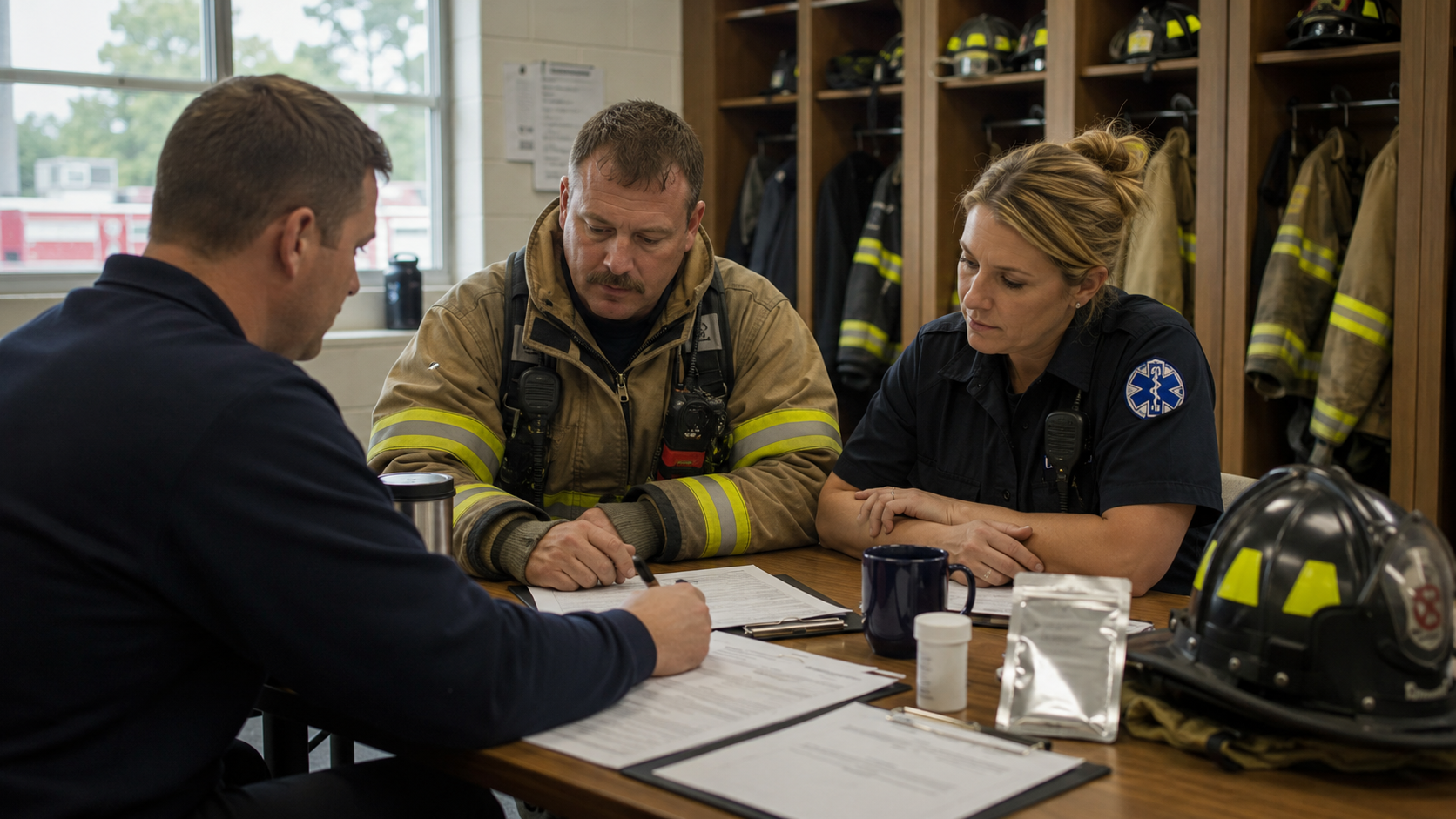
Firefighter and EMS workers reviewing PTSD treatment paperwork
Medical cannabis access is becoming part of a larger workforce wellness conversation for first responders. Marijuana Moment, via Stateline, reports that states are expanding protections and treatment pathways for firefighters, emergency medical workers, police officers, rescue workers, and military veterans dealing with PTSD and trauma related conditions. Maryland enacted medical cannabis employment protections for certain fire and rescue public safety employees, while Connecticut expanded a psychedelic assisted therapy pilot program and Missouri lawmakers advanced supervised research legislation before the session ended. For operators, employers, healthcare providers, compliance teams, and public safety workers, this is a clear signal that cannabis policy is moving into workplace health, impairment, and patient access territory.
Quick facts
• States are expanding treatment pathways for first responders dealing with PTSD and trauma exposure
• Maryland enacted employment protections for certain fire and rescue public safety employees who are registered medical cannabis patients
• Maryland’s law goes into effect October 1, 2026
• The Maryland law protects lawful off duty medical cannabis use, but does not protect impairment at work
• Ohio created a Post Traumatic Stress Injury Commission to review treatment assistance applications from eligible first responders
• Connecticut expanded its psychedelic assisted therapy pilot program beyond veterans, retired first responders, and direct care health workers
• Missouri lawmakers advanced a bill on supervised psilocybin and ibogaine research for veterans and first responders, but the session ended before final passage
• The universal operator lesson is simple: medical cannabis access is becoming a workforce policy issue, not just a patient access issue
If medical cannabis employment protections or workplace impairment rules are affecting your organization, start our quick Cannashield intake form so you can map policy, compliance, and insurance exposure before employee access creates confusion.
Why this story matters
This story matters because first responders face trauma exposure that most workplaces never see. Firefighters, EMS workers, police officers, rescue personnel, and military veterans may experience repeated exposure to fatal crashes, violence, injuries, death, and emergency scenes. That can create long term mental health strain, including PTSD, anxiety, depression, sleep issues, and chronic pain.
Lawmakers are now being pushed to recognize that traditional counseling and standard medication pathways may not be enough for every worker. Some states are responding with medical cannabis protections. Others are funding treatment assistance or researching emerging therapies. The common thread is that public safety workforce wellness is becoming a policy priority.
For cannabis operators and employers, that creates a new compliance lane. Access rules, workplace rules, drug testing, impairment standards, and employee protections need to be handled carefully.
Why Maryland’s law is important
Maryland’s approach is important because it focuses on employment protection. The state enacted a law prohibiting employers from taking certain discriminatory employment actions against fire and rescue public safety employees based on lawful medical cannabis use, subject to conditions. The protection applies to registered medical cannabis patients who test positive for cannabis metabolites but are not impaired while working.
That distinction matters. A positive test does not always show current impairment. Cannabis metabolites can remain detectable after use, creating problems for employees who use medical cannabis legally outside work. Maryland’s law tries to separate off duty medical use from on duty impairment.
This is the universal operator lesson. Cannabis employment policy cannot rely only on old testing logic. Employers need impairment based procedures, clear documentation, and role specific safety rules.
Why employers need clearer rules
Public safety employers face a difficult balance. They need to support worker mental health and lawful medical treatment, but they also have safety sensitive duties. Firefighters, EMTs, paramedics, police officers, and rescue personnel cannot be impaired while responding to emergencies. That means policies need to distinguish between lawful medical use, positive test results, impairment signs, fitness for duty, and safety risk.
Employers should review written policies, supervisor training, employee reporting procedures, reasonable suspicion documentation, return to duty rules, and accommodations. They should also avoid making broad promises that medical cannabis use will always be protected. The details matter by state, role, timing, and whether impairment is involved.
For operators and insurers, this is where employment practices, workers compensation, liability, and workplace safety begin to overlap.
Why emerging therapies are part of the same conversation
The Stateline report also connects cannabis policy to a broader mental health treatment conversation. Connecticut expanded its Yale connected psychedelic assisted therapy pilot program to allow any state resident age 18 or older to participate if they meet clinical eligibility criteria. Missouri lawmakers advanced a bill that would have allowed veterans and first responders in approved research studies to receive psilocybin and ibogaine under medical supervision for PTSD and other conditions, but the bill did not reach the governor before adjournment.
That does not mean these therapies are broadly available everywhere. It means states are exploring more treatment pathways for trauma exposed workers. For healthcare providers and compliance teams, that reinforces the need for careful patient screening, clinician oversight, documentation, and safety controls.
If you need to organize workplace cannabis policy, patient access guidance, and insurance records before laws change in your state, use the Cannashield intake form to identify weak points and build a cleaner compliance file.
Conclusion
States are starting to treat first responder PTSD as a workforce wellness and access issue. Maryland’s medical cannabis employment protections, Ohio’s treatment assistance structure, Connecticut’s expanded research program, and Missouri’s proposed supervised therapy research all point in the same direction. Lawmakers are looking for ways to support trauma exposed workers while still protecting workplace safety.
For operators, employers, healthcare providers, insurers, and compliance teams, the message is simple. Medical cannabis policy is moving into employment, impairment, and public safety. The businesses and agencies that prepare early will be better positioned than those waiting for a dispute, claim, or failed drug test to force the issue.
Educational note: This article is for education only and is not legal, regulatory, medical, employment, tax, financial, or insurance advice. Workers should speak with qualified healthcare providers and employers should consult counsel before changing workplace policies.
What to do this week
• Review whether your state protects off duty medical cannabis use for first responders or safety sensitive employees
• Update workplace policies to separate lawful medical use, positive tests, and actual impairment
• Train supervisors on reasonable suspicion documentation and fitness for duty procedures
• Review employee accommodation, return to duty, and reporting workflows
• Watch state legislation tied to PTSD treatment, medical cannabis protections, and emerging therapy programs
• Build a short internal memo on workforce wellness, impairment risk, employment protections, and insurance exposure
FAQ
What is changing for first responders?
Some states are expanding medical cannabis protections, treatment funding, and emerging therapy research for first responders dealing with PTSD and trauma exposure.
What did Maryland do?
Maryland enacted employment protections for certain fire and rescue public safety employees who are registered medical cannabis patients using cannabis lawfully off duty.
Does Maryland’s law protect impairment at work?
No. The law protects certain lawful off duty medical cannabis use, but it does not protect employees who are impaired while working.
Why does this matter to employers?
Employers need policies that distinguish between lawful medical use, positive cannabis tests, actual impairment, and safety sensitive job duties.
What are Connecticut and Missouri doing?
Connecticut expanded a psychedelic assisted therapy pilot program, while Missouri lawmakers advanced but did not pass a bill for supervised psilocybin and ibogaine research involving veterans and first responders.
What is the biggest operator takeaway?
Medical cannabis access is becoming part of workforce wellness, so operators and employers need stronger policies around impairment, employment protections, patient access, and compliance.

Firefighter reviewing PTSD cannabis treatment options and workplace protections
You might also like


SOURCES
Marijuana Moment, States Move To Let First Responders Use Cannabis And Psychedelics To Treat PTSD
https://www.marijuanamoment.net/states-move-to-let-first-responders-use-marijuana-and-psychedelics-to-treat-ptsd/
Stateline, More states expand PTSD treatment options for first responders
https://stateline.org/2026/06/30/more-states-expand-ptsd-treatment-options-for-first-responders/
Maryland General Assembly, SB0439 Employment Discrimination Fire and Rescue Public Safety Employees Use of Medical Cannabis
https://mgaleg.maryland.gov/mgawebsite/Legislation/Details/SB0439?ys=2026RS

Trulieve and Cronos have each gained roughly 27 percent in 2026 while reporting stronger operating results. The broader signal is that public market attention is increasingly rewarding cash generation, improving margins, liquidity, and measurable revenue growth.