
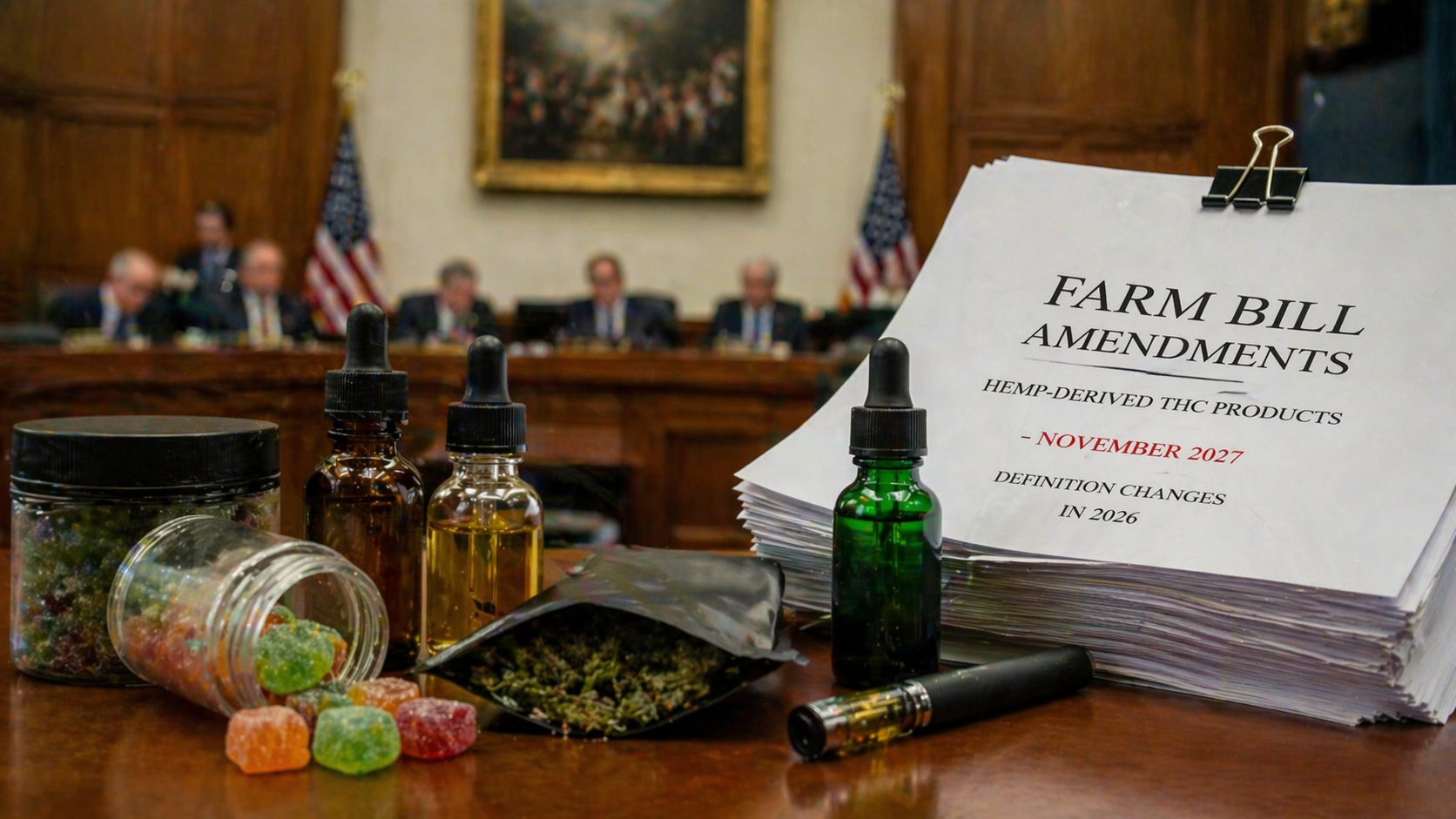
Hemp derived THC products displayed beside congressional amendment paperwork, showing efforts to delay a federal crackdown and tighten hemp definitions.
The federal hemp THC crackdown may not arrive on the timetable many operators feared. Republican lawmakers have filed Farm Bill amendments that would delay the scheduled federal push against hemp derived THC products, including one proposal that would move the effective ban timeline to November 2027. That matters because many businesses have been planning around a much tighter runway. It also matters because the newer federal definition changes expected later in 2026 could still narrow what counts as legal hemp, even if lawmakers buy the industry more time.
If federal hemp timing affects your growth plan, Start with our quick Cannashield intake form so you can map exposure and plan for multiple outcomes.
Quick facts
• Republican lawmakers filed Farm Bill amendments aimed at delaying the scheduled federal crackdown on hemp derived THC products.
• One proposal would push the effective ban timeline to November 2027.
• The broader federal direction still points toward tighter rules for hemp derived THC products.
• Newer hemp definition changes later in 2026 could narrow what qualifies as legal hemp.
• The universal operator lesson is simple: a revenue stream that depends on a gray area can become an enforcement target fast.
This is really a timing fight
At a basic level, this is a fight over timing more than a fight over whether federal pressure is coming. The amendments show that some lawmakers want to avoid an abrupt market shock by giving hemp businesses more time to adjust. That does not mean the sector is safe. It means there is still a live debate over how quickly Washington should tighten the rules.
For operators, that distinction matters. A delayed crackdown can feel like relief, but it is not the same as stability. If your product mix depends heavily on intoxicating hemp products, a delay gives you more room to plan, not a permanent green light. Too many businesses confuse extra time with long term security. That is where mistakes get expensive.
Why the 2026 definition changes still matter
Even if the ban timeline gets pushed, the newer federal definition changes expected later in 2026 could still tighten the market in a meaningful way. That is the part many people miss. The headline may focus on delay, but the deeper risk sits in how hemp is defined. Once the definition gets narrower, products that previously looked compliant may fall into a far more exposed position.
That creates a practical business problem. Many companies are not just selling gummies. They are selling a full menu that may include tinctures, flower, vapes, and other hemp derived THC products. If the legal definition changes, the issue is not just whether one item stays on the shelf. It is whether your testing, labeling, sourcing, and revenue model still hold together under the new standard.
If uncertainty is affecting how you plan or negotiate, Complete our quick Cannashield intake form to pressure test your product, inventory, and distribution exposure.
The real business lesson is about dependency
The biggest lesson here is not political. It is operational. If a large share of your revenue depends on a category sitting in a federal gray zone, you need a backup plan before the rules force one on you. The businesses that survive this kind of policy shift are usually the ones that already know which products carry the most risk, which channels are most exposed, and what revenue can be replaced if the market tightens.
This is especially important for retailers and manufacturers that have treated hemp derived THC as an easy growth lane. Easy growth can disappear quickly when law, enforcement, and product definitions start moving at the same time. A business that has not mapped that risk can get trapped between unsellable inventory, confused customers, and partners who suddenly turn cautious.
What smart operators do next
Smart operators should treat this moment like a warning, not a victory lap. A delayed ban can buy time to diversify product lines, review vendor relationships, upgrade compliance files, and rethink how much of the business depends on policy ambiguity. It can also be the right time to tighten internal documentation so testing records, product descriptions, and sourcing standards are easier to defend if scrutiny rises.
If you wait for final federal action before getting organized, you are already late. The better move is to use the current uncertainty to strengthen the business while there is still room to pivot.
If policy uncertainty is shaping inventory, cash flow, or product strategy, Complete our quick Cannashield intake form so you can identify weak points before the rules do it for you.
You might also like


Conclusion
These Farm Bill amendments matter because they show the federal hemp debate is still fluid. But the bigger signal is not that the industry is safe. It is that operators are being warned in real time that the lane may narrow, and fast. Whether the crackdown comes sooner or later, the businesses in the strongest position will be the ones that used this window to prepare rather than assume the market would stay open forever.
Educational note: This article is for education only and is not legal, regulatory, tax, or insurance advice.
What To Do This Week
• Review which products depend most heavily on the current hemp definition.
• Build two forecasts, one if the crackdown is delayed and one if rules tighten on the current path.
• Recheck testing and labeling records for hemp derived THC products.
• Identify how much revenue comes from gummies, tinctures, flower, and vape products separately.
• Talk with suppliers about how they are preparing for tighter federal definitions.
• Create one internal memo that explains your hemp product exposure in plain language.
FAQ
What are lawmakers trying to do?
Republican lawmakers filed Farm Bill amendments that would delay the scheduled federal crackdown on hemp derived THC products.
How far could the delay go?
One proposal would push the effective timeline to November 2027.
Does a delay mean the market is safe?
No. A delay only gives operators more time. It does not remove the broader federal pressure.
Why do the 2026 definition changes matter?
Because tighter definitions can shrink what qualifies as legal hemp, even before or apart from a ban timeline.
Who should pay attention most?
Retailers, manufacturers, and distributors with heavy exposure to hemp derived THC products.
What is the universal operator lesson?
Do not build your entire growth model on a category that depends on federal ambiguity staying in place.

Trulieve and Cronos have each gained roughly 27 percent in 2026 while reporting stronger operating results. The broader signal is that public market attention is increasingly rewarding cash generation, improving margins, liquidity, and measurable revenue growth.