

Los Angeles Cannabis Tax Amnesty Program Signals A Compliance Reset Moment
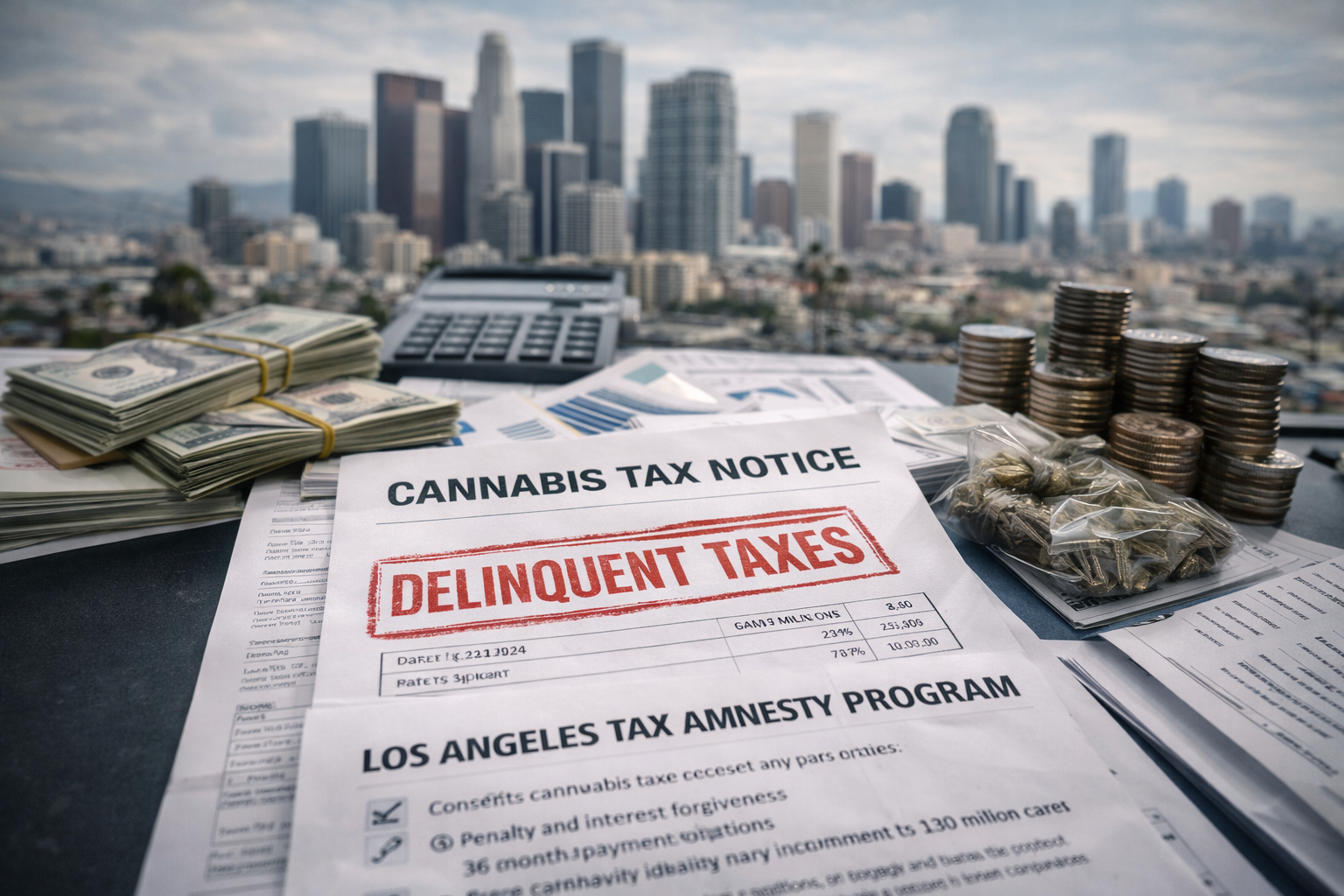
Los Angeles cannabis tax amnesty concept with overdue tax paperwork and money on a desk
Los Angeles cannabis tax pressure is no longer a background issue. A proposed Los Angeles cannabis tax amnesty program is designed to pull delinquent operators back into compliance by forgiving penalties and interest for participants and allowing up to 36 months to pay what they owe. For operators, this is not a free pass. It is a market signal that the city is trying to stabilize the legal channel while tightening the expectations around who is actually paying.
Quick facts
• Los Angeles Office of Finance reported 738 licensed, registered cannabis business accounts
• More than 500 accounts were reported delinquent, with about $400 million in outstanding taxes, including about $35 million in interest and about $100 million in penalties
• Office of Finance noted only about $150 million may be collectible due to time limits and inactive accounts
• The Council direction calls for a program with full waiver of penalties and interest and installment agreements for up to 36 months
• Businesses would need to sign an agreement, provide missing gross receipts information, and stay current on both installment payments and ongoing monthly taxes
• The city treasurer projected the city could receive as little as $30 million through the program
If you have exposure to Los Angeles cannabis business taxes, Start with our quick Cannashield intake form so you can map gaps and prioritize fixes.
Why Los Angeles Is Offering Amnesty Now
The city is dealing with a simple math problem. A huge portion of the licensed ecosystem is delinquent, and a meaningful slice of the headline balance is not realistically collectible due to age, closures, or stale accounts. The Office of Finance framed the cannabis environment as extremely challenging, with high tax burden and widespread noncompliance feeding the illegal channel, which makes strict collection feel like a blunt instrument when businesses are already struggling.
For the city, amnesty is a bet on recovery and clarity. It attempts to separate operators who will come into compliance from operators who will not, while creating a cleaner enforcement narrative. For the market, it is a reminder that local taxes can become the sharpest lever a city has, especially when the legal channel is under stress.
Universal operator lesson: when taxes start stacking up across hundreds of accounts, cities look for a reset tool first, then enforcement leverage second.
How The Proposed Amnesty Would Work
The program is structured like a compliance contract, not a handshake. The Office of Finance outlined an amnesty agreement that requires missing tax filings to be completed and missing gross receipts information to be provided. Once the agreement is executed, the amount due becomes a legally enforceable liability.
There are also teeth in the process:
• Penalties and interest are tied to performance, not intention. Waivers are connected to meeting the payment terms.
• Down payments matter. Installment agreements include a down payment that must be made for the agreement to be effective.
• Staying current is the real test. Missing an installment payment or missing an ongoing monthly business tax payment can terminate the agreement, which cancels the amnesty and makes amounts due enforceable immediately.
• Audits are part of the risk. The Office of Finance stated businesses that have not been audited in the last two years may be audited, and the audit could change the liability.
The key change that makes this proposal feel more like a lifeline is the term. The Budget and Finance Committee direction calls for installment agreements up to 36 months, paired with full waiver of penalties and interest.
If you are considering an amnesty path, Complete our Cannashield questionnaire to pressure test your documentation, filing gaps, and payment plan reality before you sign anything.
What This Signals For Operators In Los Angeles And Beyond
For Los Angeles operators, the message is that the city is prioritizing legal market stability, but it is also drawing a line around tax behavior. A structured amnesty program creates a list of who raised their hand to comply. That makes future enforcement easier to justify.
For operators outside Los Angeles, this is still relevant. Municipal taxes are increasingly the pressure point in high cost markets, and when delinquency gets widespread, cities tend to consider the same playbook: limited time relief, installment plans, and stronger enforcement posture afterward.
Universal operator lesson: do not treat local taxes as a quarterly cleanup task. Treat them like a monthly operating system, because cities will eventually force the issue.
How To Use Amnesty Without Getting Trapped
If you are delinquent, the goal is to turn chaos into a plan. Do not enter an agreement based on hope.
Start by reconciling your real exposure. Separate tax owed, penalties, and interest. Confirm what periods are missing filings. Confirm what periods are estimates versus actual gross receipts. Then build a payment plan that assumes you will still need to pay current taxes on time while the installment plan runs.
Also protect your operations. If you miss a payment and the agreement terminates, you may end up worse off than before because the liability becomes enforceable and the compliance narrative flips fast.
If you want a monthly tax compliance checklist and a simple document folder structure your team can follow, use our Cannashield intake form to request it.
Conclusion
Los Angeles is signaling a reset moment. The city wants to recoup what it can, bring operators into compliance, and strengthen the legal channel against the illegal market. For operators, the lesson is straightforward: amnesty is a structured compliance agreement, and the winners will be the ones who use it to build a repeatable tax discipline system, not just to survive one deadline.
What To Do This Week
• Pull your Los Angeles cannabis business tax account history and list every missing filing period
• Separate principal tax owed from penalties and interest so you know what a waiver actually changes
• Build a cash plan that covers both installment payments and ongoing monthly taxes
• Centralize gross receipts support documents and keep them ready for audit questions
• Draft an internal policy for who approves tax payments and when, so payments are not missed
• Create a one page escalation plan for notices, deadlines, and payment issues
FAQ
What is the Los Angeles cannabis tax amnesty program trying to do
It is designed to bring delinquent licensed operators back into compliance by offering relief on penalties and interest in exchange for a structured payment plan.How long would businesses have to pay
The Council direction calls for installment agreements of up to 36 months.How large is the delinquency problem
The Office of Finance reported more than 500 delinquent accounts and about $400 million in outstanding taxes, interest, and penalties, with only a portion likely collectible.What happens when a business signs an amnesty agreement
The Office of Finance said the amount due becomes a legally enforceable liability once the agreement is executed, and missing filings and gross receipts reporting must be addressed.Can a business lose the amnesty benefit
Yes. Missing required installment payments or missing ongoing monthly business tax payments can terminate the agreement and cancel the amnesty.What is the universal operator lesson for other cities
When a city uses amnesty to stabilize compliance, operators should treat it as a signal to tighten documentation and build a monthly tax discipline system before enforcement escalates.