

Legal Cannabis Industry Sheds Jobs For The First Time
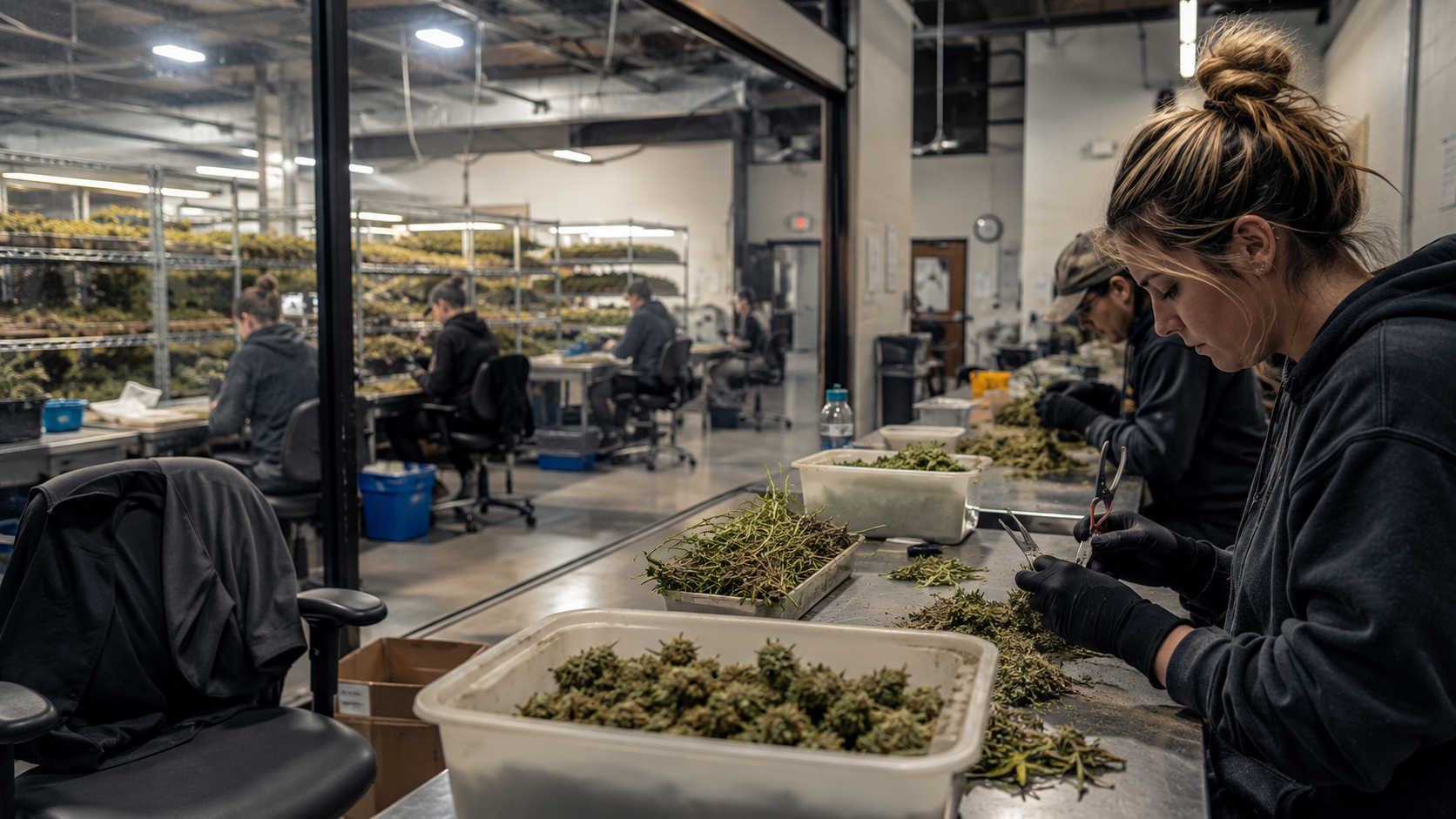
Cannabis processing team trimming flower under labor pressure
The U.S. legal cannabis industry is sending a new signal. MJBizDaily reports that the legal cannabis workforce fell for the first time, with 412,500 jobs in early 2026, down 2.7 percent from the prior year. Retail revenue also slipped to $29.1 billion in 2025, showing that the regulated market is no longer in easy expansion mode. For operators, cultivators, retailers, manufacturers, investors, and compliance teams, this is a high intent warning sign. Cannabis business growth is still possible, but it now depends more on efficiency, cost control, and disciplined market positioning than simple market momentum.
Quick facts
• The U.S. legal cannabis workforce fell to 412,500 jobs in early 2026
• That was down 2.7 percent from the prior year
• MJBizDaily reported this was the first annual decline in legal cannabis jobs
• U.S. legal cannabis retail revenue fell to $29.1 billion in 2025
• The article points to price compression, oversupply, higher costs, and mature market slowdown
• Emerging states such as New York, Maryland, and Ohio are helping offset losses in older markets
• The universal operator lesson is simple: when a cannabis market matures, labor efficiency and margin discipline become survival issues
If workforce pressure or slowing revenue is affecting your growth plan, complete our quick Cannashield intake form so you can map labor, compliance, and insurance exposure before margin pressure turns into a deeper operating problem.
Why this jobs decline matters
This decline matters because it breaks one of the industry’s favorite narratives. For years, legal cannabis was defined by job creation and rapid expansion. More stores, more cultivation, more markets, and more hiring all pointed in the same direction. A workforce decline changes that tone. It suggests the legal market is becoming leaner and more selective.
That does not mean the industry is collapsing. It means the easy phase is ending. Mature markets tend to reward operational discipline more than raw growth. Businesses that once staffed up for expansion may now be cutting hours, reducing headcount, or delaying hiring while they protect cash flow. In a lower margin environment, payroll becomes one of the first line items to face pressure.
Why mature markets are getting squeezed
The core issue is not jobs alone. Jobs are the result of a broader financial squeeze. MJBizDaily points to price compression, oversupply, higher costs, and mature market slowdown. Those pressures are especially difficult in states where competition is heavier, wholesale prices have fallen, and operators are still dealing with taxes, compliance costs, rent, and debt.
When product prices fall faster than operating costs, even businesses with decent sales can feel weak. A company may be selling more units and still feeling worse financially if labor, utilities, security, packaging, taxes, and financing remain high. That is why layoffs and staffing cuts matter so much. They are often a symptom of margin stress, not just weak demand.
This is the universal operator lesson for the national market. Revenue does not protect a business if the underlying economics are getting worse.
If uncertainty around payroll, staffing, taxes, or cost control is affecting how you plan, complete our Cannashield questionnaire to pressure test your exposure before a softer market forces more aggressive cuts.
Why emerging states still matter
One important point in the story is that newer markets are still helping carry the industry. MJBizDaily notes that states like New York, Maryland, and Ohio are offsetting some of the losses coming from older markets. That matters because growth has not disappeared. It has shifted.
For operators and investors, the opportunity is no longer simply “cannabis is growing everywhere.” The better question is where growth is still healthy and whether a company is positioned to participate without overextending itself. Emerging markets can create strong upside, but they also require licensing strategy, capital discipline, local knowledge, and patience. Chasing growth without a plan can create new problems instead of solving old ones.

Cannabis compliance paperwork and market access review in North Carolina
Why efficiency is becoming the new advantage
The next phase of cannabis will likely belong to operators that can run tighter businesses. That means cleaner labor planning, better inventory control, smarter purchasing, stronger vendor relationships, and sharper attention to margin by product line. It also means being realistic about expansion. In a mature market, a business that opens too fast or staffs too aggressively can create its own financial stress.
Efficiency does not sound as exciting as growth, but it often matters more when the market tightens. Investors, lenders, and landlords should be paying attention to this shift too. A business that looks busy on the surface may still be under serious strain if its payroll, tax obligations, and cost structure are out of balance.
If you need to organize payroll, tax, operational, and insurance records before efficiency pressure gets worse, use the Cannashield intake form to identify weak points and build a clearer operating plan.
You might also like


Conclusion
The first annual decline in legal cannabis jobs is a meaningful market signal. It shows that the regulated industry is becoming more mature, more competitive, and less forgiving. Retail revenue softness, oversupply, and cost pressure are forcing businesses to make harder decisions about labor, growth, and efficiency.
For operators, cultivators, retailers, manufacturers, investors, and compliance teams, the message is simple. Cannabis is still a growth industry in some places, but it is no longer an easy growth industry everywhere. The businesses most likely to hold up will be the ones that manage labor carefully, protect margin, and treat operational discipline like a competitive advantage.
Educational note: This article is for education only and is not legal, regulatory, tax, financial, employment, or insurance advice.
What To Do This Week
• Review payroll trends and identify whether labor costs are rising faster than gross profit
• Compare current product margins against last year to see where price compression is hitting hardest
• Recheck inventory turnover and purchasing discipline to avoid tying up cash in slow moving stock
• Review tax, rent, and debt obligations alongside staffing plans
• Evaluate whether growth assumptions still fit current market conditions
• Build a short internal memo on labor efficiency, margin pressure, and market positioning
FAQ
What happened to legal cannabis jobs in 2026?
MJBizDaily reported that legal cannabis jobs fell to 412,500 in early 2026, down 2.7 percent from the prior year.
Why is this important?
It marks the first annual decline in legal cannabis jobs and suggests the market is becoming leaner and more mature.
What happened to cannabis retail revenue?
Retail revenue fell to $29.1 billion in 2025, adding to the pressure on operators.
What is driving the slowdown?
The article points to price compression, oversupply, higher costs, and slowdown in mature markets.
Are there still growth markets in cannabis?
Yes. Emerging states such as New York, Maryland, and Ohio are helping offset weakness in older markets.
What is the biggest operator takeaway?
Cannabis businesses now need stronger labor discipline, tighter margins, and more selective growth strategies.
SOURCES
MJBizDaily, Legal cannabis industry sheds jobs for first time
https://mjbizdaily.com/news/legal-cannabis-industry-sheds-jobs-for-first-time/616528/
New York Office of Cannabis Management
https://cannabis.ny.gov/
Ohio Division of Cannabis Control
https://com.ohio.gov/divisions-and-programs/cannabis-control

A federal crackdown could reshape an estimated $28 billion hemp THC market as businesses prepare for product restrictions, stranded inventory, reformulation costs, and major revenue disruption. Tennessee offers an early example of how quickly farmers, manufacturers, and retailers may need to pivot.