

Massachusetts Regulators Consider A Temporary Cannabis Licensing Freeze
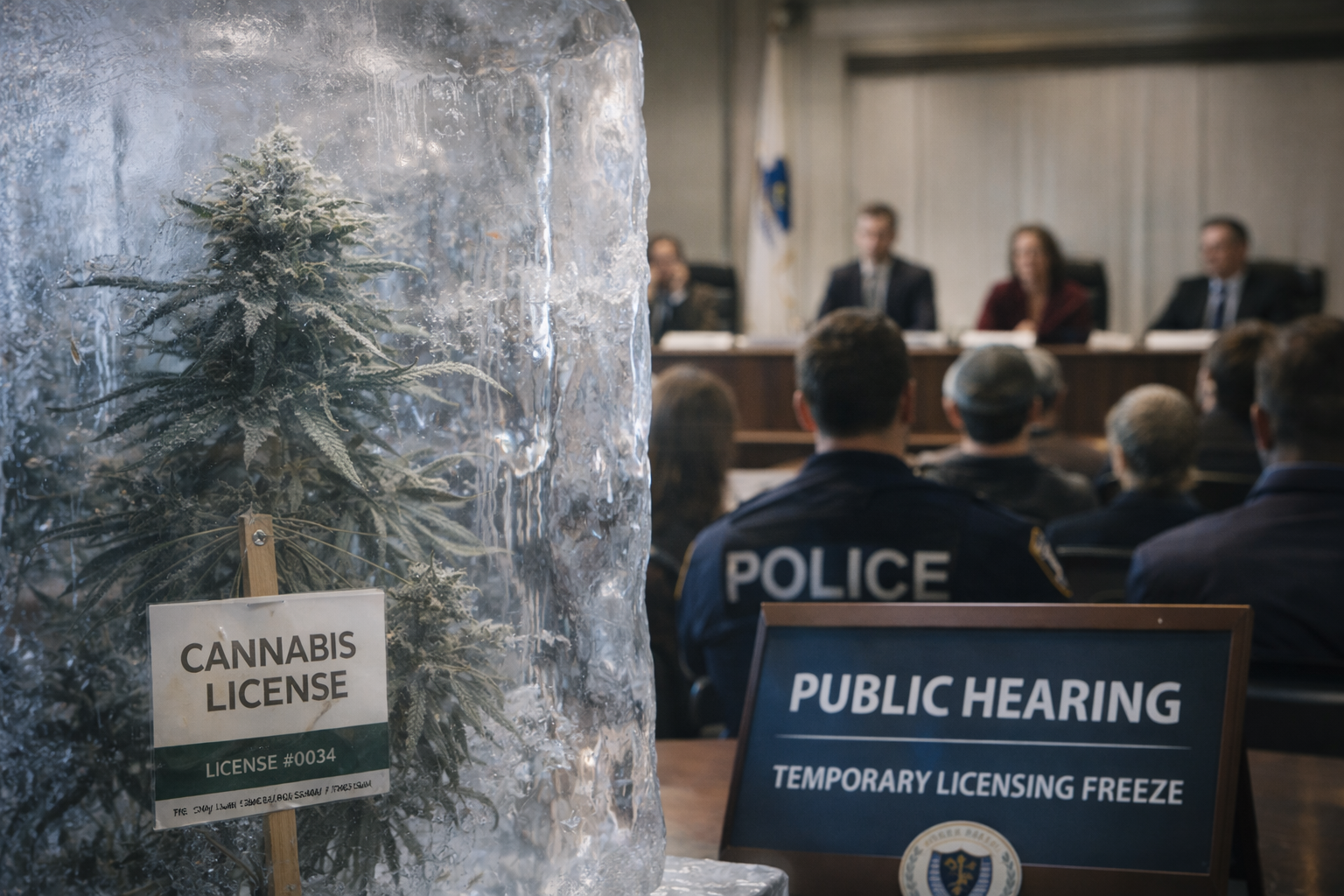
Cannabis licensing freeze hearing in Massachusetts showing regulators police and a cannabis license sign
Massachusetts regulators are openly discussing a temporary cannabis licensing freeze, a clear sign that mature markets will step in when supply outpaces demand. The Massachusetts Cannabis Control Commission voted to schedule a public hearing to consider pausing new cultivation licenses and temporarily stopping approvals that expand canopy, with the goal of stabilizing a market facing extreme price compression.
Quick facts
• The Commission voted to schedule a public hearing on a potential freeze of new cultivation licenses and a temporary moratorium on approving additional canopy capacity
• Testimony may also cover whether other license types should be frozen, including craft cooperatives, product manufacturing, and microbusinesses
• The average retail price for an ounce of flower was reported at a record low $113.68 in December, down from $401.43 in December 2020, based on Commission data cited in reporting
• The number of licensees was cited as rising from 223 in July 2023 to 686 in January, with 24 licensees placed into court appointed receivership
• Even with falling prices, Massachusetts adult use cannabis sales totaled more than $1.65 billion in 2025 and transactions increased to 46.3 million, according to the Commission
If Massachusetts timing affects your growth plan, Start with our quick Cannashield intake form so you can map exposure and plan for multiple outcomes.
What A Licensing Freeze Actually Signals
This is not a ban and it is not a shutdown. It is a structural pause being discussed as a tool to slow supply growth and give existing operators room to breathe. In plain terms, regulators are asking the market a serious question: should Massachusetts stop adding cultivation capacity for a period of time so prices can stabilize and businesses can survive.
For operators, the signal matters even before any vote on a freeze happens. The moment a regulator seriously considers pausing new cultivation licenses, every growth plan becomes a scenario plan. If you are building new canopy, expanding canopy, or counting on new licenses coming online soon, you have to model what happens if timelines extend or approvals tighten.
Universal operator lesson: in mature markets, rules can still evolve when market conditions force the issue. Do not confuse legalization with regulatory permanence.
Why Mature Markets Reach For Structural Tools
Oversupply does not just lower prices. It changes behavior across the entire supply chain. Operators cut pricing to move volume, then cut again when competitors follow. Retail discounts become the default. Cultivators race on raw volume. Quality consistency often suffers because the incentive shifts from repeatable product to fast sell through.
Massachusetts is a perfect case study because sales can remain strong while pricing collapses. The Commission reported record annual sales in 2025, but also noted that average prices continued to fall. That is how you end up with a market that looks healthy on revenue headlines while operators feel like they are underwater on margin.
A proposed freeze is essentially an attempt to slow the speed of the oversupply engine. It does not solve costs, taxes, compliance burden, or capital constraints. But it can change the competitive temperature by reducing the number of new cultivation entrants and limiting how much existing canopy grows during the pause.
Universal operator lesson: when pricing falls faster than costs, regulators tend to look for levers that slow the supply side, because demand side levers are limited.
If price compression is affecting how you plan, hire, or negotiate, Complete our Cannashield questionnaire to pressure test your exposure and tighten your operating controls before renewal season.
How A Freeze Can Reshape Competition In Smaller And Mid Size Markets
If a cultivation pause becomes real, it changes who has leverage.
Existing licensed operators with efficient production and tight quality control can benefit because the supply pipeline stops expanding as quickly. Retailers may still discount, but the downward pressure can ease if wholesale supply growth slows.
New entrants feel the opposite. A freeze can delay market entry, change financing assumptions, and push more people toward acquisition rather than buildout. That is how consolidation accelerates. Not because regulators want consolidation, but because scarcity of approvals turns licenses into strategic assets.
It also pushes more pressure onto execution. When you cannot rely on expansion as the growth strategy, you lean on operational discipline: cost per gram, production yield, shrink control, inventory turns, and consistent product decisions that build repeat customers.
Universal operator lesson: when supply is capped or paused, winners are rarely the loudest. Winners are the most consistent.
What Operators Should Do Right Now
Treat this like a market intervention drill.
First, update your capacity plan. Separate what is already permitted from what depends on future approvals. Anything that depends on new approvals should have a conservative timeline and a backup option.
Second, clean up your cost structure. In price compression cycles, survivability is about cash cycle speed. Tighten purchasing. Reduce slow moving inventory. Stop letting discounts hide margin leakage.
Third, strengthen your proof. When markets get stressed, scrutiny rises. Keep vendor documentation tight, keep product testing records organized, and make sure your inventory controls are clean. If regulators and stakeholders are talking about stabilization, they are also talking about which operators look viable and responsible.
If you want a practical Massachusetts market stabilization checklist that covers pricing, capacity planning, and documentation readiness, use the Cannashield intake form to request it.
Conclusion
Massachusetts considering a temporary cultivation pause is not just a local headline. It is a mature market signal that regulators are willing to intervene structurally when oversupply and record low pricing start breaking operators.
The smart move is not to guess what regulators will do. The smart move is to plan for both outcomes and build an operating system that survives low prices with discipline, consistency, and clean documentation.
What To Do This Week
• Build two scenarios for 2026, one with new cultivation approvals continuing and one with a pause
• Separate your growth plan into permitted capacity versus approval dependent capacity
• Set a weekly margin dashboard that tracks average selling price, discount rate, and inventory aging
• Review supplier and wholesale agreements for pricing terms and volume commitments
• Tighten quality control and batch documentation so consistency becomes your edge
• Create a simple cash protection plan for the next 90 days that prioritizes payroll, taxes, and core compliance
FAQ
What is Massachusetts regulators core idea here
A public hearing to consider freezing new cultivation licenses and temporarily pausing approvals that expand canopy.Is a licensing freeze already approved
No. Reporting describes a vote to schedule a public hearing and gather testimony, not a final decision.Would other license types be affected too
Testimony may include whether craft cooperatives, product manufacturing, and microbusinesses should also be frozen.Why would regulators consider this in a legal market
Because oversupply and price compression can create widespread operator stress even if consumer demand remains strong.What is the operator lesson from this debate
Do not base long term planning on the assumption that licensing rules stay unchanged once a market matures.What should operators focus on if prices stay low
Cash cycle speed, inventory discipline, consistent quality control, and documentation readiness.