

Chicago Veto Shows How City Politics Shapes Hemp THC Market Access
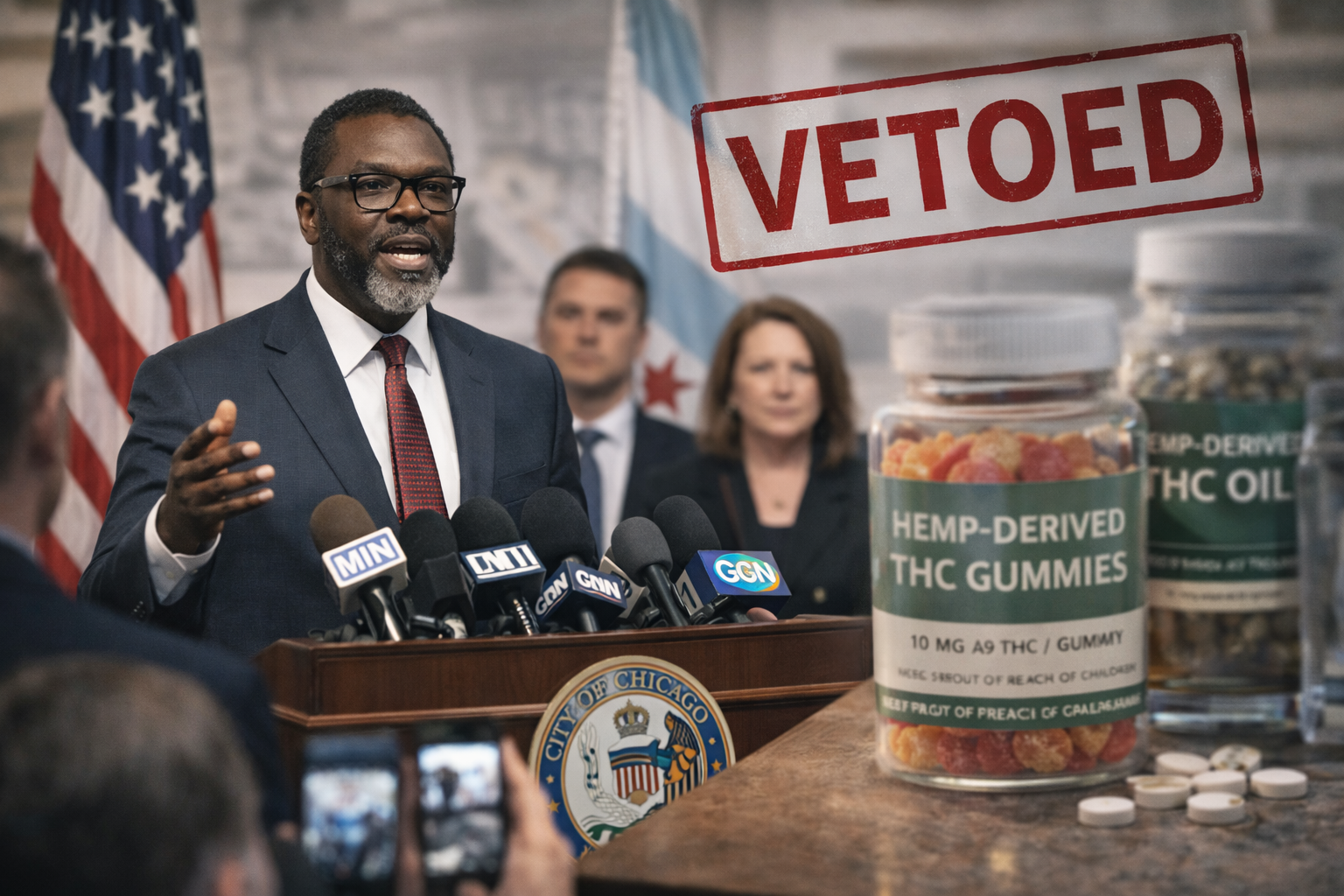
Mayor Johnson at press conference with vetoed notice and hemp THC gummies and oil visible
Chicago just delivered a clear signal for anyone selling or watching intoxicating hemp derived THC products: local leadership can reshape the rules overnight. Mayor Brandon Johnson vetoed a city ordinance focused on cannabinoid hemp products, calling the approach premature and urging alignment with forthcoming federal government guidance. For operators, this is not just a headline. It is a blueprint for how market access gets won or lost in major cities.
Quick facts
• The Mayor vetoed a City Council ordinance on February 13, 2026, stating the ordinance was premature and should align with forthcoming federal government guidance
• The City Council approved the ordinance on January 21, 2026 by a 32 to 16 vote, according to local reporting
• The proposed rules would have prohibited most intoxicating cannabinoid hemp products from being sold at city licensed premises, with an exception for licensed cannabis business establishments
• The proposed rules allowed hemp beverages and hemp additives to continue through certain liquor and package goods channels with age, labeling, and display requirements
• The ordinance set an April 1, 2026 effective date for key sections, but the veto paused that path
If Chicago policy shifts affect how you sell or distribute hemp THC products, Start with our quick Cannashield intake form so you can map your sales channels and local exposure before rules change again
What The Veto Actually Means
A veto is not the end of regulation. It is a reset of the strategy. In his veto letter, the Mayor emphasized two things that operators should translate into business planning.
First, timing and coordination. He framed the ordinance as premature and said the city should align with anticipated federal government guidance rather than move ahead in a fast changing landscape.
Second, balance and enforcement capacity. He argued a local framework should protect health, especially for young people, support small business stability, and ensure enforcement agencies have the capacity to implement rules equitably. That last word matters. If enforcement is uneven, the market becomes chaotic, and compliant operators get punished alongside bad actors.
Universal operator lesson: when the fight is about public safety and youth access, cities move fast, and the “how” of enforcement becomes as important as the “what” of the rule.
What The Proposed Ordinance Would Have Changed
The proposed ordinance was not just a warning label update. It was a channel control move.
In simple terms, it defined a category of prohibited cannabinoid hemp products intended for human consumption that can produce an intoxicating effect, then barred those products from being sold at most city licensed premises. It carved out an exception for licensed cannabis business establishments, which would have concentrated sales of many intoxicating hemp products into the licensed cannabis retail channel.
At the same time, the ordinance created a lane for hemp beverages and hemp additives to remain available through certain permitted sellers such as liquor licensed businesses and package goods stores, but with guardrails. Those guardrails included age restrictions, required THC disclosure, QR code style testing access, limits on marketing that appeals to minors, and rules about keeping products behind the counter or away from minors.
This is why operators viewed it as market structure, not just regulation. The rule design would have changed who could sell what, and where.
If your labeling, age checks, or product sourcing would not hold up under a city inspection, Complete our Cannashield questionnaire to pressure test your controls and tighten your documentation.
Why This Matters For Cannabis Operators And Hemp Retailers
For cannabis operators, the takeaway is that municipal decisions can tilt demand without any change in state law. A city can push consumers toward licensed cannabis dispensaries, or keep alternative channels open, simply by changing where certain products may be sold. That affects foot traffic, basket size, and the competitive set.
For hemp retailers and convenience operators, the takeaway is even sharper. Your business model can be legal at the state level and still get boxed in by a city ordinance. In major urban centers, local governments often treat intoxicating hemp as a public health issue first, and an economic issue second. That means you should expect repeated attempts to regulate category access, especially around products that look like candy, are easy to conceal, or create youth access concerns.
For everyone, this is a policy risk management story. Chicago is a high influence market. When Chicago debates an approach, other cities watch. Some copy. Some react in the opposite direction. Either way, the patchwork grows.
Universal operator lesson: in mature markets and emerging markets alike, your expansion plan must include city level rules, not just state level licensing.
What Operators Should Watch Next
The Mayor’s veto letter points to “forthcoming” federal government guidance as a key reason to slow down and collaborate. That means two tracks are worth monitoring in 2026.
One track is federal direction on hemp derived intoxicating cannabinoids, which could tighten definitions, enforcement standards, or product requirements nationally.
The other track is local compromise. The veto does not remove the political pressure. It increases the odds of a revised ordinance that focuses on age verification, packaging, testing transparency, and enforcement clarity rather than a broad channel restriction.
Your job is to be ready for either outcome.
If you want a city policy watchlist template to track local moves like this across major markets, Cannashield intake form to request it so your team can stay ahead without living in the news.
Conclusion
Chicago’s veto is a reminder that market access is not only created by state legalization. It is shaped by city councils, mayors, and the enforcement reality on the ground. Whether you sell hemp derived THC, operate licensed cannabis retail, or plan multi city expansion, the winning posture in 2026 is simple: track local politics, tighten compliance basics, and plan scenarios before you spend money like the rules are guaranteed.
What To Do This Week
• Build a city level policy tracker for every market you serve, starting with major urban centers
• Categorize your products by risk, especially intoxicating items, edibles, and vapes, and document sourcing and testing
• Tighten age verification procedures and train staff to enforce them consistently
• Review packaging and marketing for youth appeal risk and remove anything questionable
• Create a one page “inspection ready” binder with licenses, invoices, testing documentation, and written policies
• Run two scenarios in your financial model, one where sales channels narrow and one where they remain open
FAQ
What did the Chicago Mayor veto
He vetoed an ordinance passed by City Council regarding regulation of cannabinoid hemp products.Why did he say he vetoed it
He said it was premature and argued the city should align with forthcoming federal government guidance and pursue a more balanced framework.Would the ordinance have limited where intoxicating hemp products could be sold
Yes. It would have prohibited most intoxicating cannabinoid hemp products from being sold at most licensed premises, with an exception for licensed cannabis business establishments.Were hemp beverages treated differently
Yes. Hemp beverages and hemp additives were allowed for certain permitted sellers with age and labeling rules.Does the veto mean there will be no regulation
No. It signals the city may pursue a different approach, and operators should expect continued debate and potential revisions.What is the universal operator lesson
Local politics can change distribution rules quickly, so operators must track city actions, keep documentation clean, and plan for multiple outcomes.