

Michigan Wholesale Cannabis Tax Is Squeezing Sales And Operators Need A Plan
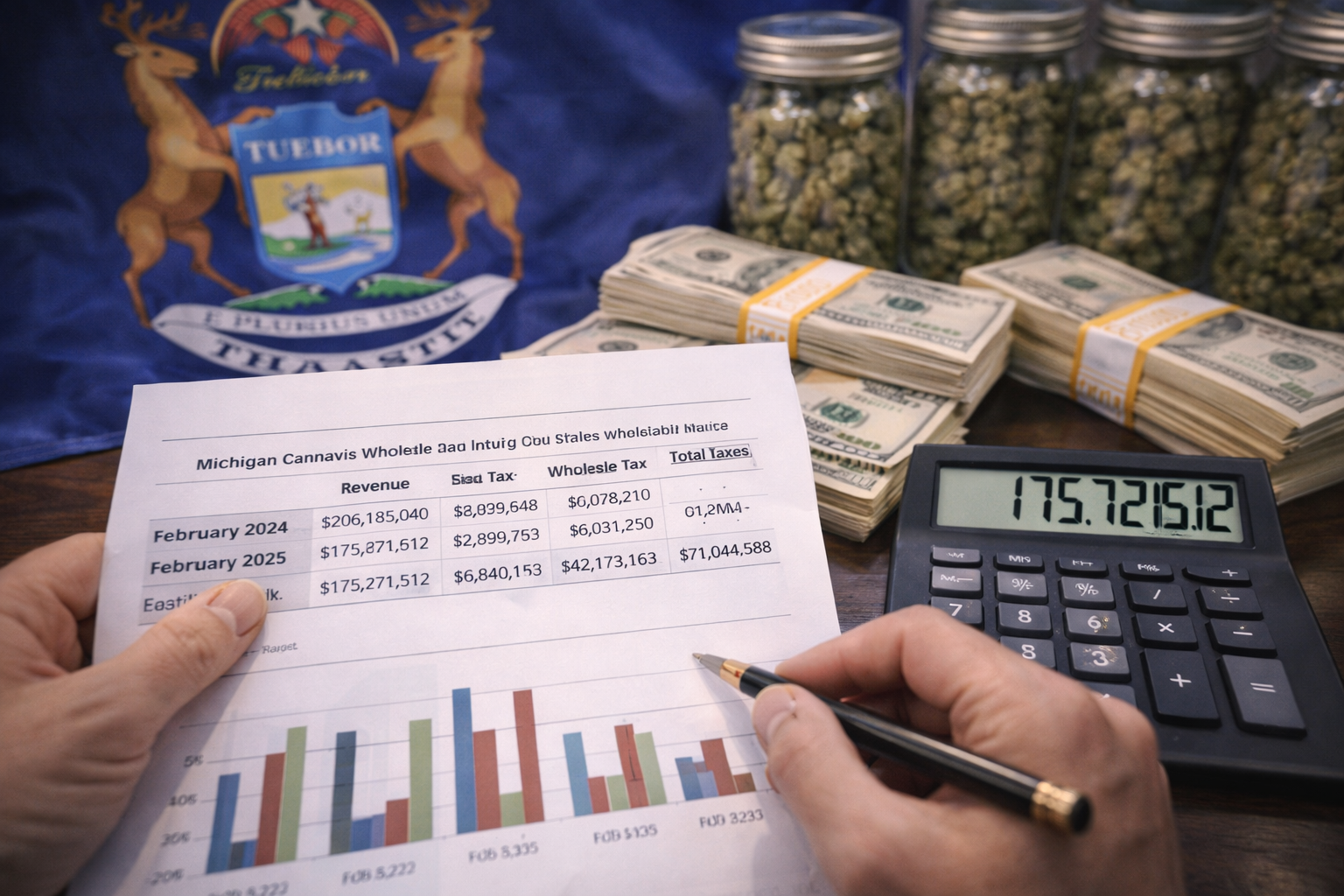
Michigan wholesale cannabis tax paperwork on desk with calculator money and product jars
Michigan wholesale cannabis tax pressure is now showing up in the numbers, not just in complaints. With the new 24 percent wholesale tax in effect since January 1, 2026, operators are dealing with a higher cost base before products ever hit a shelf. Preliminary Headset data cited in recent reporting puts February statewide cannabis revenue around $206.18 million, down 14.8 percent year over year and the lowest monthly total since November 2022.
Quick facts
• Michigan’s wholesale cannabis tax rate is 24 percent and applies to certain adult use wholesale sales and transfers.
• The wholesale tax stacks on top of Michigan’s 10 percent retail excise tax and 6 percent sales tax.
• February revenue was about $206.18 million, down 14.8 percent year over year, based on preliminary Headset data cited in reporting.
• Reporting says sales dropped 16 percent from December to January after the wholesale tax took effect.
• The Michigan Cannabis Industry Association is challenging the tax in court and lawmakers are also pushing repeal legislation.
• Michigan Treasury says wholesale tax revenue is deposited into the neighborhood road fund for infrastructure improvements.
If the Michigan wholesale cannabis tax is impacting your pricing or cash plan, Start with our quick Cannashield intake form so you can map exposure and plan for multiple outcomes
What The 24 Percent Wholesale Tax Really Does
This tax is not a retail add on at checkout. It is imposed upstream on the wholesale price of certain sales or transfers involving adult use cannabis. Michigan Treasury’s guidance explains it applies to the first sale or transfer from a licensed cannabis establishment to a retail licensee, as well as certain vertically integrated and medical to adult use transfers, with the wholesaler legally responsible for paying and remitting the tax even if the wholesaler tries to pass the cost through.
That structure matters because upstream taxes tighten the entire chain at once. Wholesale prices are already compressed in mature markets. Add a new 24 percent layer and everyone fights over the same question: who absorbs it. The retailer, the wholesaler, or the consumer. In real life, it becomes a split, and that split creates tension in vendor terms, discounts, and invoice disputes.
Universal operator lesson: when a tax hits before retail, your cash cycle becomes the battlefield, not just your shelf price.
Why The February Numbers Matter
The February revenue number is important because it suggests the market is feeling the tax immediately, not slowly. Reporting tied to preliminary Headset data says statewide cannabis revenue sank to $206.18 million in February, down 14.8 percent year over year.
The pattern also looks broad, not isolated. The same reporting lists year over year declines by category, including flower, concentrates, vape cartridges, and edibles, which signals consumers are not simply switching categories inside the legal channel to avoid the tax burden.
Universal operator lesson: when every major category softens at once, you are looking at a market structure problem, not a single product trend.
If uncertainty is affecting how you plan or negotiate, Complete our Cannashield questionnaire to pressure test your tax stack, margin sensitivity, and documentation readiness.
The Second Order Damage: Discounts, Inventory, And Vendor Chaos
A wholesale tax does not just increase cost. It changes behavior.
Retailers often respond by pulling back on discounting or raising list prices, which can reduce unit volume. Wholesalers respond by tightening payment terms because they are on the hook for remitting tax. Smaller operators get squeezed first because they have the least working capital to float higher inventory costs while waiting for sales to clear.
This is also where the unregulated market becomes the silent competitor. When legal pricing rises or promotions disappear, some demand reroutes. That does not require consumers to become political. It only requires a price gap that feels worth it.
Universal operator lesson: when policy increases friction, demand does not disappear. Demand reroutes.
How To Respond Without Panic
The right move is to treat this as a systems problem you can manage.
Start with a tax stack worksheet by product category. Your goal is to know your true landed cost per unit after the wholesale tax, plus your retail excise and sales tax environment, plus packaging and labor. If you do not know your real cost, you will discount blindly.
Next, tighten your SKU count. Fewer SKUs means fewer packaging variations, fewer slow movers, and less cash trapped in items that do not turn. In a tax shock, complexity kills margin.
Then, build vendor discipline. Get invoice language clean. Document who remits the wholesale tax, when it is due, and what happens if payments are late. This reduces disputes that drain time and create compliance mess.
Finally, protect your trust categories. If you cut corners on quality control or documentation because margin is tight, you increase your risk at the worst moment. When regulators, partners, or lenders get nervous, clean records become a competitive advantage.
If you want a Michigan tax shock playbook and a copy and paste tax stack worksheet, use the Cannashield intake form to request it.
Conclusion
Michigan’s 24 percent wholesale cannabis tax is more than a new line item. It is an upstream cost shock that can shrink legal demand, tighten cash cycles, and accelerate consolidation. With February revenue reported around $206.18 million and down 14.8 percent year over year, operators should assume volatility stays high until either the policy changes or the market adapts.
The universal lesson is simple: build a plan that survives policy friction. Know your tax stack, reduce SKU chaos, tighten vendor terms, and keep documentation clean so you can stay standing while the rules get argued in court and in the legislature.
What To Do This Week
• Build a tax stack worksheet for your top 20 SKUs and recalculate true landed cost
• Identify five slow moving SKUs to cut so you free cash and reduce packaging complexity
• Update vendor invoices and payment terms so responsibility and timelines are clear
• Tighten inventory turns with reorder rules and a weekly aging report
• Centralize COAs, invoices, and batch records so you can retrieve proof fast
• Run two scenarios for the next 90 days, one where sales keep sliding and one where they stabilize
FAQ
What is Michigan’s new wholesale cannabis tax
A 24 percent excise tax on the wholesale price of certain adult use cannabis sales and transfers beginning January 1, 2026.Does the wholesale tax replace other cannabis taxes
No. Michigan Treasury says it is in addition to the 10 percent retail excise tax and the 6 percent sales tax.Who is responsible for paying the wholesale tax
Michigan Treasury guidance says the wholesaler is legally responsible for paying and remitting the tax on applicable transactions.What does the early data suggest
Reporting citing preliminary Headset data put February revenue around $206.18 million, down 14.8 percent year over year.Why are industry groups pushing back
Reporting says the Michigan Cannabis Industry Association filed a lawsuit and lawmakers are also moving repeal legislation.What is the universal operator lesson
Upstream taxes pressure cash flow first. Operators win by tightening inventory turns, simplifying SKUs, and keeping documentation clean.