
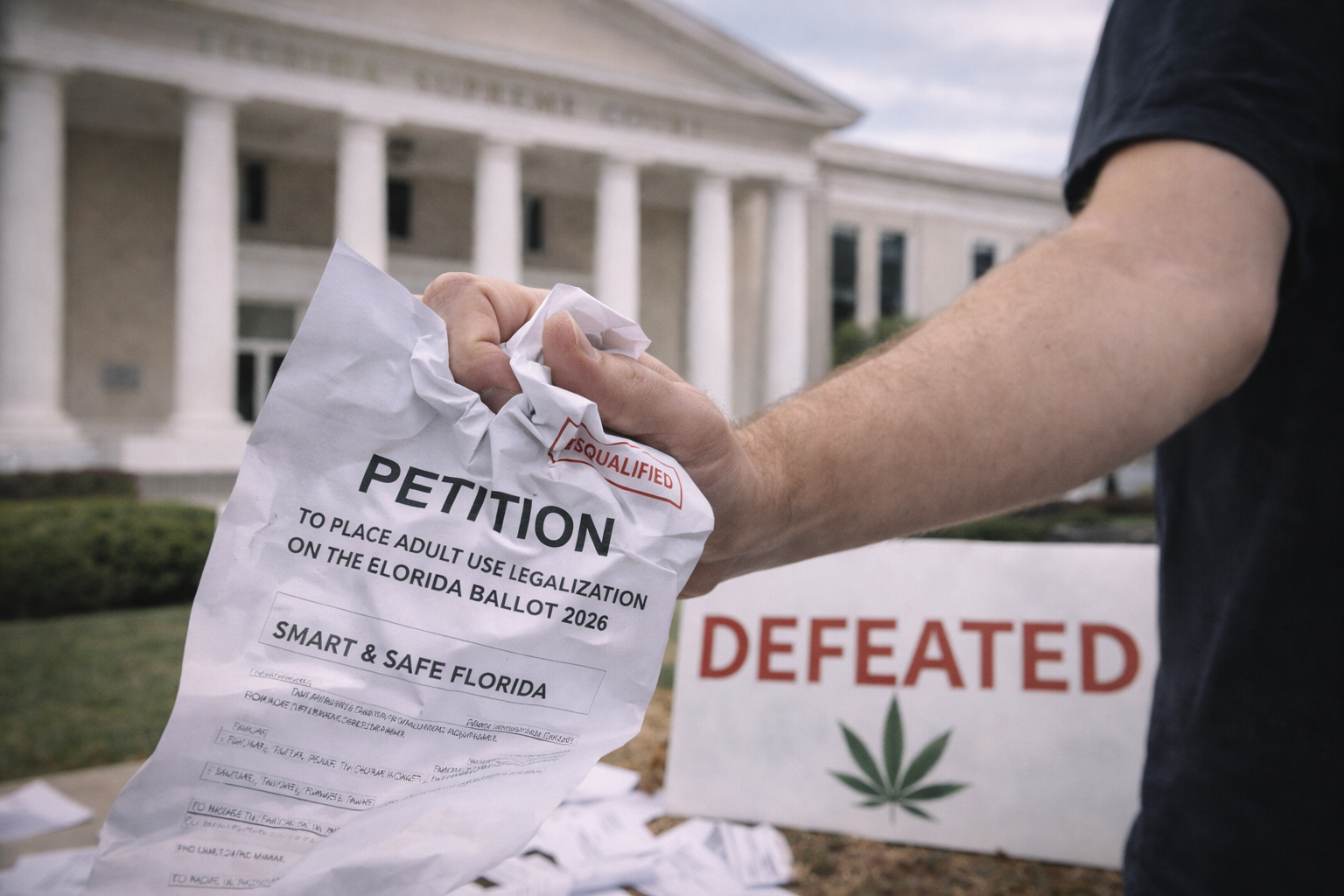
Florida legalization petition paper crumpled with defeated sign after court ends 2026 ballot path
Florida adult use cannabis ballot 2026 planning just hit a hard stop. The Florida Supreme Court declined to take up Smart and Safe Florida’s signature dispute and made clear it would not entertain rehearing, which effectively ends the campaign’s path to the November 2026 ballot through the citizen initiative route.
Quick facts
• On March 9, 2026, the Florida Supreme Court denied the petition for review and stated no motion for rehearing will be entertained.
• About 71,000 petition signatures were disqualified, including signatures tied to “inactive” voters and petition circulator eligibility issues described in reporting.
• County supervisors validated more than 833,000 signatures, but the threshold to qualify for the 2026 ballot was 880,062 valid signatures.
• With the court declining review and the threshold not met, adult use legalization is effectively not happening through a Florida 2026 ballot campaign.
If Florida timing affects your growth plan, Start with our quick Cannashield intake form so you can map exposure and plan for multiple outcomes.
Why This Matters For Operators
Ballot failure is not just a political event. It is a market access event. When a state as large as Florida goes from “maybe this year” to “not this year,” every related decision gets reshuffled: retail entry timing, real estate strategy, hiring plans, vendor agreements, and how investors price risk.
The universal operator lesson is simple. Never build a single state future around one ballot path. Ballot mechanics can break late, even after heavy spending and wide public discussion. The winners are the teams that plan two timelines from day one: a fast path if the market opens, and a slow path that still produces revenue while you wait.
What The Court Decision Signals
The court’s order is short, but the message is loud. It declined to accept jurisdiction and denied the petition for review. It also shut the door on rehearing.
For operators, that is the signal that matters most: the window is closed for this cycle. That clarity has value. When uncertainty drags, businesses stall. When a decision lands, the smart teams immediately reallocate resources and stop bleeding time on wishful timelines.
What Changes In Florida Market Planning
For 2026, the biggest change is expectation management.
If you were planning around adult use retail opening soon, that plan now needs to be converted into either a medical focused plan or a watching brief, depending on your role. Florida still has an established regulated medical system, but the adult use expansion story that would reshape demand and distribution is not arriving through the ballot route this year.
This also changes competitive behavior. When adult use is delayed, expansion and capital may shift toward other states with clearer timelines. That can affect staffing availability, vendor focus, and where large multi state operators choose to deploy money and attention.
If uncertainty is affecting how you plan or negotiate, complete our Complete our Cannashield questionnaire to pressure test your market entry assumptions, timeline risk, and documentation readiness.
How Operators Should Respond Without Overreacting
The move is disciplined execution, not drama.
First, stop planning like rules are guaranteed. Build a policy watchlist with deadlines, court actions, and signature milestones so you are never surprised by timing again.
Second, tighten capital discipline. If your plan assumed a 2026 adult use launch, rewrite your model for a slower path. That means shorter lease commitments, flexible staffing, and supplier terms that do not trap you in minimums.
Third, protect your credibility. In rollback and delay years, regulators and communities tend to become more sensitive to youth access, labeling clarity, and unlicensed activity. Even if you are doing everything right, your category can still get judged by the weakest actors. Clean documentation, clean training, and conservative product messaging are your shield.
Universal operator lesson: market access delays are survivable if you keep cash tight, keep documentation clean, and keep optionality high.
What To Watch Next
This does not mean Florida will never move. It means the 2026 ballot path is not the lane.
Watch for three things. Legislative activity that proposes a different framework. Enforcement focus that reshapes how hemp derived intoxicating products are treated. And any future initiative planning that starts early enough to build signature cushion and legal resiliency.
If you want a simple ballot risk tracker and a Florida market watchlist template your team can update weekly, use the Cannashield intake form to request it.
Conclusion
Florida’s 2026 adult use ballot effort appears finished after the Florida Supreme Court declined review and the campaign fell short of the required signature threshold. The operator takeaway is universal and brutal in the best way: plan for delays, run your business like timing is uncertain, and build a pipeline that does not depend on a single vote.
What To Do This Week
• Freeze any Florida adult use expansion spend that depends on a 2026 launch timeline
• Rewrite your plan with two scenarios: Florida stays medical only through 2026, and Florida reopens a path later
• Build a policy watchlist for Florida and assign one owner to track developments weekly
• Tighten vendor terms to reduce minimums and protect cash if timelines move again
• Refresh compliance training on age checks, labeling clarity, and documentation discipline
• Create a short internal script for staff and partners so messaging stays consistent
FAQ
What happened with the Florida Supreme Court decision
The court denied the petition for review and stated it would not entertain rehearing.Why did the campaign fail to reach the 2026 ballot
The campaign fell short of the valid signature threshold after about 71,000 signatures were disqualified, according to reporting.What was the signature threshold for the 2026 ballot
Reporting cited a threshold of 880,062 valid signatures.Does this mean adult use legalization is guaranteed not to happen in Florida
It means the 2026 citizen initiative ballot path is effectively closed. Other paths would require new political movement and timelines.What is the universal operator lesson from this Florida outcome
Never build a single state growth plan around one ballot route. Always run fast path and slow path scenarios.How should operators protect themselves during delay years
Protect cash, reduce fixed commitments, tighten documentation, and keep a multi state pipeline so one state delay does not stall the business.