
Michigan Lab Data Integrity Complaints Put COAs Under A Microscope
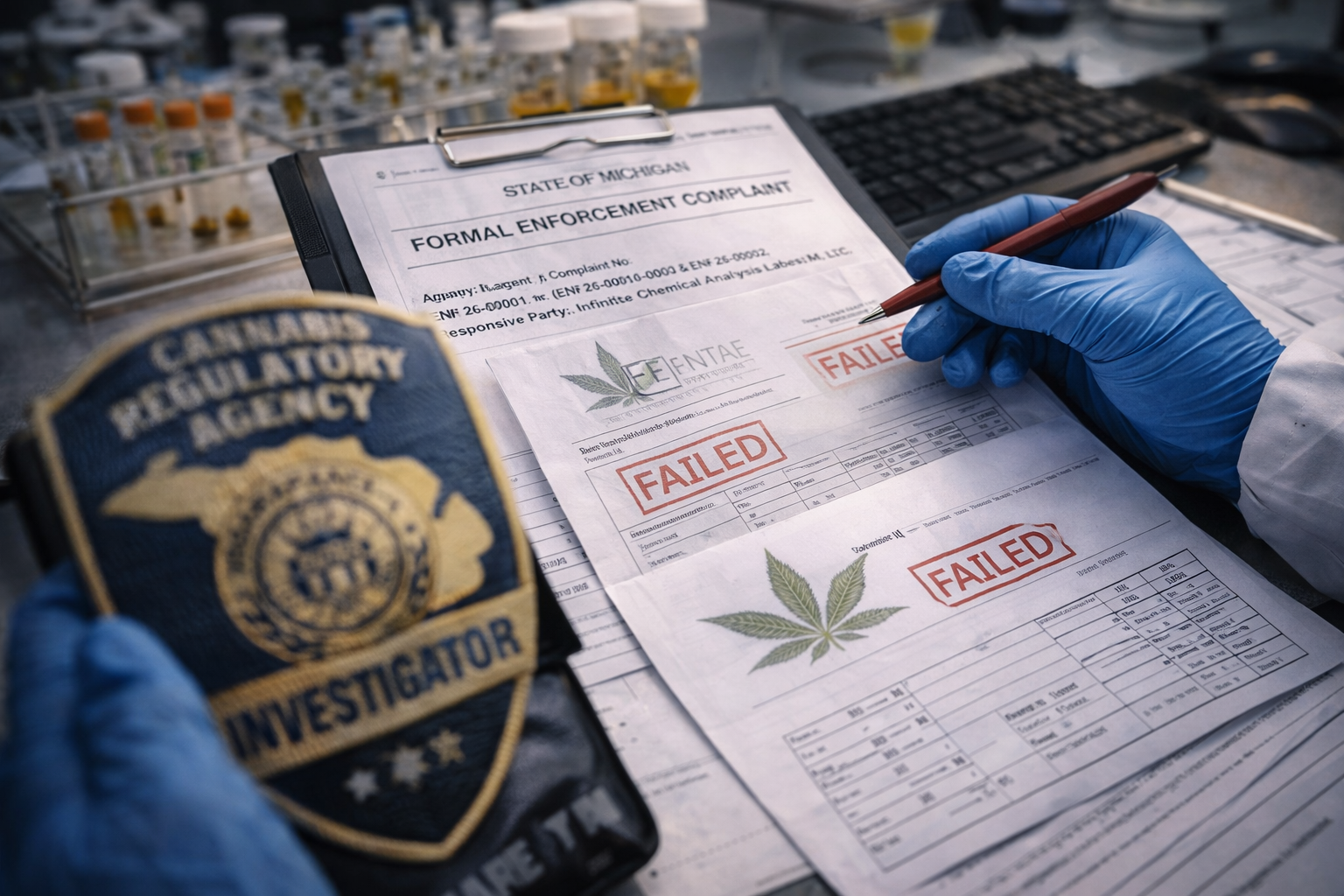
Michigan lab compliance investigation scene with enforcement complaint papers and testing records on a desk
Michigan just delivered a sharp reminder that cannabis lab testing compliance is not a back office detail. It is market access. The Michigan Cannabis Regulatory Agency filed formal enforcement complaints against Infinite Chemical Analysis Labs MI, LLC, alleging testing and sampling data did not align with approved methods and standard operating procedures.
Quick facts
• CRA filed complaints against both the adult use safety compliance facility license and the medical safety compliance facility license
• CRA says it may seek sanctions that can include suspension, revocation, restriction, or refusal to renew
• CRA states the allegations are just allegations at this stage
• The complaints focus on data integrity and whether reported results matched approved lab procedures
• The agency action raises downstream exposure for COAs used across cultivation, manufacturing, distribution, and retail
If lab risk touches your supply chain, Start with our quick Cannashield intake form so you can map your lab dependencies and COA handling process.
What Michigan Alleged And Why It Matters
The complaints are aimed at the lab itself, but the impact spreads to everyone who relies on that lab’s certificates of analysis. CRA’s press release confirms the agency filed formal complaints against the lab’s adult use license and medical license and is seeking potential sanctions.
Inside the complaint narrative, CRA describes reviewing raw data the lab submitted as part of complaints the lab filed against other testing facilities. CRA alleges that further review showed inconsistencies between the lab’s approved SOPs and the methods it actually used, leading the agency to question reliability, accuracy, and scientific validity.
That is the core operator risk: when a regulator questions the scientific validity of a lab’s process, COAs stop being a shield and start being a liability.
The Specific Failure Pattern CRA Points To
One allegation in the adult use complaint is simple and damning: the lab’s own SOP said to use the median of three counts for total yeast and mold on flower, but CRA alleges the reported number was not the median of the three values shown.
In the medical complaint, CRA highlights a coliform example where the COA reported one value and the prep sheet indicated a value an order of magnitude lower, and it notes the manufacturer’s counting guidance versus what the lab’s SOP directed.
CRA also describes an onsite visit by its science section and raises concerns about how certain retests were handled versus how the approved SOP allowed them to be handled.
You do not need to be a scientist to understand the operator lesson. Regulators expect the lab to follow the method it promised to follow. If they believe the lab did not, everything tied to those COAs becomes exposed to questions, holds, and potential enforcement actions.
If you want a lab vetting checklist that focuses on data integrity red flags, Complete our Cannashield questionnaire and request the lab due diligence pack.
Why COA Risk Becomes Recall And Embargo Risk
Most operators treat COAs like a receipt. They print it, file it, move on. That is fine until a regulator challenges the underlying testing process.
When that happens, the chain reaction is predictable.
Retailers get asked to pull product fast, often by batch and tag.
Distributors get asked to prove where product moved and what lots were impacted.
Manufacturers get asked to prove inputs, blending logic, and batch lineage.
Cultivators get asked for pesticide and microbial control records that support the COA story.
Even if a specific recall is not announced yet, this type of enforcement action is a warning shot that lab surveillance is tightening and data integrity is now a priority category for regulators.
Universal operator lesson: your compliance stack is only as strong as your weakest vendor. Labs sit at the center of that stack.
The Operator Playbook To Reduce Lab Dependency Risk
You cannot control what a lab does. You can control how your business relies on lab results.
1. Build a lab dependency map
List which labs appear on your COAs by category and by volume. If one lab touches most of your revenue, you need a backup plan before anyone forces you to build one.
2. Standardize COA storage and retrieval
Store COAs, manifests, and batch records in one folder system by batch and date. Your goal is to pull proof in minutes, not hours.
3. Add a retest trigger rule
If results look inconsistent with historical patterns, or if you see major swings without a clear production explanation, retest before product spreads across locations.
4. Tighten vendor terms
Your agreements should include clear timelines for documentation delivery and cooperation if a regulator questions testing data.
If you want a recall and embargo response runbook your managers can execute under pressure, use the Cannashield intake form and request the lab risk and recall readiness pack.
Conclusion
Michigan’s enforcement complaints against a licensed safety compliance facility are a signal that lab practices and data integrity are under sharper scrutiny. For operators, the lesson is not panic. It is preparation. Build documentation discipline, reduce single lab dependency, and be ready to trace product by batch fast if lab credibility gets challenged.
Educational note: This article is for education only and is not legal or compliance advice.
What To Do This Week
• Inventory every SKU tested by each lab you use and identify your single point of failure
• Centralize COAs and batch records in a folder structure your whole team can navigate
• Add a simple retest trigger policy for outlier results or inconsistent batches
• Update vendor agreements or onboarding to require fast documentation response during investigations
• Run a mock trace exercise to see how fast you can identify all lots tied to one COA
• Train staff on one calm customer response for lab questions that avoids speculation
FAQ
What did Michigan regulators file against the lab
Formal enforcement complaints against the lab’s adult use and medical safety compliance facility licenses.What is the main allegation
CRA alleges testing and sampling data did not align with the lab’s approved methods and SOPs, raising reliability concerns.What penalties could result
CRA states it may seek sanctions that can include suspension, revocation, restriction, or refusal to renew.Does a complaint mean the lab is guilty
No. CRA notes statements in formal complaints are allegations.Why does this matter to operators who never used that lab
It signals heightened scrutiny of lab practices, and lab credibility issues can trigger broader market surveillance and tighter documentation expectations.What is the universal operator lesson
Treat labs like critical vendors and build redundancy, traceability, and recall readiness before a regulator forces the issue.