
State Attorneys General Push Congress to Restrict Hemp-Derived THC Products
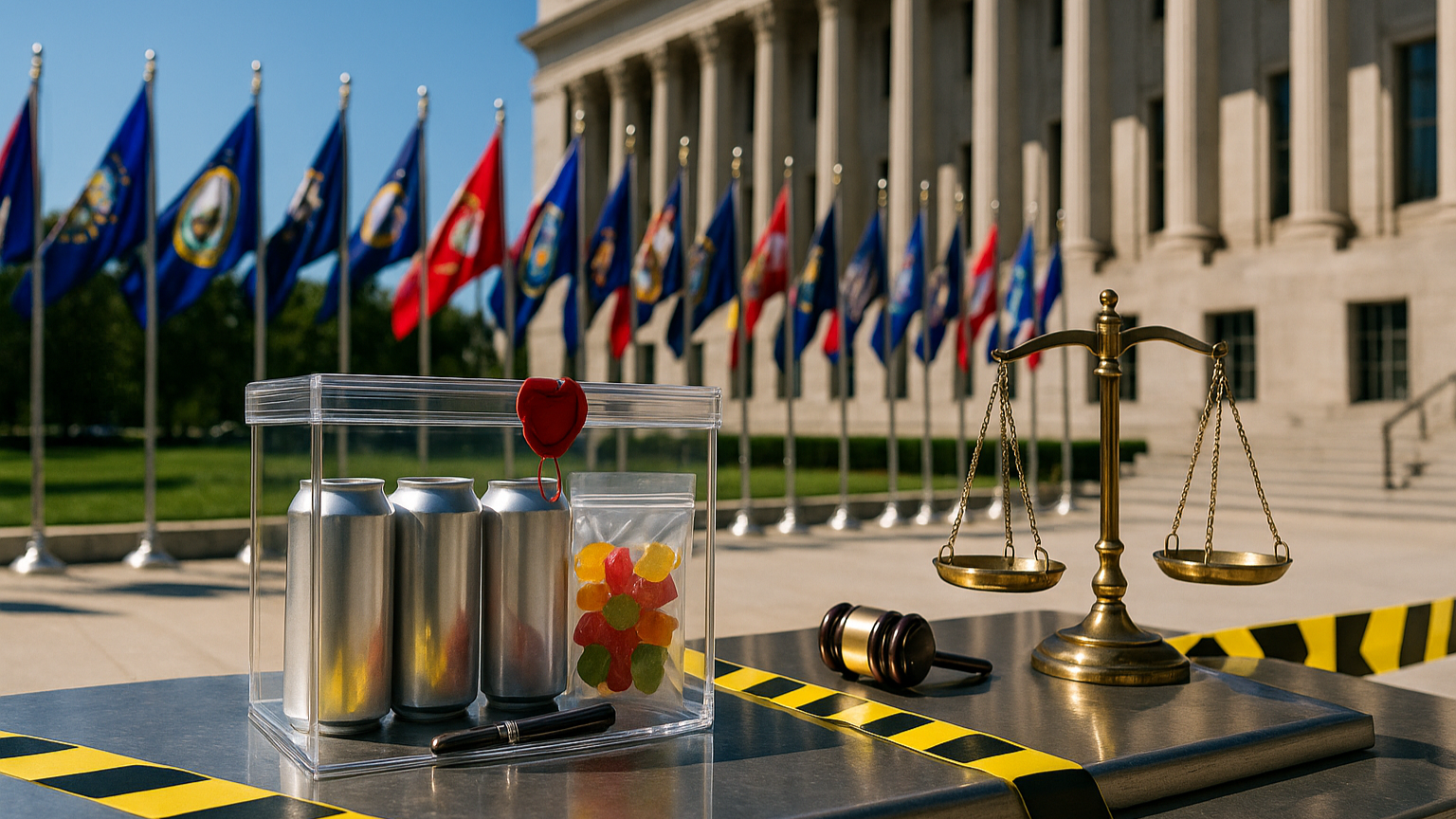
Evidence box with hemp gummies and beverages beside gavel and scales of justice outside government building, symbolizing state attorneys general urging Congress to restrict hemp-derived THC.
On October 29, a coalition of dozens of state attorneys general sent a formal letter to Congress urging federal lawmakers to clarify — and potentially ban intoxicating hemp-derived THC products — in an effort to close what they view as dangerous regulatory gaps in the hemp industry.

The letter represents one of the most coordinated state-level actions yet against the growing market for hemp-derived intoxicants such as Delta-8 THC and hemp-derived Delta-9 THC. It also signals mounting regulatory and enforcement pressure on businesses operating within the gray areas of hemp legality.
If your hemp or cannabis business sells, manufactures, or distributes THC-derived products, now’s the time to evaluate your compliance and coverage. Start with our quick Cannashield intake form to safeguard your operation against upcoming federal and state actions.
The Call for Congressional Action
The joint letter, led by attorneys general from both Republican and Democratic states, urged Congress to revisit the 2018 Farm Bill, which legalized hemp containing less than 0.3% Delta-9 THC by dry weight. Law enforcement officials argue that this framework unintentionally opened the door to synthetic and intoxicating hemp products that mimic the effects of cannabis — but fall outside the jurisdiction of regulated cannabis programs.

The coalition’s letter emphasized several key points:

•   Public Safety Concerns: States report an increase in unregulated products with inconsistent potency, inaccurate labeling, and youth-targeted marketing.

•   Regulatory Confusion: Businesses and consumers face conflicting rules, with hemp-derived THC legal federally but restricted or banned in multiple states.

•   Call for Federal Clarity: The AGs are asking Congress to explicitly distinguish between industrial hemp and intoxicating derivatives, giving states clear authority to regulate or ban them.

This marks a growing consensus that the Farm Bill’s loophole has created more confusion than clarity — and that the next federal reform must directly address hemp-derived intoxicants.
Why States Are Taking the Lead
While federal lawmakers debate the next Farm Bill, states have been forced to fill the regulatory void. More than a dozen have enacted restrictions or bans on Delta-8 THC, THC-O, and similar compounds — while others have integrated these products under their cannabis regulatory frameworks.

The problem, according to state officials, is that unregulated intoxicating hemp products are widely available online and in retail shops, often marketed as “legal THC.” Without standardized testing or manufacturing oversight, some of these products have been found to contain harmful contaminants or misleading dosage information.

For law enforcement and public health officials, this patchwork approach has become unsustainable. The coalition’s letter argues that national standards are needed to prevent unsafe products from crossing state lines.
Unsure how hemp-derived THC restrictions could affect your operations? Complete our Cannashield questionnaire to review your risk exposure and ensure compliance across state lines.
What This Means for Businesses
For hemp and cannabis operators, this letter is more than political posturing — it’s a clear warning shot that enforcement will intensify in 2025 and beyond. Even before Congress acts, states are expected to ramp up inspections, product seizures, and enforcement actions against businesses operating in unlicensed or loosely regulated hemp-THC sectors.

Key implications include:

1. Increased Oversight: Expect heightened scrutiny on product testing, labeling, and THC content verification.

2. Cross-State Challenges: Businesses selling across borders could face differing compliance requirements or outright bans.

3. Insurance and Liability Exposure: Companies caught in enforcement sweeps could face litigation or loss of coverage if their products fall under newly restricted categories.

4. Market Consolidation: Stricter rules could push smaller operators out — but open the door for compliant, well-insured businesses to establish dominance.

In short, the next phase of the hemp industry won’t favor speed or innovation — it will favor compliance and accountability.
Federal Reform on the Horizon
The attorneys general’s letter adds significant political weight to the debate surrounding hemp reform in Washington. Congressional leaders are already preparing to reauthorize the Farm Bill, which could include new language distinguishing industrial hemp (for fiber and CBD) from intoxicating cannabinoid derivatives.

While no specific timeline has been confirmed, lawmakers on both sides have acknowledged that clarifying the definition of hemp-derived THC is essential to balancing innovation with consumer protection.

For legitimate operators, this presents both a challenge and an opportunity. Those who invest early in testing protocols, risk management, and insurance coverage will be best positioned to adapt when new regulations take effect.
The Bottom Line
The October 29 letter from state attorneys general marks a critical moment in the evolution of the hemp and cannabis industries. As the line between hemp and cannabis continues to blur, regulatory action is no longer theoretical — it’s inevitable.

Businesses that take compliance seriously will not only survive this next wave of enforcement but stand out as trusted, credible players in a tightening market.

At Cannashield, we help hemp and cannabis operators navigate regulatory shifts through insurance, compliance, and risk management strategies tailored for evolving markets.
Complete our full intake form here to protect your operation, ensure compliance, and prepare for the next stage of federal and state hemp regulation.
Read the full article here →