
Texas Smokable Hemp Rules Leave Mail Order Risk Unclear
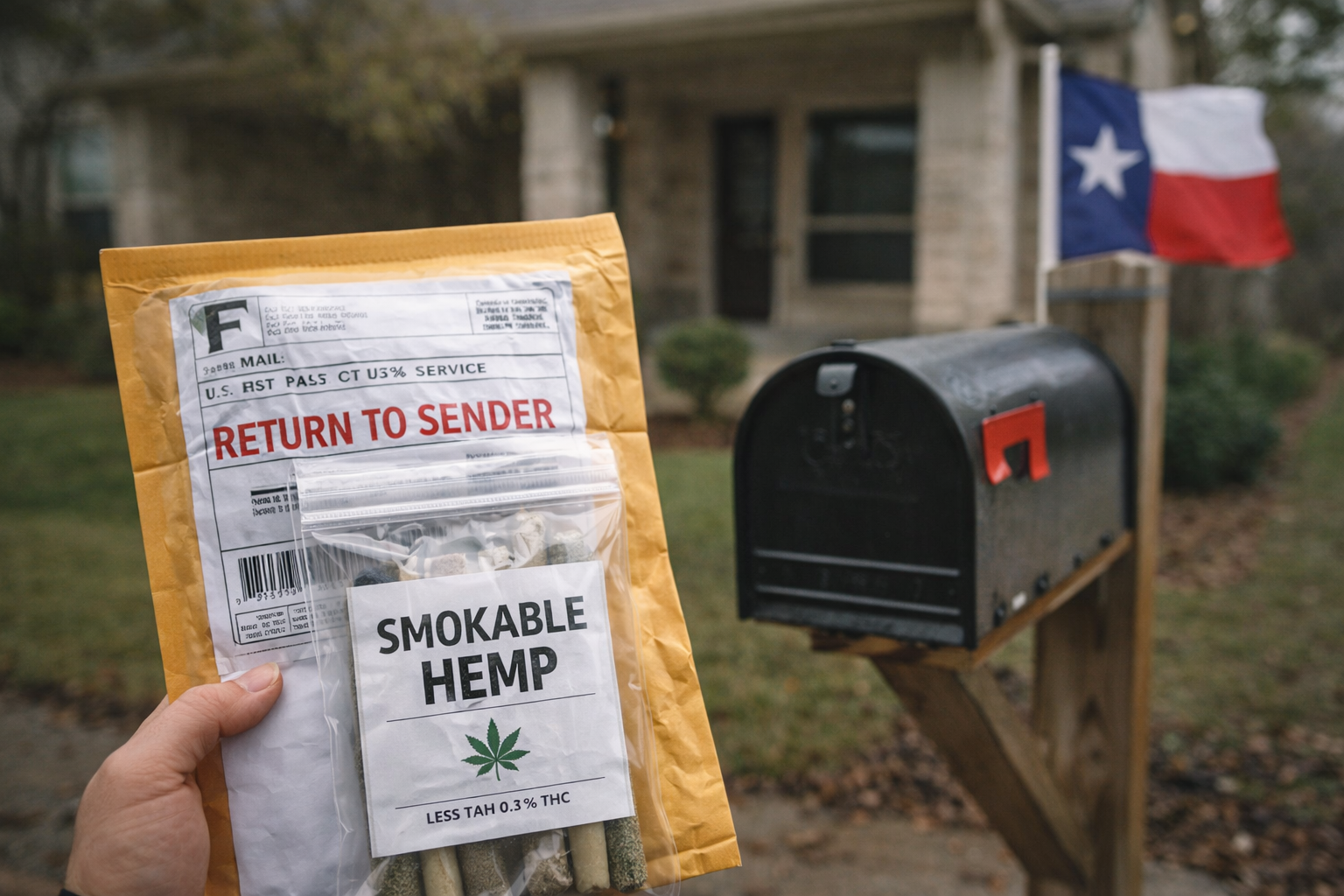
Texas mail order hemp scene showing a returned package, mailbox, and uncertainty around smokable hemp shipping rules.
Texas smokable hemp sales rules are now live, but the bigger business problem is not just what came off the shelf. It is the uncertainty around mail orders, direct to consumer shipments, and how enforcement will actually work. Texas Department of State Health Services rules took effect March 31, 2026. KUT reported that hemp flower, extracts, and other smokable forms of cannabis can no longer be sold in Texas stores, while possession remains legal because the rules apply to retailers and manufacturers, not consumers. That gap is exactly why this story matters. It turns a product issue into a distribution and compliance issue fast.
Quick facts
• Texas DSHS says its adopted consumable hemp rules were published in the March 20, 2026 Texas Register and became effective March 31, 2026.
• The adopted rules define total THC using THCA in the formula and require products introduced into commerce in Texas to test at 0.3% or less total delta 9 THC on a dry weight basis.
• DSHS revised Section 300.403 to clarify that out of state consumable hemp products sold in Texas must comply with Chapter 300, and the rule text says a person selling products in Texas that were processed or manufactured outside Texas must comply with the chapter.
• KUT reported that state regulators say there is no mail order carve out and that products shipped directly to Texas consumers must comply, while cannabis attorneys say online orders from out of state remain a legal gray area and difficult to police.
If Texas hemp compliance changes are affecting your shelf plan, Start with our quick Cannashield intake form so you can map product, labeling, and distribution exposure before enforcement makes the decision for you.
What Changed And Why It Hits Smokable Products First
The new case attacks the structure of the tax, not just the politics behind it. Plaintiffs argue the levy is imposed on the selling price rather than on a simple per unit basis, and because the later 10% adult use excise tax and 6% sales tax are applied to a price that already includes the 24% wholesale levy, the same product is taxed multiple times on the way to the customer. The complaint says that turns the levy into something closer to a sales tax than a traditional excise tax.
The complaint even lays out a simple example. On a $100 wholesale transaction, the new levy would add $24 before the retail layer is taxed. From there, the complaint says the 10% adult use excise tax becomes $12.40 and the 6% sales tax becomes $7.44 instead of $6. That is the heart of the tax on tax argument.
Why Tax Design Matters More Than The Headline Rate
The official rules matter because they tighten both the testing framework and the compliance burden. DSHS now defines total THC as the potential total tetrahydrocannabinol content derived from all THC isomers and THCA content, using a conversion formula that counts THCA toward the total. The adopted rules also require retail products introduced into commerce in Texas to be tested for delta 9 THC, total delta 9 THC, and total THC, with total delta 9 THC at 0.3% or less on a dry weight basis. In practice, that hits smokable flower and similar products hardest because THCA levels are usually much more significant there than in heavier products like edibles or beverages. KUT described that change as the reason most smokable hemp products are effectively pushed out of legal Texas retail sale.
The universal operator lesson is simple. A product does not become safe just because it sold well last week. Once testing definitions change, yesterday’s shelf item can become today’s compliance problem. [Texas Hemp Retail Compliance Checklist] [Product Testing File Review]
Why Mail Orders Are The Real Gray Zone
This is where the story gets messy. KUT reported that DSHS spokesperson Lara Anton said there is no carve out for mail order and that any product introduced into commerce in Texas, including items shipped directly to consumers, must comply with the new regulations. That position lines up with the adopted rule text, which says out of state consumable hemp products sold in Texas must still comply with Chapter 300. But KUT also reported that cannabis attorneys say whether someone can actually be criminally prosecuted for buying noncompliant products from out of state is doubtful and difficult. In Austin, police also told KUT that their general enforcement approach has not changed, and an APD official said officers often rely on packaging because they cannot distinguish hemp from cannabis plant material by sight alone.
That is the real operator lesson here. If a revenue stream only works because retail rules and shipping rules are pulling in different directions, that is not clean revenue. It is unstable revenue. [Mail Order Hemp Risk Map] [Retail Search And Seizure Readiness Guide] This is an inference based on the adopted rule text, the DSHS position reported by KUT, and the uncertainty described by cannabis attorneys and local enforcement.
If you sell anything that sits near a shipping or sourcing gray line, use our Cannashield questionnaire to pressure test your files, vendor records, and channel exposure.
What Smart Operators Should Fix Right Now
The best move is not to argue with the rule after a shipment is challenged. It is to tighten the file before that happens. Texas now requires retailers to evaluate packaging and labeling for compliance and maintain written procedures around packaging and labeling control. Products sold in Texas also need current testing records, including results for delta 9 THC, total delta 9 THC, and total THC, plus supporting certificate of analysis records. For any out of state product, the seller must be able to show the product was manufactured or processed in compliance with the required plan or jurisdictional rules and that it meets Texas standards. That means operators should stop thinking in broad category terms like hemp flower or legal hemp and start thinking SKU by SKU, channel by channel, file by file.
If uncertainty is affecting how you price, stock, or source hemp products, Complete our quick Cannashield intake form to identify weak spots before an inspector, carrier, or payment partner does.
Conclusion
Texas did not just tighten hemp rules. It created a live separation between what stores can sell, what consumers may still possess, and what regulators say should not be shipped into the state. That is why this is bigger than a Texas shelf story. It is a reminder that when product form, shipping, and enforcement do not line up cleanly, operators need stronger files, not stronger opinions.
Educational note: This article is for education only and is not legal, regulatory, tax, or insurance advice.
What To Do This Week
Based on the adopted rules and the current enforcement posture, here is what to do this week.
• Pull every smokable hemp SKU and separate in store shelf product from shipped or drop shipped product.
• Verify your COAs show delta 9 THC, total delta 9 THC, and total THC, not just one number.
• Save vendor proof for every out of state product and how it was processed or manufactured.
• Review website copy, shipping language, and checkout flows for Texas sales.
• Build written procedures for packaging and label review before product reaches the shelf.
• Prepare a response plan for regulator questions, shipment holds, or product challenges.
FAQ
What changed in Texas on March 31, 2026?
Texas DSHS rules governing consumable hemp products took effect on March 31, 2026. KUT reported those rules stopped in state retail sales of hemp flower, extracts, and other smokable forms of cannabis.
Does possession of smokable hemp stay legal in Texas?
KUT reported that possession remains legal because the new rules apply to retailers and manufacturers, while state law itself did not change on that point.
Do the Texas rules apply to products shipped from out of state?
Texas says yes. The adopted rule text says out of state consumable hemp products sold in Texas must comply with Chapter 300, and KUT reported DSHS said items shipped directly to consumers are included.
Why do smokable products get hit harder than edibles or drinks?
The rules count THCA toward total THC, and KUT reported that this total THC approach effectively pushes most smokable hemp products out of compliant Texas retail sale.
Why is mail order still considered a gray area?
Because regulators say shipped products must comply, while cannabis attorneys told KUT that criminal prosecution for out of state purchases would be doubtful and difficult.
What is the operator lesson here?
Do not rely on ambiguity as a business model. If your product only works because shipping, labeling, and enforcement are still unsettled, your revenue is more exposed than it looks. This is an inference based on the rule text and the reported enforcement uncertainty.