
CMS CBD Pilot Lawsuit Tests Federal Policy
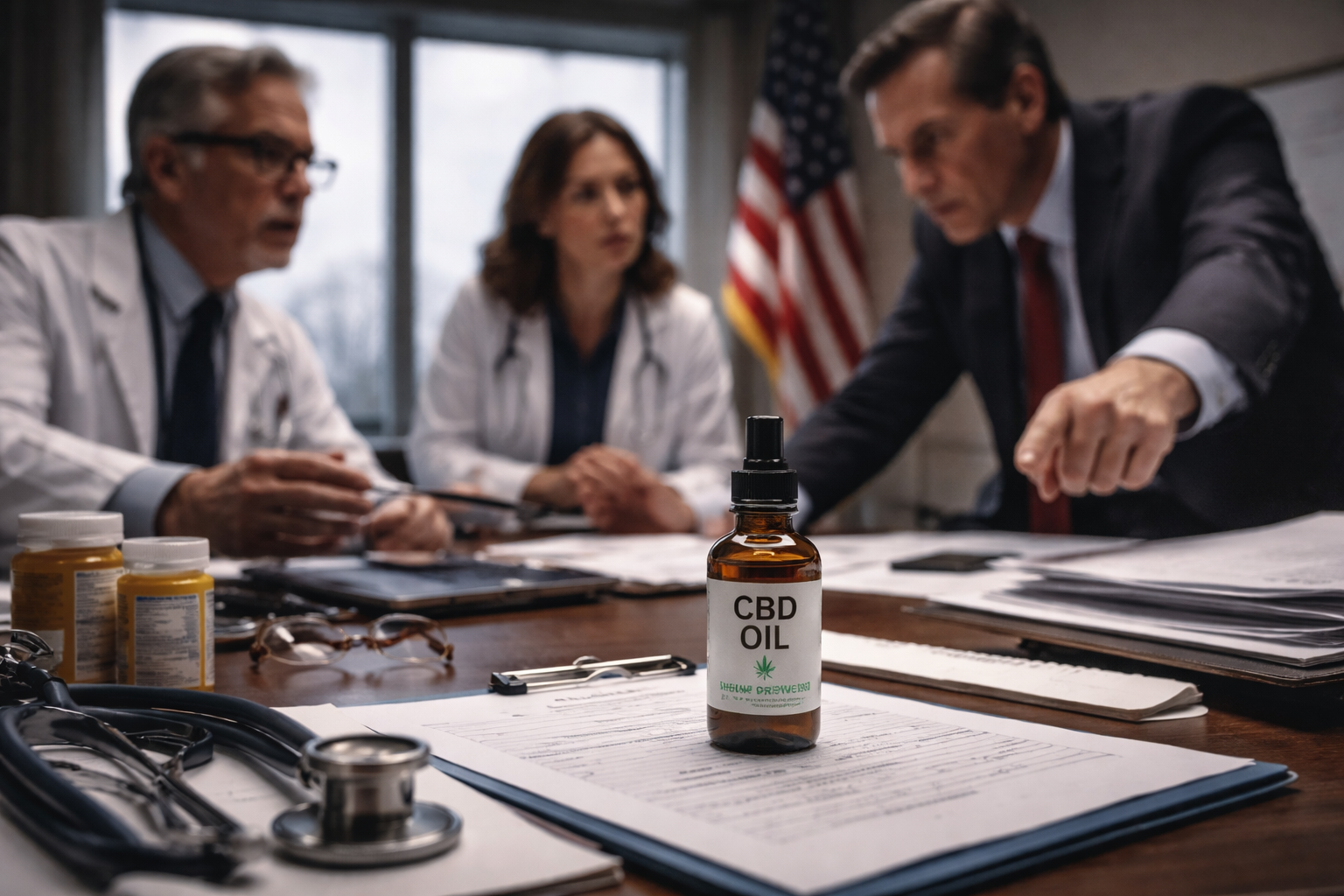
Federal healthcare and policy meeting scene showing documents, a CBD oil bottle, and officials reviewing a challenged CMS pilot.
Federal CBD policy risk is now tied to an active court fight. A coalition led by Smart Approaches to Marijuana filed a federal lawsuit on March 30 against HHS, CMS, Health Secretary Robert F. Kennedy Jr., and CMS Administrator Mehmet Oz over CMS’s new Substance Access Beneficiary Engagement Incentive. The program is set to begin April 1 for some participating CMS Innovation Center models, and court records as reported by MJBizDaily show that a request for an immediate temporary restraining order was denied, with a hearing scheduled for April 20.
Quick facts
• The complaint says CMS created the BEI on March 20, 2026, and plaintiffs filed suit on March 30, 2026 in the U.S. District Court for the District of Columbia.
• CMS says participants in ACO REACH and the Enhancing Oncology Model may begin offering the BEI on April 1, 2026, while LEAD starts January 1, 2027.
• CMS says participants may furnish eligible hemp products up to $500 per year per eligible beneficiary, but Medicare does not pay the participant for the product and beneficiaries should not submit a Medicare claim.
• MJBizDaily reported that the plaintiffs’ request for an immediate temporary restraining order was denied and that a hearing is scheduled for April 20.
If federal CBD policy uncertainty is affecting how you think about product access, provider partnerships, or distribution strategy, Start with our quick Cannashield intake form so you can map compliance and operational exposure before the federal government draws a harder line.
Why The Program Is Narrower Than The Headline Sounds
The first thing operators should understand is that this is not a broad retail reimbursement lane. CMS describes the BEI as an optional incentive inside certain Innovation Center models that allows participating organizations to consult with eligible beneficiaries about certain hemp products and, if they choose, furnish those products up to $500 annually. CMS also says Medicare does not pay the participant for the product and beneficiaries should not submit a Medicare claim. That distinction matters because federal policy language can reshape how the market talks about access, even when the actual operational structure is much narrower.
CMS also built real guardrails into the current structure. Eligible products must be federally legal hemp derived products, cannot be inhalable, cannot exceed 3 milligrams of tetrahydrocannabinols per serving in orally administered form, must comply with state and local law, and must be furnished directly by a qualified physician affiliated with the participant organization. Participants also need a CMS approved implementation plan describing products, dosing, beneficiary criteria, and safeguards. [CBD Labeling and Claims Checklist] [Retail Product File Review]
What The Lawsuit Is Actually Challenging
The complaint does not just object to CBD policy in general. It argues that CMS rolled out a binding program without notice and comment rulemaking, gave only eleven days’ notice before implementation, bypassed the Federal Register process, and moved ahead without FDA’s medicine approval framework. The plaintiffs also argue the BEI is arbitrary, exceeds CMS’s statutory authority, and conflicts with a tighter federal hemp standard set in the 2026 Agriculture Appropriations Act. Those are allegations, not court findings, but they show exactly where the legal attack is aimed.
The current court posture matters too. Because the emergency request to stop the launch was denied, the pilot can move forward for now while the larger legal fight continues toward the April 20 hearing. That means operators do not have the luxury of waiting for the courtroom dust to settle before tightening documents and decision making.
If your business model depends on federal ambiguity turning into opportunity, use our Cannashield questionnaire to pressure test your files, labels, and distribution logic before policy changes faster than your team can react.
The Real Operator Lesson Is About Documentation
The bigger lesson here is not whether this coalition wins. The lesson is that federal government movement around hemp derived CBD can quickly become a fight over process, claims, and authority. When that happens, the businesses in the strongest position are usually the ones with clean records, disciplined product files, realistic labeling, and a clear explanation for why a product belongs in a given channel. That is an inference based on CMS’s current safeguards and the specific legal objections in the complaint. [Federal Policy Risk Review] [Multi State CBD Distribution Risk]
CMS itself signals that this is a live moving target. The agency says the BEI operates within the 2018 Farm Bill framework, does not override the Controlled Substances Act, and will adjust its definition if legal limits on hemp derived products change. In plain English, federal access and federal enforcement can move together, not separately. That is why operators should treat this as a documentation issue now, not just a policy headline.
If uncertainty around federal CBD access, claims, or product eligibility is affecting your next move, Complete our quick Cannashield intake form so you can identify weak spots before the rules settle on someone else’s timeline.
Conclusion
This lawsuit puts real pressure on a federal government pilot that was already moving fast. The immediate takeaway is not that CBD access is expanding cleanly or collapsing immediately. It is that federal CBD policy is now active, contested, and operationally important. For companies anywhere near hemp derived wellness, medical, or distribution channels, that is your cue to tighten the file now.
Educational note: This article is for education only and is not legal, regulatory, healthcare, tax, or insurance advice.
What To Do This Week
Based on the live CMS program structure and the federal lawsuit, here is what to do this week.
• Review every CBD product file for labels, test records, and ingredient detail
• Separate physician channel assumptions from retail channel assumptions
• Flag any claim that sounds medical, therapeutic, or hard to support
• Confirm how your state treats hemp derived CBD before expanding distribution
• Build one clean internal memo explaining product eligibility and sourcing
• Prepare a response plan in case partners ask how federal policy affects supply or risk
FAQ
What is the CMS program being challenged?
It is the Substance Access Beneficiary Engagement Incentive, an optional CMS Innovation Center incentive that allows certain participants to consult with eligible beneficiaries about certain hemp products and, if they choose, furnish them within program limits.
Does Medicare directly reimburse the product itself?
CMS says Medicare does not pay the participant for the product and beneficiaries should not submit a Medicare claim for it.
When does the program start?
CMS says ACO REACH and the Enhancing Oncology Model may begin offering the BEI on April 1, 2026, while LEAD begins January 1, 2027.
What does the lawsuit allege?
The complaint alleges CMS skipped required notice and comment rulemaking, moved too quickly, acted without proper authority, and created a policy inconsistent with federal law and its own prior position.
Did the judge stop the program right away?
Not at this stage. MJBizDaily reported that the request for an immediate temporary restraining order was denied, with a hearing scheduled for April 20.
What is the operator lesson here?
Do not build strategy on fuzzy federal language. If access, labeling, product eligibility, and distribution depend on an unsettled federal posture, the safer move is tighter documentation and cleaner positioning. This is an inference based on the CMS framework and the live complaint.