

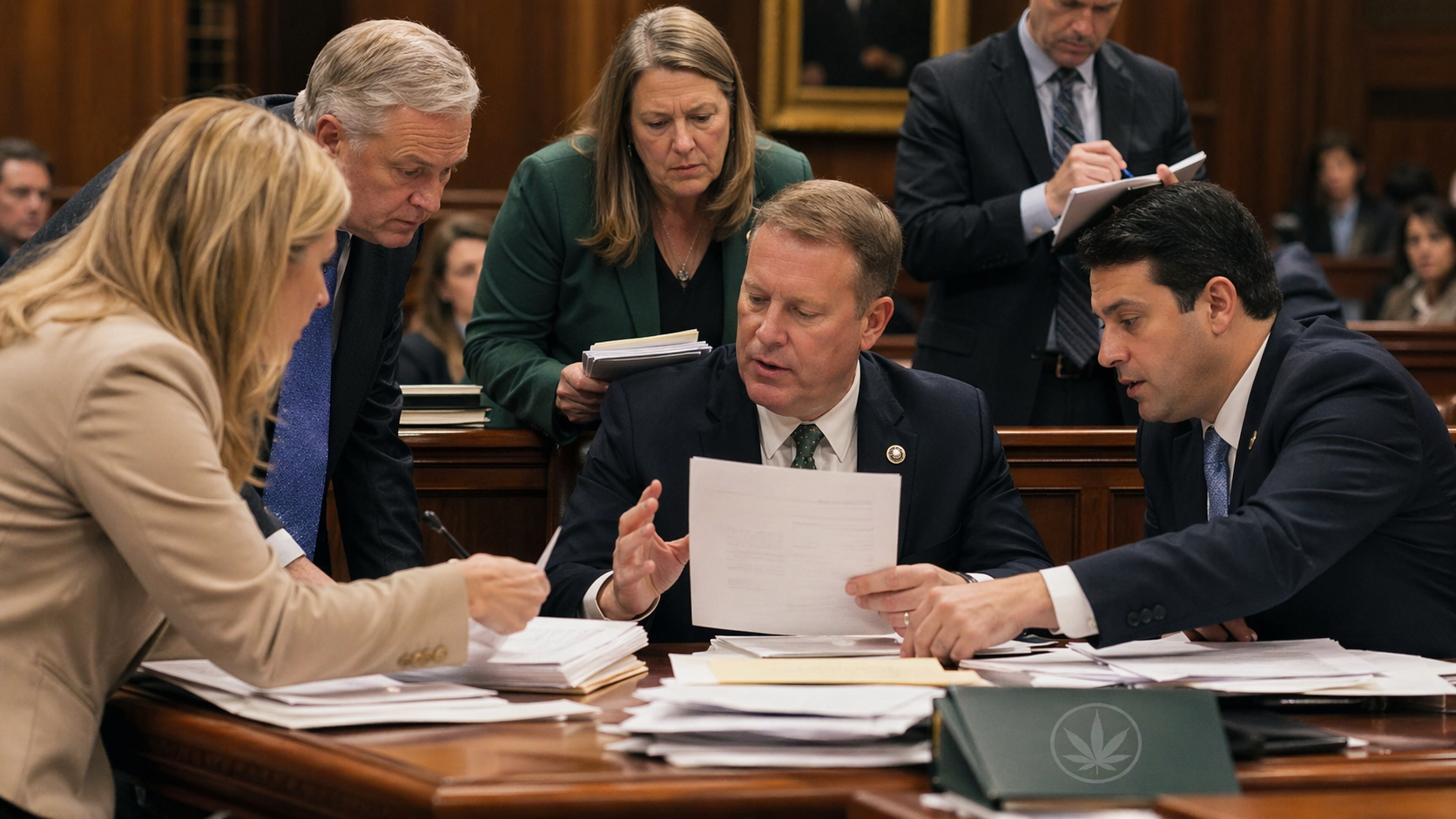
Virginia lawmakers reviewing cannabis sales legislation in the statehouse, showing the dispute over substitute amendments and the uncertain path for adult use retail sales.
Virginia’s adult use cannabis sales bill is back in a high stakes holding pattern. Lawmakers rejected Gov. Abigail Spanberger’s substitute changes and sent the original bill back to her desk, even though that raises the risk of a veto they likely cannot override. For operators, this is not just a political story. It is a market timing story. Virginia has adult use possession, but still no legal retail system, so every delay keeps the state stuck in an awkward middle ground where demand exists but the regulated sales channel does not.
Quick facts
• Cannabis Business Times reported that the Virginia Senate rejected the governor’s substitute by a 21 to 18 vote, while the House rejected it by voice vote.
• The original legislation would allow adult use dispensary sales to begin on January 1, 2027.
• The governor’s substitute would have delayed the launch to July 1, 2027, reduced possession limits from 2.5 ounces to 2 ounces, and increased the excise tax from 6 percent to 8 percent starting July 1, 2029.
• The substitute also would have lowered the dispensary cap from 350 to 200 stores before January 1, 2029, and removed dedicated tax allocations for programs including the Cannabis Equity Reinvestment Fund.
• Because lawmakers rejected the substitute, the governor can now sign the original bill, veto it, or allow it to become law without her signature. Cannabis Business Times reported that Democrats do not have the supermajority needed for an override if she vetoes it.
If Virginia timing affects your growth plan, Start with our quick Cannashield intake form so you can map exposure and plan for multiple outcomes.
Why lawmakers rejected the substitute
The core fight was not about whether Virginia should have a legal retail market. It was about what kind of market should be built and whether legalization should come with a return to tougher criminal enforcement. Cannabis Business Times reported that lawmakers rejected amendments that sponsors said would undermine restorative justice goals, including changes that would criminalize public cannabis use and underage possession and create a new felony for transporting certain amounts of cannabis. Sponsors argued those changes cut against the original intent of legalization.
That matters because the bill was never just a sales framework. It was also part of a broader attempt to build a system that does not repeat the enforcement harms of prohibition. When the substitute added tougher penalties, higher taxes, and fewer stores, lawmakers behind the bill decided they would rather risk losing the legislation entirely than accept a structure they believed moved Virginia backward. VPM reported the rejection reflected open disagreement between the governor and the legislature over the future of major Democratic legislation.
What the rejected changes would have meant for operators
The governor’s substitute would have changed several practical parts of the operating landscape. Cannabis Business Times reported the launch date would have moved from January 1, 2027 to July 1, 2027. It also would have reduced the possession limit, raised the excise tax later in the cycle, and lowered the cap on dispensary licenses from 350 to 200 before 2029. Those are not cosmetic edits. Those are direct changes to market access, customer capacity, tax burden, and competitive density.
For operators, the universal lesson is simple. In emerging cannabis markets, the risk is not just whether legalization happens. The risk is how the framework changes at the last minute. A state can look ready for launch on paper and still create real uncertainty through late tax edits, criminal penalty language, store caps, or shifting regulatory priorities. That is why operators need scenario planning, not just optimism. This is an inference based on the specific revisions proposed in Virginia’s substitute and the legislature’s rejection of them.
If uncertainty is affecting how you plan or negotiate, Complete our quick Cannashield intake form to pressure test your exposure.
What happens next
Now the bill goes back to the governor in its original form. Cannabis Business Times reported she can sign it, veto it, or let it become law without her signature. The problem for supporters is that if she vetoes it, lawmakers likely cannot override because they do not have the numbers for a supermajority. That means Virginia’s adult use retail path is still alive, but it remains politically fragile.
This is the broader operator lesson for high impact state markets. A legalization state is not truly open until the final decision is locked. Business planning has to account for timing risk, implementation risk, and the chance that a governor, regulator, or legislature changes the lane late in the process. Virginia is showing that even a politically favorable environment can still produce serious commercial uncertainty. This is an inference based on the bill’s procedural posture and the remaining veto risk.
If market timing is shaping your capital, hiring, or entry strategy, Complete our quick Cannashield intake form so you can identify weak points before the rules do it for you.
You might also like


Conclusion
Virginia lawmakers made a blunt choice. They rejected the governor’s substitute and sent the original cannabis sales bill back, even though that could kill the bill if a veto follows. For operators, the headline is not just political tension. It is a reminder that market readiness depends on final policy decisions, not hopeful assumptions. Virginia may still open the door to adult use retail sales, but until the governor acts, the market remains in limbo.
Educational note: This article is for education only and is not legal, regulatory, tax, or insurance advice.
What To Do This Week
• Review any Virginia market entry plan and build separate timelines for bill approval, veto, and delayed implementation. This is practical guidance based on the bill’s current status.
• Recheck tax and margin assumptions using both the original bill framework and the governor’s rejected substitute as planning scenarios. This is practical guidance based on the different excise tax structures reported.
• Monitor whether the governor signs, vetoes, or allows the bill to become law without a signature. This is practical guidance based on the next procedural step.
• Avoid treating projected launch dates as guaranteed until the bill is fully settled. This is practical guidance inferred from the current uncertainty.
• Review how store caps and possession limits would affect your model if Virginia changes course again in future rulemaking. This is practical guidance based on the substitute’s proposed revisions.
• Keep one clear memo on your Virginia assumptions so investors, partners, and advisors are working from the same facts. This is practical guidance inferred from the unstable legislative environment.
FAQ
What did Virginia lawmakers do?
They rejected Gov. Abigail Spanberger’s substitute changes to the adult use cannabis sales bill and sent the original bill back to her desk.
Why did lawmakers reject the substitute?
Sponsors said the substitute would undermine the bill’s intent by adding harsher criminal penalties and changing major parts of the framework, including taxes and rollout timing.
What would the original bill do?
The original legislation establishes a framework for a retail cannabis market in Virginia, with adult use dispensary sales beginning January 1, 2027.
What changes did the governor propose?
Reported changes included delaying sales until July 1, 2027, reducing possession limits, raising the excise tax later, cutting the store cap, and removing dedicated revenue allocations for certain programs.
Can lawmakers override a veto?
Cannabis Business Times reported they likely cannot, because they do not have the required supermajority.
What is the operator lesson here?
In state cannabis markets, late policy edits can change timing, margins, and market structure fast, so operators need multiple planning scenarios, not just one. This is an inference based on Virginia’s bill fight.

Trulieve and Cronos have each gained roughly 27 percent in 2026 while reporting stronger operating results. The broader signal is that public market attention is increasingly rewarding cash generation, improving margins, liquidity, and measurable revenue growth.