

BC Cannabis Delivery Enforcement Action Shows The Risk Of Unlicensed Online Sales
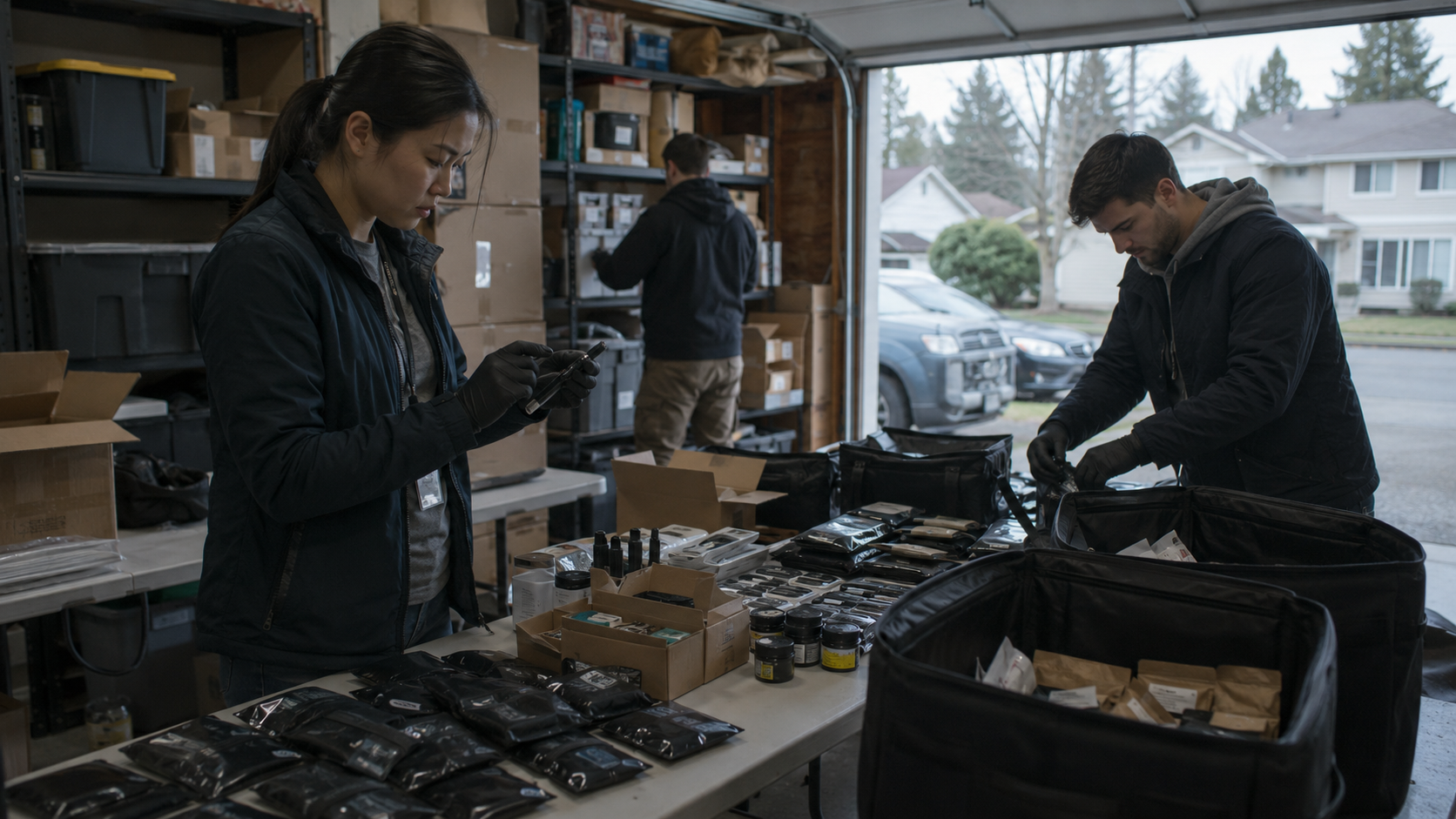
Workers sorting packaged cannabis inventory tied to illicit delivery enforcement.
Unlicensed online delivery remains one of the clearest pressure points in the cannabis market. StratCann reports that Mission RCMP in British Columbia arrested three people and executed search warrants at two Abbotsford properties connected to a website allegedly providing local delivery of cannabis and psilocybin. Police said the investigation began after parents reported that their children had purchased products from the website. Reported seizures included multiple cannabis packages, more than 1,000 edible cannabis products, more than 1,000 vapes, and psilocybin products, with lab testing still pending. For licensed operators, retailers, landlords, payment providers, and compliance teams, this is a reminder that youth access allegations can turn online sales activity into a serious enforcement event.
Quick facts
• Mission RCMP arrested three people in connection with an alleged online delivery operation
• Police executed search warrants at two Abbotsford properties
• The investigation began after parents reported that their children had purchased products from the website
• Police reported seizing multiple cannabis packages
• Officers also reported seizing more than 1,000 edible cannabis products and more than 1,000 vapes
• Psilocybin products were also reportedly seized
• Lab testing was still pending as of publication
• The universal operator lesson is simple: weak online controls and youth access allegations can quickly become an enforcement and reputational problem
If online sales, delivery controls, or youth access exposure is affecting your growth plan, complete our quick Cannashield intake form so you can map compliance, operational, and insurance risk before enforcement pressure escalates.
Why this enforcement action matters
This story matters because it shows how fast online delivery can become an enforcement problem when regulators or police believe products are reaching minors. The alleged website was not just accused of selling cannabis. It was also tied to reported psilocybin sales and youth access concerns. That combination makes the situation more serious for everyone watching the market.
For licensed businesses, the danger is not only the illicit competition. It is the public perception that online cannabis sales are loose, hard to control, and vulnerable to underage access. Every case like this gives regulators and enforcement agencies a reason to tighten scrutiny across the broader delivery space.
Why youth access changes the stakes
Youth access is one of the fastest ways for a cannabis compliance problem to become politically sensitive. Adults may argue about market freedom, product choice, or whether enforcement is too aggressive. That debate changes quickly when children are alleged to have bought products online.
This is where licensed operators need to be sharp. Age verification, order review, customer recordkeeping, payment controls, website restrictions, and delivery procedures are not just operational details. They are part of the business defense file. If a regulator or enforcement agency starts asking questions, a company needs to show that its controls are real and consistently used.
This is the universal operator lesson. In cannabis, youth access controls are not optional safeguards. They are core market access protections.
If uncertainty around age verification, delivery procedures, or website controls is affecting how you plan, complete our Cannashield questionnaire to pressure test your exposure before a weak process becomes a public problem.
Why landlords and payment providers should care
This kind of case is also important for landlords and payment providers. A property that appears to be a simple storage or delivery site can become part of an enforcement action if it is tied to unlicensed product movement. Payment providers also face risk when online sales involve questionable products, poor age controls, or activity that appears outside the legal framework.
That means third parties should not assume cannabis related activity is compliant just because it looks organized online. They need to understand who the operator is, what licenses are held, what products are being sold, how customers are verified, and whether delivery activity matches local law.
What licensed operators should learn from this
Licensed operators should treat stories like this as compliance case studies. The goal is not only to avoid illegal conduct. The goal is to avoid sloppy process that creates enforcement questions or makes the legal market look weak.
That means checking website language, confirming delivery boundaries, documenting age verification, reviewing product listings, tightening intake procedures, and making sure staff know how to reject questionable orders. A legal business can still create risk if its controls are loose, inconsistent, or poorly documented.
If you need to organize delivery, website, product, and insurance records before your next audit, renewal, or expansion step, use the Cannashield intake form to identify weak points and build a cleaner compliance file.
You might also like


Conclusion
The Mission RCMP action in British Columbia is a reminder that unlicensed online delivery remains a live enforcement issue, especially when youth access allegations are involved. The reported product seizures and search warrants show how quickly online sales activity can move from a website to a criminal investigation.
For licensed operators, retailers, landlords, payment providers, and compliance teams, the message is simple. Delivery and online sales need disciplined controls, not casual assumptions. In a regulated market, weak verification and unclear oversight can create problems far bigger than a single order.
Educational note: This article is for education only and is not legal, regulatory, criminal, financial, or insurance advice.
What To Do This Week
• Review website and delivery procedures for age verification strength
• Confirm product listings match what your licenses actually allow
• Check whether delivery staff follow documented identity and handoff procedures
• Review landlord, vendor, and payment relationships tied to online sales activity
• Audit whether complaints or red flags are escalated and documented quickly
• Build a short internal memo on youth access controls and delivery compliance gaps
FAQ
What happened in British Columbia?
Mission RCMP arrested three people and executed search warrants at two Abbotsford properties tied to a website allegedly providing local delivery of cannabis and psilocybin.
How did the investigation start?
Police said the investigation began after parents reported that their children had purchased products from the website.
What products were reportedly seized?
Police reported seizing multiple cannabis packages, more than 1,000 edible cannabis products, more than 1,000 vapes, and psilocybin products.
Why does this matter to licensed operators?
Because youth access allegations and online delivery activity can increase scrutiny across the legal market.
Why should landlords and payment providers care?
Because property use and payment activity tied to unlicensed or poorly controlled sales can create serious exposure.
What is the biggest operator takeaway?
Online cannabis sales need strong age verification, delivery controls, product oversight, and documentation.
SOURCES
StratCann, RCMP in BC target website reportedly selling cannabis, psilocybin to youth
https://stratcann.com/enforcement/rcmp-in-bc-target-website-reportedly-selling-cannabis-psilocybin-to-youth/
Royal Canadian Mounted Police in British Columbia
https://bc-cb.rcmp-grc.gc.ca/
Government of British Columbia, Cannabis in B.C.
https://www2.gov.bc.ca/gov/content/safety/public-safety/cannabis

The Netherlands' cannabis pilot is showing early improvements in regulated supply and track and trace systems, but packaging, potency guidance, hash availability, and consumer information still need work. The experiment offers a rare look at what happens when an established tolerated retail market attempts to convert its entire supply chain into a regulated system.