
California Condemnation Order Shows Why Track And Trace Protects Your License
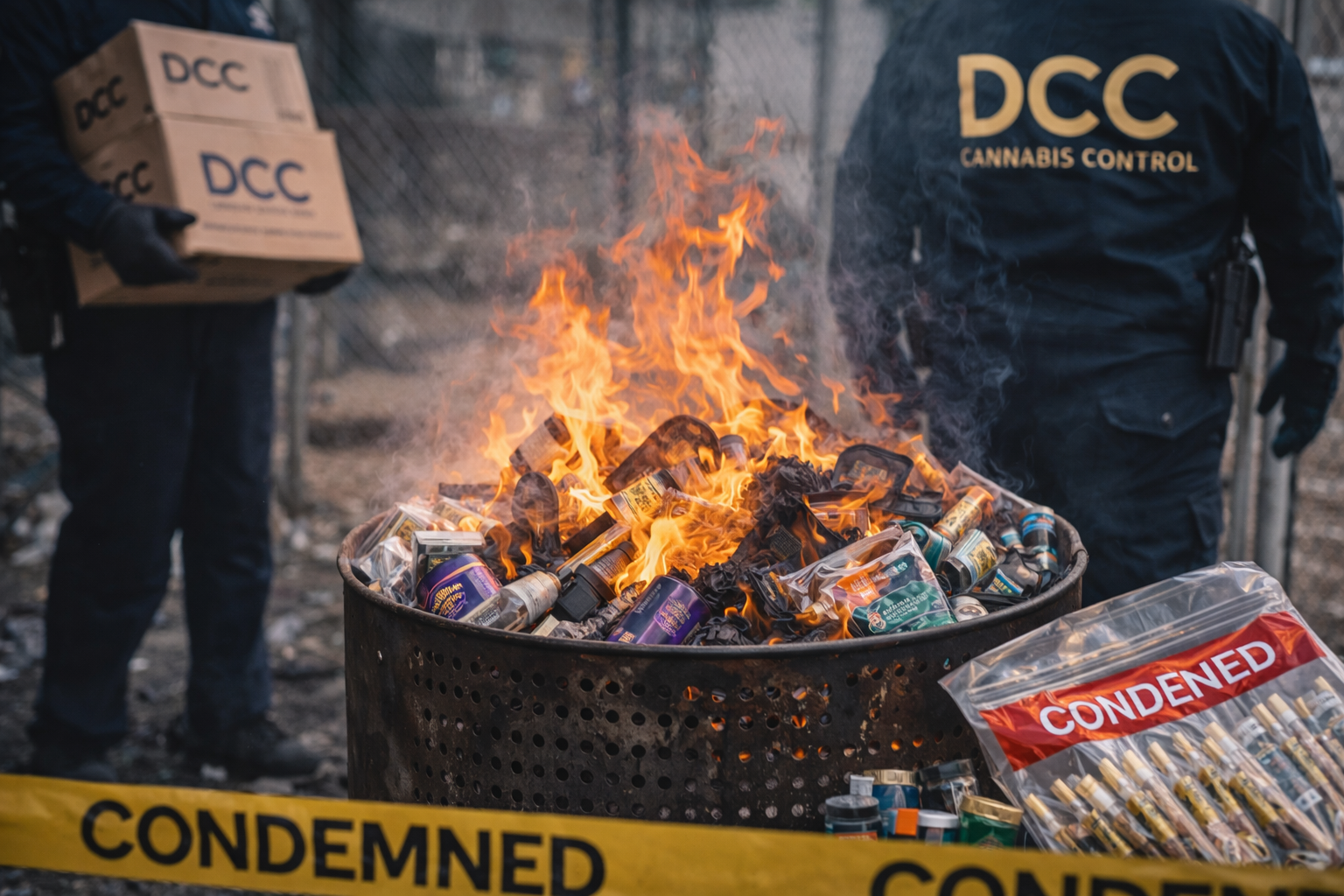
Inspectors reviewing a California cannabis condemnation order beside evidence bags and vape cartridges
A California cannabis condemnation order is the clearest reminder that compliance is not theoretical. It is physical inventory that can be destroyed under supervision, on a set timeline, with real cost recovery attached.
On March 3, 2026, the California Department of Cannabis Control adopted a stipulated settlement and condemnation order as a final decision against All Done Management Group, Inc. doing business as Packs South Los Angeles. The order set a 15 day window for destruction and disposal of embargoed cannabis and cannabis products, with DCC scheduling oversight availability on March 10, March 11, or March 12.
If you want a fast track and trace risk check for your operation, Start with our quick Cannashield intake form so you can map exposure and tighten your proof trail.
What Triggered The Embargo
According to DCC’s factual allegations, the issue started as a traceability problem during inspections in October 2025.
DCC staff reported finding bulk cannabis trim and several jars of distillate without unique identifier tags stored in refrigerators in the distribution area. Staff separated the cannabis and distillate identified as potentially unsourced, inventoried it, and placed it under embargo.
A second inspection in the cultivation area escalated the problem. Inspectors documented large quantities of plants and cuttings that did not have unique identifier tags, or had tags that were not assigned in the California Cannabis Track and Trace account. They also documented harvested plants hanging without unique identifier tags and without a harvest batch name or date to identify the harvest.
This is the core operator lesson. The moment your on site reality and your track and trace reality diverge, you are no longer “missing paperwork.” You are holding inventory that regulators may treat as unsourced.
Why Condemnation Is Worse Than A Recall
A recall is painful, but it is often narrow and it can sometimes be managed through pull, return, and documentation.
Condemnation is different. It is the state formally declaring that the embargoed inventory is subject to destruction at the licensee or product owner’s expense, under supervision. California’s enforcement framework allows DCC to embargo cannabis or cannabis products when it has probable cause to believe the products are adulterated or misbranded, or that sale would violate the rules.
In this case, the accusation states the respondent failed to provide documentation establishing the origins of the cannabis in its possession or a written plan for release of embargoed cannabis. The filing states that the cannabis was therefore misbranded and subject to condemnation under state law.
For any operator, the message is blunt. If you cannot prove origin and track and trace integrity, you are not arguing about minor errors. You are arguing about whether the inventory is legally sellable at all.
What The Order Required And The Real Money Impact
The inventory list under embargo was not small. It included multiple lots of biomass and trim, 1,500 clone cuttings, hundreds of vegetative and flowering plants across multiple cultivation rooms, 2,113 immature plants, and one harvest batch.
The order also included cost recovery. The stipulated settlement required payment of $6,599.25 in investigation and enforcement costs within 30 days of the effective date.
This is where operators get trapped. Condemnation hits you in three places at the same time:
Inventory value disappears
Labor time gets consumed by audit, segregation, and destruction logistics
Cash pressure rises because enforcement costs show up while revenue is disrupted
If you want a recall, embargo, and condemnation readiness checklist your manager can run without panic, Complete our Cannashield questionnaire and request the pack.
How To Build A Traceability Firewall
You do not need a perfect operation. You need a defensible one.
Treat unique identifier assignment as a daily production step, not an admin task
Tie every cultivation movement to a documented system action the same day
Require source documentation and transfer records to be stored with the batch file, not scattered across emails
Run a weekly internal audit that compares physical counts to system counts, then log the reconciliation
Create an embargo response SOP that includes quarantine, access control, and a written plan template ready to send
This is not about being paranoid. It is about being fast when scrutiny shows up. If an inspector asks “where did this come from,” you should be able to answer with documents, not stories.
If you want a simple track and trace audit worksheet plus a folder structure for UIDs, COAs, manifests, and batch records, use the Cannashield intake form.
Conclusion
California’s final condemnation decision against a licensed microbusiness shows how quickly missing traceability becomes forced destruction and cost recovery. The takeaway is universal: track and trace is not a compliance department issue. It is a survival system that protects inventory, cash flow, and your ability to operate.
Educational note: This article is for education only and is not legal, tax, or compliance advice.
What To Do This Week
• Run a physical to system reconciliation on one room or one product category and document the results
• Verify every distillate or concentrate input has a clean source file with UIDs and transfer records
• Create a quarantine area and a hold tag system so embargoed items cannot be accidentally moved
• Build a written plan template you can submit quickly if DCC requests a response to an embargo notice
• Centralize COAs, manifests, invoices, and UID screenshots in one batch folder per run
• Schedule a monthly mock inspection pull where you retrieve proof for one batch in under 10 minutes
FAQ
What is a condemnation order in California cannabis enforcement
It is a final action where embargoed cannabis or cannabis products are ordered destroyed under supervision because they cannot be legally released for sale.What triggered this case
DCC alleged inspectors found cannabis and distillate without UID tags and large quantities of plants without assigned traceability in the track and trace system.Why does missing UID assignment matter
If inventory cannot be traced to a compliant source through the required system, regulators may treat it as unsourced and misbranded.What did the order require
Destruction and disposal of listed embargoed inventory within a set window under DCC supervision, plus cost payment requirements.How much were the investigation and enforcement costs in this case
The order lists $6,599.25 in investigation and enforcement costs.What is the universal operator lesson
If your physical inventory and your track and trace records do not match, you are exposed to product holds, destruction, and cost recovery.