

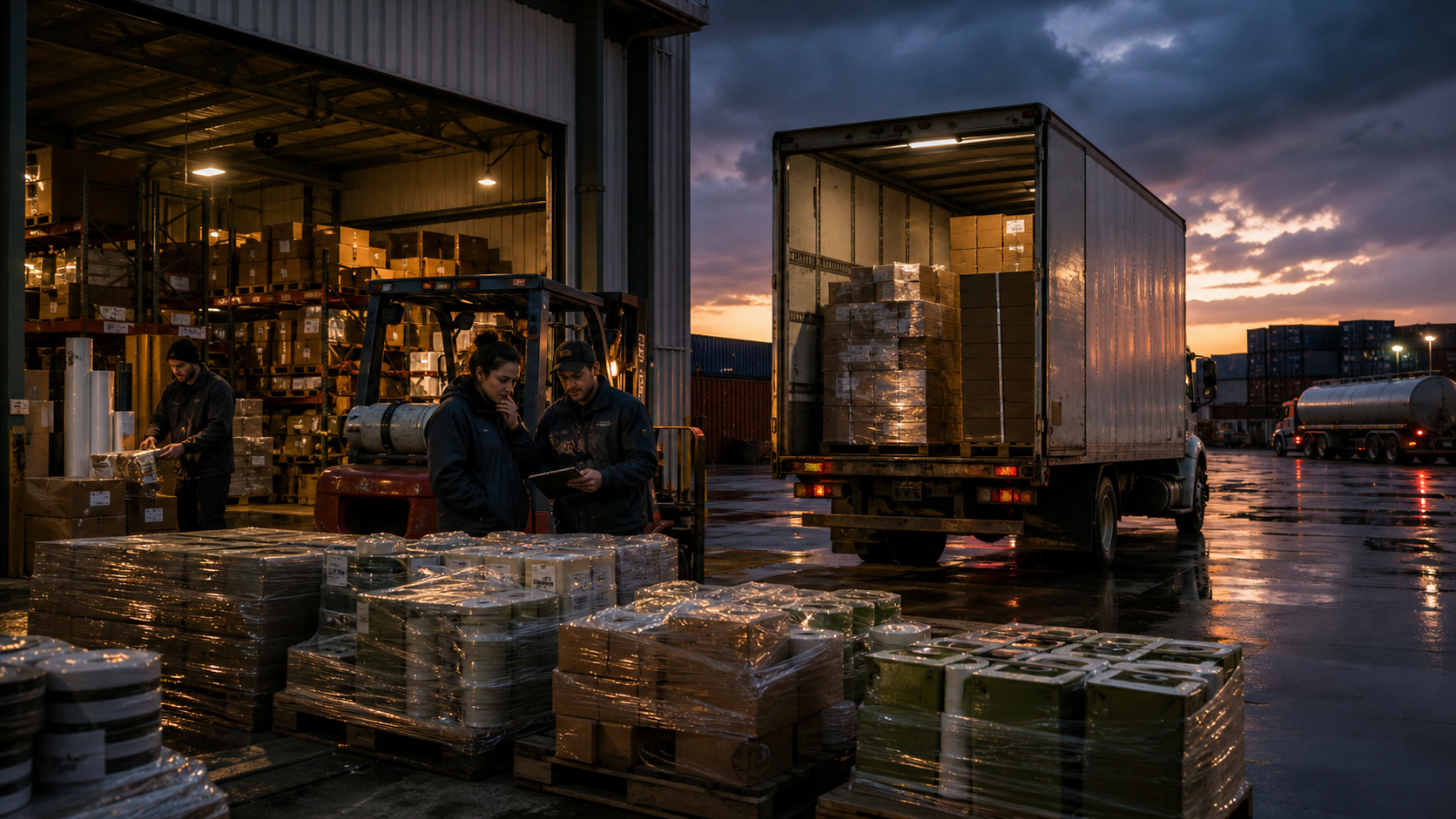
Cannabis warehouse loading shipments during freight delays and rising logistics costs.
Cannabis supply chain risk is getting harder to ignore. MJBizDaily reports that fuel cost spikes and global supply chain disruption tied to the U.S. led war on Iran are creating new pressure for cannabis operators, retailers, distributors, and packaging suppliers. For businesses already dealing with price compression and tax pressure, this is not just another international headline. It is an operating problem that can hit freight costs, inventory timing, packaging availability, and retail margins all at once.
Quick facts
• MJBizDaily reports that fuel cost spikes are increasing pressure across the cannabis supply chain
• The reported disruption is tied to the U.S. led war on Iran and wider global shipping stress
• The article points to higher shipping costs, canceled orders, and force majeure issues
• Cannabis operators are also dealing with limited supply chain redundancy
• Packaging suppliers, distributors, retailers, and operators may all feel the impact
• The universal operator lesson is simple: when outside shocks hit logistics, disciplined inventory and backup vendors matter more than ever
If supply chain uncertainty is affecting your growth plan, Start with our quick Cannashield intake form so you can map operational, inventory, and insurance exposure before disruption turns into a margin problem.
What this market signal really means
The most important part of this story is not just that freight costs are rising. It is that operators are being squeezed from multiple directions at the same time. Higher fuel costs can raise shipping expenses. Canceled orders can throw off production timing. Force majeure language can limit what a vendor is required to do when outside disruption affects performance. Limited supplier redundancy means many businesses may not have an easy backup when one link in the chain breaks.
That combination matters because cannabis businesses are not operating in a low pressure environment to begin with. Many are already facing tax pressure, margin compression, and pricing competition. When supply chain friction gets layered on top, a manageable business can start feeling unstable very quickly.
Why packaging and freight matter so much
Packaging and shipping are often treated like back office functions until they fail. That is a mistake. If packaging is delayed, the product may not get to market on time. If freight costs jump, the margin on each unit gets thinner. If suppliers cancel orders or invoke force majeure, operators can get stuck holding inventory that cannot be finished, shipped, or sold on schedule.
This is why supply chain discipline matters beyond logistics. It affects forecasting, cash flow, production scheduling, wholesale commitments, and retail execution. A cannabis company may have product ready to move, but if packaging components or freight lanes become unreliable, the business still takes a hit.
This is the universal operator lesson for every market. Supply chain strength is not only about having product. It is about how many weak points sit between your product and the shelf. The more fragile the chain, the more exposed the business.
If rising freight costs, vendor delays, or order uncertainty are affecting how you plan, Complete our quick Cannashield intake form to pressure test your inventory discipline, vendor mix, and operating exposure.
Why inventory discipline becomes a survival tool
This kind of disruption usually exposes the difference between businesses that planned ahead and businesses that ran too close to the edge. Operators with clearer forecasts, stronger vendor communication, and some inventory cushion are generally in a better position than those relying on tight timing and a single source for key materials.
That does not mean every company should start over ordering. It means operators need to understand which items are critical, which vendors are replaceable, and where lead times could stretch without warning. A warehouse full of the wrong inventory does not solve the problem. But running too lean while global freight conditions deteriorate can create its own crisis.
This is where leadership needs a more practical view of the supply chain. Which packaging items are hardest to replace? Which suppliers are overseas? Which product lines are most vulnerable to cost spikes? Which customers are least tolerant of delay? Those answers matter more now than they did a month ago.
The operator lesson
The temptation is to treat this as a temporary global disruption story. It is more useful to treat it as a business continuity story. Operators, retailers, and manufacturers should assume that geopolitical risk can affect cannabis even when the product itself is local. Packaging, freight, inputs, and vendor obligations all sit inside a broader global system.
The businesses that handle this best usually do a few things early. They review freight assumptions. They identify backup vendors. They tighten purchase planning. They talk to suppliers before delays become excuses. They also stop treating operations and risk management as separate conversations.
If you need to assess how rising shipping costs, canceled orders, or vendor concentration could affect your operation, Complete our quick Cannashield intake form to organize your exposures and planning priorities in one place.
You might also like


Conclusion
The reported pressure from fuel spikes and supply chain disruption is a reminder that cannabis businesses do not operate in isolation. Global conflict can show up in a warehouse, on a purchase order, in a packaging delay, or in a thinner retail margin.
For operators, the lesson is simple. Tighter supply chain planning, higher inventory discipline, adjusted freight pricing, and stronger backup vendor relationships are no longer optional habits. They are part of staying stable when the market gets hit from the outside.
Educational note: This article is for education only and is not legal, regulatory, tax, financial, or insurance advice.
What To Do This Week
• Review which packaging items or inputs rely on a single vendor
• Identify where freight cost increases could reduce margin the fastest
• Ask key suppliers about lead times, contingency planning, and force majeure language
• Separate critical inventory from noncritical inventory so planning is clearer
• Build a short list of backup vendors for packaging, freight, and key supplies
• Revisit pricing assumptions if shipping or sourcing costs continue to rise
FAQ
What is driving this cannabis supply chain pressure?
MJBizDaily reports that fuel cost spikes and global disruption tied to the U.S. led war on Iran are increasing pressure on the cannabis supply chain.
Who is affected by this?
Operators, retailers, distributors, manufacturers, and packaging suppliers may all be affected.
Why do fuel costs matter so much?
Higher fuel costs can increase shipping expenses and squeeze margins across the supply chain.
What does force majeure mean in this context?
It generally refers to contract language that may excuse or delay performance when outside events disrupt operations.
Why is limited supply chain redundancy a problem?
Because businesses with only one key supplier or one logistics path have fewer options when disruption hits.
What is the biggest operator takeaway?
Treat supply chain planning like risk management. Review vendors, inventory, and freight assumptions before disruption gets worse.
SOURCES
MJBizDaily, Fuel costs and canceled orders, how the U.S. led war on Iran is hurting cannabis
https://mjbizdaily.com/news/fuel-costs-and-canceled-orders-how-the-us-led-war-on-iran-is-hurting-cannabis/615798/
U.S. Energy Information Administration
https://www.eia.gov/
Federal Maritime Commission
https://www.fmc.gov/

Trulieve and Cronos have each gained roughly 27 percent in 2026 while reporting stronger operating results. The broader signal is that public market attention is increasingly rewarding cash generation, improving margins, liquidity, and measurable revenue growth.