

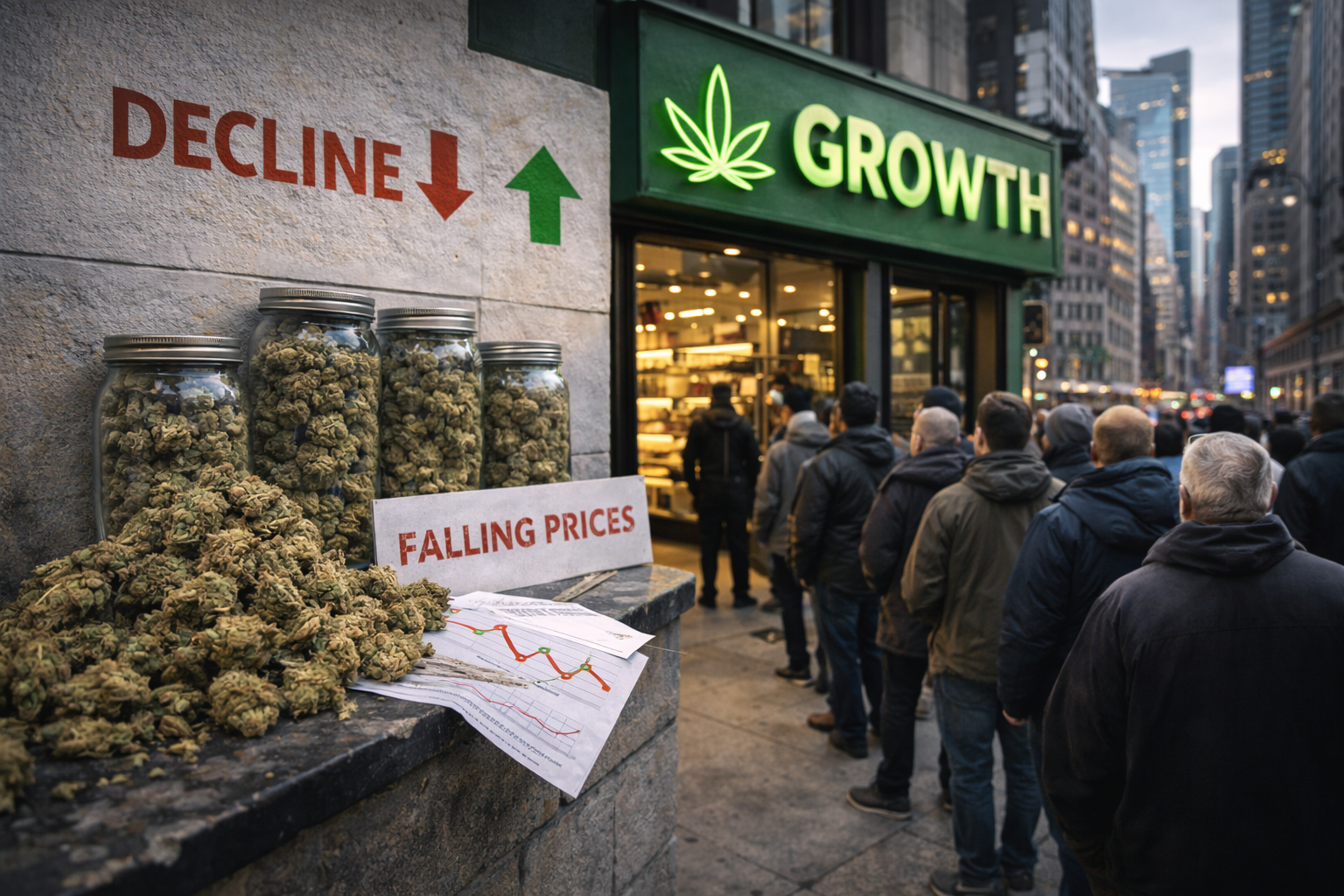
Dispensary exterior with a customer line showing the split between fast growth markets and price compression in mature markets
Cannabis market data in 2026 is splitting the United States into two realities. Emerging markets are still growing fast as new licensed stores open and consumers shift into regulated buying. Mature markets are seeing flat or declining revenue as competition and oversupply compress prices. For operators, this is not a headline to debate. It is a planning signal that should change where you put time, capital, and inventory.
Quick facts
• New York February 2026 sales: about $163.5 million, up 54.8 percent year over year, average item price about $31.29
• California February 2026 sales: about $286.9 million, down 6.4 percent year over year, average item price about $18.44
• Illinois February 2026 sales: about $113.3 million, down 10.2 percent year over year, average item price about $28.47
• Oregon February 2026 sales: about $66.9 million, down 5.7 percent year over year, average item price about $12.26
• Washington February 2026 sales: about $79.1 million, down 10.0 percent year over year, average item price about $11.99
• Connecticut February 2026 sales: about $22.2 million, up 0.2 percent year over year, with strong unit growth and falling prices in key categories
If market timing is affecting your growth plan, Start with our quick Cannashield intake form so you can map exposure and plan for multiple outcomes.
Why Emerging Markets Are Still Running Hot
New York is the clearest growth market signal right now. February 2026 sales were about $163.5 million, with growth of 54.8 percent year over year. Prices remain high, but they are already easing, which is what you expect as more stores open and product variety increases.
New York regulators are also telling the same story from the inside. The Office of Cannabis Management reported total retail sales around $2.97 billion and noted nearly $250 million generated through the first three weeks of February, alongside continued dispensary expansion across regions.
Universal operator lesson for any emerging market: speed matters, but disciplined speed wins. The teams that build a clean local access map, keep documentation tight, and open with consistent operations tend to hold share when the next wave of competitors shows up.
What Is Breaking Mature Markets
California, Illinois, Oregon, and Washington show the mature market pressure pattern.
California is still the biggest market, but February 2026 sales were down 6.4 percent year over year and average item price softened to about $18.44.
Illinois posted February 2026 sales around $113.3 million, down 10.2 percent year over year, while prices remain among the highest at about $28.47, a sign that consumers may seek value elsewhere when cross border options exist.
Oregon and Washington show the sharpest price compression, with average item prices around $12.26 and $11.99 and sales down 5.7 percent and 10.0 percent year over year.
Universal operator lesson for mature markets: your edge is execution, not access. Tighten the cash cycle, cut SKU clutter, standardize packaging and hardware, and stop using discounts as your default strategy. In a low price environment, the operators who survive are the ones who can run clean, lean, and repeatable.
If you want to pressure test your margin and supply chain exposure, Complete our Cannashield questionnaire so you can see where your cash is leaking and what to tighten first.
Connecticut Shows The Middle Path
Connecticut is still growing, but it is also showing early signs of price pressure. February 2026 sales were about $22.2 million and flat year over year, while units increased sharply.
Headset highlights pre roll growth driven by falling prices, with pre roll average item price around $14.18. That is the warning sign every smaller market should watch. When units rise faster than dollars, your market is training customers on cheaper baskets.
Universal operator lesson for smaller markets: build discipline before compression arrives. Once production scales and more doors open, pricing drops fast unless you have real differentiation and tight cost control.
The Operator Playbook For 2026
Treat this split like two playbooks.
Growth market playbook: pick jurisdictions where access is real, get open on time, and build trust through consistency. Do not overbuild. Keep cash reserves, assume rules evolve, and document everything.
Mature market playbook: protect margin with fewer products, stronger vendor terms, and faster inventory turns. Compete on reliability, not noise.
Across both lanes, federal government friction still shapes financing and operational risk. That makes documentation discipline and cash planning more valuable than aggressive expansion.
If you want a copy and paste market split dashboard template to track sales, pricing, unit velocity, and compliance risk across states, use the Cannashield intake form to request it.
Conclusion
The 2026 cannabis market is widening into a growth lane and a compression lane. Operators who win will allocate resources based on market velocity, keep costs tight in mature states, and move with discipline in emerging states where the doors are still opening.
What To Do This Week
• Pick three target states and label each as growth lane or compression lane based on sales trend and price trend
• Build a simple category margin sheet for your top 20 SKUs and update it weekly
• Cut five slow moving SKUs to free cash and reduce packaging complexity
• Add a backup supplier for one high risk input such as vape hardware or child resistant packaging
• Standardize COA and invoice storage so any batch can be traced in minutes
• Assign one person to track local access signals such as licensing approvals and store openings
FAQ
Why is New York growing while mature states soften
New York is still expanding retail access and converting demand into licensed purchases, while mature markets are saturated and competing on price.Does price compression mean demand is gone
Not usually. It often means supply and competition increased, pushing down average prices and tightening margins.What is the single biggest risk in compression markets
Cash trapped in inventory and discounting that becomes permanent instead of strategic.What is the single biggest opportunity in growth markets
Winning early loyalty through consistent operations and clean compliance while the market footprint is still forming.Why do high prices matter in Illinois and Connecticut
Higher average prices can support revenue, but they can also push consumers to seek value through neighboring markets or alternative channels.What is the universal operator lesson across all states
Build two plans at once: a growth plan for access expansion and an execution plan for margin defense.