

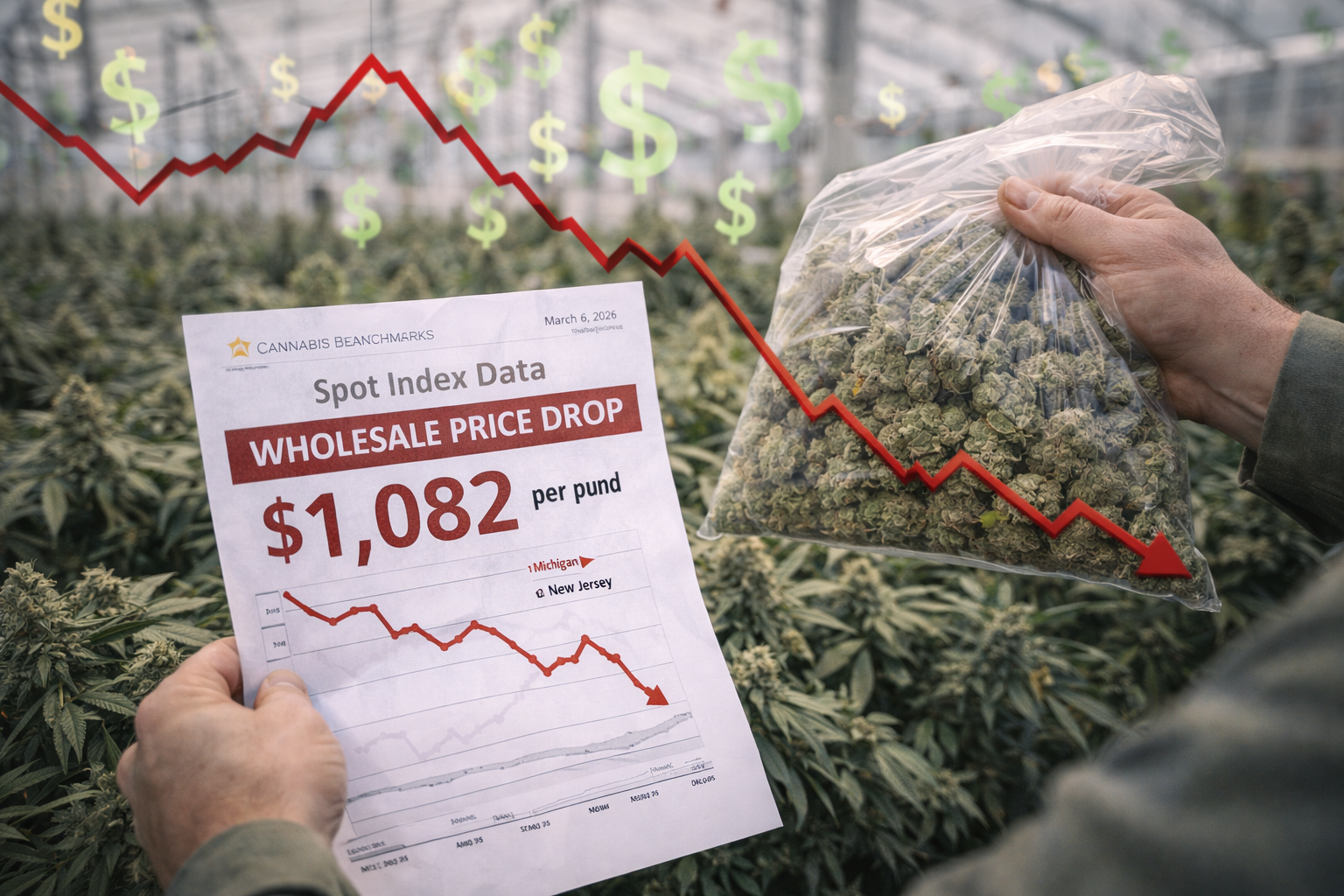
Greenhouse cannabis flower and wholesale benchmark report highlighting national spot price volatility
The cannabis wholesale spot price is moving again, and that is the kind of volatility that can quietly wreck margins if you are not ready. The latest U.S. Cannabis Spot Index fell to about $1,082 per pound, a level that instantly changes what cultivators can hold, what retailers can pay, and what everyone is forced to discount. When wholesale swings, retail does not get a vote. It gets a bill.
Quick facts
• National spot index decreased 3.7 percent to $1,082 per pound
• Spot price was $2.39 per gram
• Michigan spot index declined 18.2 percent with bulk flower declines across grow types
• Michigan greenhouse bulk pricing fell 27.4 percent and outdoor bulk pricing fell 21.6 percent
• New Jersey spot index fell 14.2 percent with greenhouse bulk pricing down 19.8 percent
• The report cites surplus bulk flower and bottom of range bulk transactions as key drivers
Wholesale volatility matters because it hits the cash cycle first. If you are a grower, it changes how fast you need to move inventory. If you are a manufacturer, it changes input costs and contract terms. If you are a retailer, it changes promotions, menu planning, and how much cash you can safely park in stock without getting trapped.
If wholesale volatility is forcing tough pricing or buying decisions, Start with our quick Cannashield intake form so you can map exposure and plan for multiple outcomes.
Why A National Spot Price Drop Hits Everyone
Wholesale pricing is the foundation under every other number. When it drops, two things happen fast.
First, buyers get picky. They demand better terms, shorter payment windows, or deeper discounts. Second, sellers get desperate. They flood the market with bulk inventory to raise cash, which pushes prices down again. That loop is how a small move becomes a slide.
This is why the spot index is such a useful signal. It is not a marketing stat. It is a real time indicator of what licensed buyers are willing to pay for bulk flower in the legal wholesale market.
Universal operator lesson: if your business only works at one price level, you do not have a business, you have a market bet.
Michigan And New Jersey Show The Real Problem
The national number is important, but the state moves explain the why. Michigan saw a major weekly turn with an 18.2 percent decline, and the report points to surplus bulk flower dragging the market lower. The details matter because they show where the pressure is concentrated: bulk greenhouse flower and bulk outdoor flower fell hard.
New Jersey also took a sharp hit, with the state index down 14.2 percent, driven by greenhouse bulk transactions priced at the bottom of the range. That is a classic sign of a market clearing event. Someone is moving product at any price to free up space and cash.
These state moves are your warning label for every mature market. When bulk supply stacks up, price drops are not polite. They are violent, and they pull everyone into a discount mindset.
Universal operator lesson: bulk oversupply does not stay in cultivation. It turns into retail promotions, thinner margins, and weaker tax receipts.
If you need to pressure test how a 15 to 25 percent wholesale move would hit your margins, Complete our Cannashield questionnaire to get a pricing and cash cycle stress test worksheet.
How Wholesale Volatility Changes Retail And Tax Reality
Retailers feel wholesale drops in two waves. Wave one looks positive. Input costs soften and deals appear. Wave two is the trap. Competitors use those deals to cut price, customers get trained on discounts, and basket value slides.
States feel it too. When wholesale and retail prices fall, taxable sales can flatten even if unit volume is steady. That creates budget pressure, which often leads to policy reactions like tax changes, new fees, or enforcement pushes. Nobody should be surprised when lawmakers start hunting for revenue in the same markets where operators are fighting for survival.
Universal operator lesson: when prices compress, the smartest operators protect trust and cash flow, not ego.
Operator Playbook For A Volatile Wholesale Market
You cannot control the spot index, but you can control your response.
1. Build a bulk exposure map
List your top revenue SKUs and identify which ones are most sensitive to bulk flower pricing. If 40 percent of your margin depends on one category, that category is your risk.
2. Tighten inventory turns
In volatile periods, stale inventory is silent debt. Reduce slow movers, simplify your menu, and stop buying like the price will bounce next week.
3. Get serious about terms
Shorten payment windows, clean up invoices, and document every adjustment. Volatility creates disputes, and disputes create late payments.
4. Protect quality and documentation
When prices drop, some operators cut corners. That is where recalls, lab issues, and enforcement pain show up. Your goal is to look more professional when the market looks messy.
If you want a vendor terms and documentation checklist for wholesale volatility, use the Cannashield intake form to request it.
Conclusion
A spot price around $1,082 per pound is not just a number. It is a signal that supply pressure is still real and that bulk inventory is moving markets quickly. Michigan and New Jersey show how fast the floor can drop when surplus flower hits the channel. The operators who win in this environment do not guess the bottom. They tighten cash discipline, simplify SKUs, lock cleaner terms, and keep documentation strong enough to survive the next wave.
What To Do This Week
• Recalculate margin on your top 20 SKUs using a lower wholesale input assumption
• Cut five slow moving SKUs to free cash and reduce packaging complexity
• Tighten reorder rules so you buy based on turns, not hope
• Add a second supplier option for your most critical input or packaging component
• Centralize COAs, invoices, and batch records so you can pull proof fast
• Update payment terms language so responsibility and timelines are clear
FAQ
What is the U.S. Cannabis Spot Index
It is a weekly benchmark assessment of the national pre tax spot price paid to cultivators and wholesalers for one pound of bulk flower, based on Cannabis Benchmarks methodology.Why does a wholesale drop matter to retailers
It triggers price competition, changes promotion behavior, and can reduce basket value even when customer traffic stays steady.What did Michigan and New Jersey signal this week
Michigan saw an 18.2 percent weekly drop and New Jersey saw a 14.2 percent weekly drop, both driven by bulk flower pricing pressure.Does a lower spot price guarantee lower retail prices
Not always. Retail pricing depends on competition, inventory, taxes, and how aggressively operators discount.What is the fastest mistake operators make in price compression
Overbuying inventory because it feels cheap, then getting trapped when prices keep sliding.What is the universal operator lesson
Build a business that survives price swings by tightening cash cycle, simplifying SKUs, and running clean documentation.