

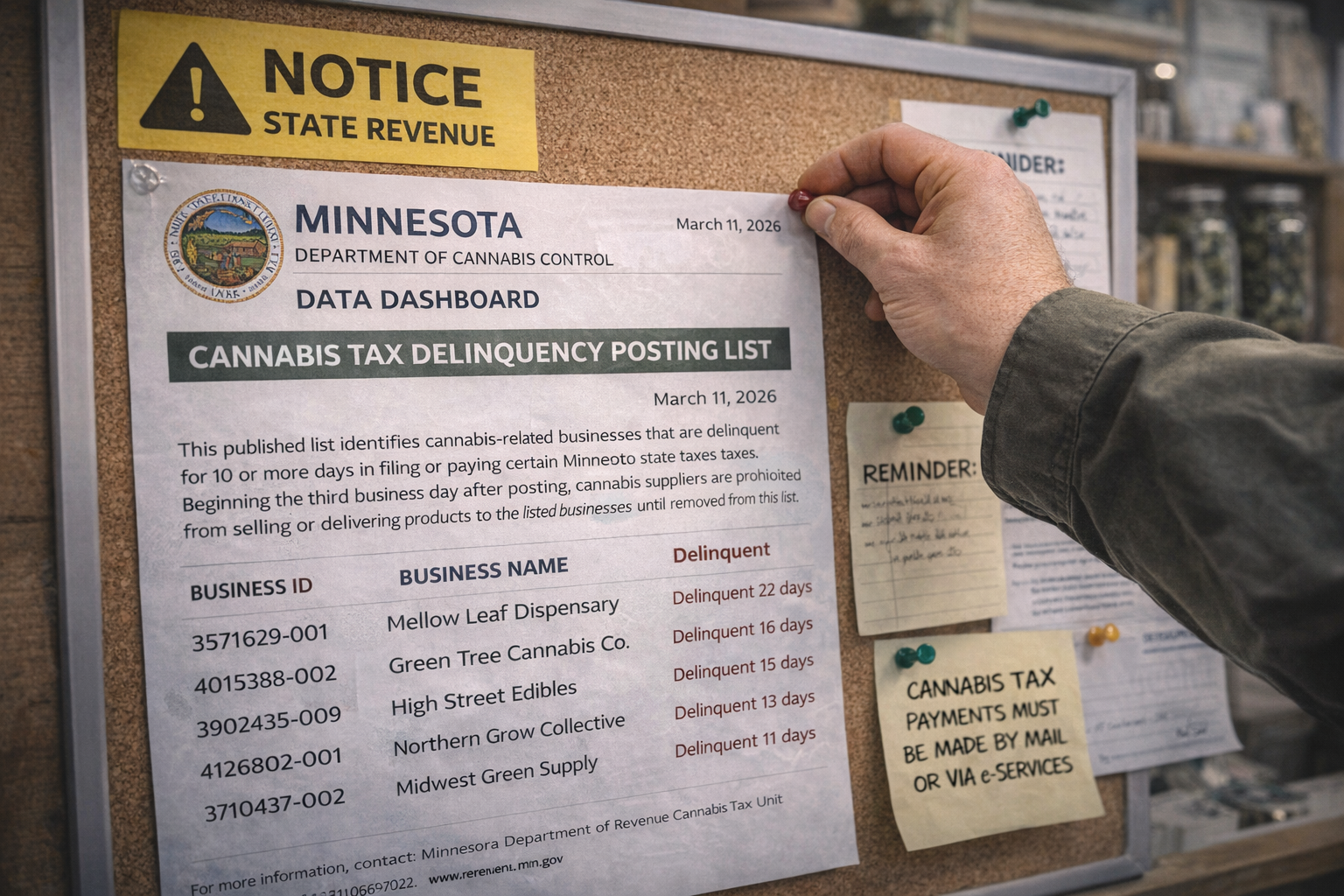
Tax delinquency list for cannabis sales in Minnesota showing no delivery rule after third business day
Minnesota published its cannabis tax delinquency posting list under state law, and it is not just a public notice. It is an operational stop sign. If a business lands on the list for being 10 or more days late on certain tax filings or payments, cannabis suppliers are prohibited from selling or delivering products to that business beginning the third business day after the posting date.
Quick facts
• The posting is issued as a tax delinquency list for cannabis sales and is updated on a regular schedule
• The list cites Minnesota Statutes section 270C.726 and states taxpayers on the list are 10 or more days delinquent
• Beginning the third business day after posting, covered cannabis suppliers may not sell or deliver any product to listed taxpayers
• Business days are Monday through Friday excluding state recognized holidays, and the list itself calls out a non delivery date tied to the posting
• The report separates newly posted names, previously posted names that remain restricted, and recently removed names where deliveries may resume
If you sell into Minnesota, Start with our quick Cannashield intake form so you can map vendor risk, delivery controls, and documentation before a shipment turns into a compliance issue.
What This List Really Is
Think of the posting list like a regulated buyer eligibility check. It is not saying a business is shut down. It is saying the supply chain must stop feeding them until they fix the tax problem and are removed. Minnesota Revenue is direct about the impact for a listed business: beginning the third business day after posting, the business cannot purchase retail taxable cannabis products for resale.
Universal operator lesson: in regulated cannabis, taxes can become a market access gate just like licensing.
Who Must Stop Deliveries
The prohibition is not aimed at one type of seller. It covers cannabis cultivators, cannabis manufacturers, cannabis microbusinesses, cannabis mezzobusinesses, medical cannabis combination businesses, cannabis wholesalers, and industrial hemp growers as defined in Chapter 342.
This is where operators get tripped up. A lot of teams treat tax issues as an accounts receivable problem. In Minnesota, it can become a compliance problem for the supplier too. Minnesota Statutes section 270C.726 makes the no delivery rule explicit, and it also points to penalties for violating it through sections 342.19 and 342.21.
Universal operator lesson: if you do not have a control that blocks shipments to restricted buyers, you are trusting luck with your license risk.
The Clock Starts Fast
The list is designed to move quickly. The prohibition begins the third business day after the date of the list, and the posting itself spells out how business days are counted.
That means you cannot rely on a weekly habit like “we check things on Fridays.” You need a repeatable process that matches the timeline: check the list before you confirm an order, check again before you ship, and log that you checked.
If uncertainty is affecting how you plan or negotiate wholesale terms, Complete our Cannashield questionnaire so you can pressure test your buyer screening workflow and your proof trail for auditors.
How To Build A Simple No Delivery Control
You do not need fancy tech to be compliant, but you do need consistency. Here is the practical setup that works for most suppliers.
Step one: assign ownership. One person owns the list check and the block list update.
Step two: create a single source of truth. Keep a simple spreadsheet or CRM field called Buyer Eligibility with three statuses: Clear, Blocked, Review.
Step three: hard stop in fulfillment. If a buyer is Blocked, shipping cannot print labels. No exceptions without documented approval.
Step four: keep proof. Save a PDF or screenshot of the list date you checked, plus a short log entry with date, time, and the staff initials. If a regulator ever asks why you delivered to someone, you need a real answer.
Step five: update customer communication templates. When a buyer is blocked, your team should be able to send one calm message explaining that the posting list restricts deliveries until removal, and that you will resume when the business is off the list.
Universal operator lesson: the difference between a controlled pause and a chaotic pause is documentation.
Getting Removed Is A Real Path
The list also shows a “recently removed” section and states deliveries may resume to those businesses. That matters because it confirms this is not permanent. It is a compliance gate with a way back through.
As a supplier, your goal is to restart safely. Treat removal like a reactivation step: confirm the name is in the removed section or no longer appears as posted, document the check, then reopen ordering.
If you want a copy and paste SOP for Minnesota posting checks, blocked buyer workflows, and documentation storage, use the Cannashield intake form and request the Minnesota Posting Control Pack.
Conclusion
Minnesota’s cannabis tax delinquency posting list is a direct supply chain rule with real consequences. It forces the industry to protect market integrity by cutting off product flow to businesses that are behind on tax filing or payment, and it puts the compliance responsibility on the entire supplier pipeline beginning the third business day after posting.
Educational note: This is for education only and is not legal or tax advice.
What To Do This Week
• Assign one owner for list checks and create a daily reminder tied to order processing
• Add a Buyer Eligibility field to your CRM or order system with Clear, Blocked, Review
• Build a two step check: before order confirmation and before shipment pickup
• Create a proof folder with saved postings and a simple log of every check
• Update your shipping workflow so blocked buyers cannot generate labels
• Draft one customer message template for blocked buyers that stays factual and calm
FAQ
What triggers placement on the posting list
Being 10 or more days delinquent in filing or payment of certain taxes, as described on the posting and in Minnesota Statutes section 270C.726.When does the no delivery rule start
Beginning the third business day after the list is posted.Who is prohibited from selling or delivering to listed businesses
Cannabis cultivators, manufacturers, microbusinesses, mezzobusinesses, medical cannabis combination businesses, wholesalers, and industrial hemp growers as defined in Chapter 342.What happens if a supplier delivers anyway
The statute says violations are subject to penalties referenced in sections 342.19 and 342.21.Can deliveries resume
Yes. The posting includes a recently removed section that states deliveries may resume to those businesses.What is the universal operator lesson
Treat buyer eligibility like a compliance control, not a bookkeeping detail, and keep proof of every check.