
Virginia Retail Cannabis Sales Are Set For January 1, 2027
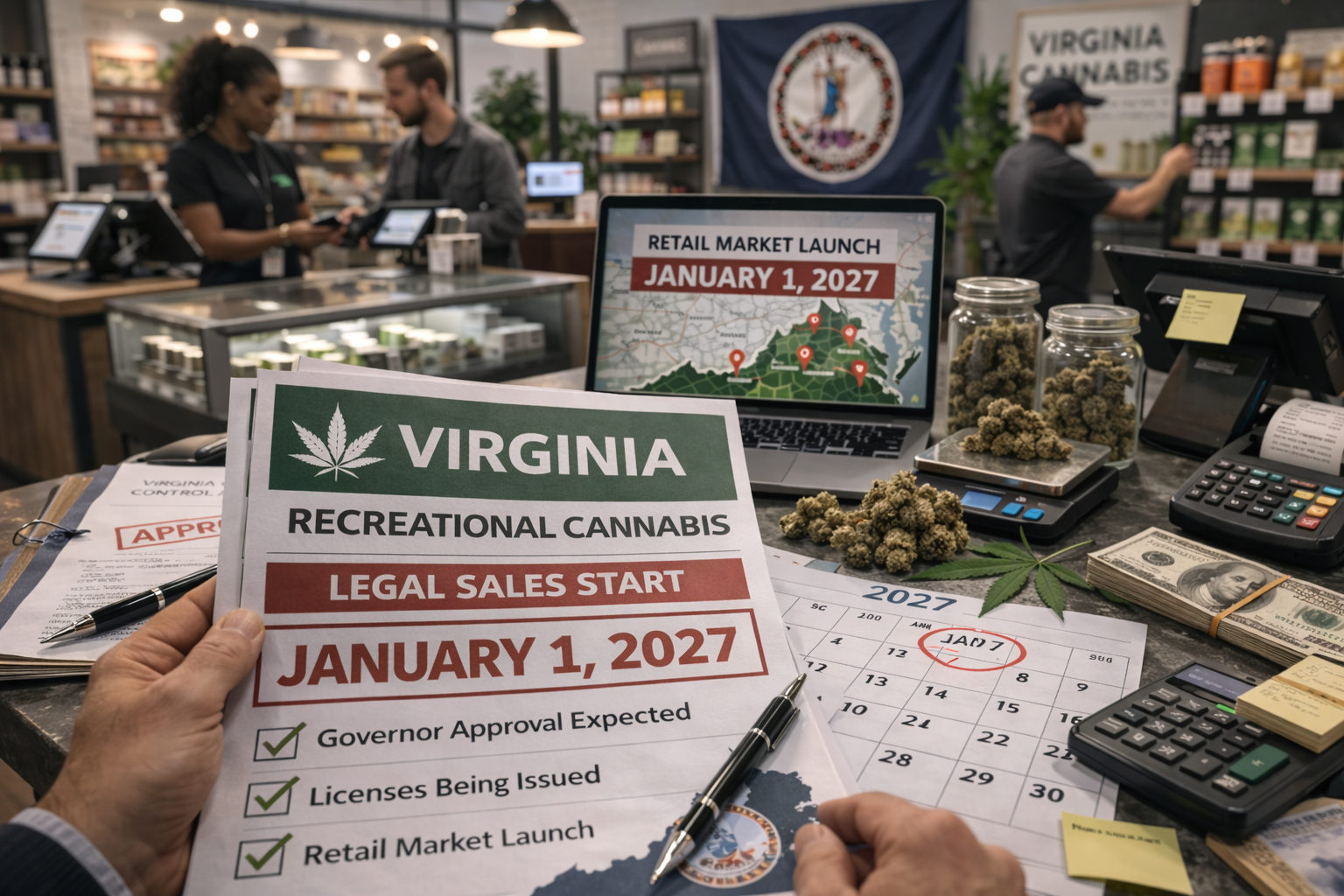
Retail launch calendar and Virginia market map on a planning desk for 2027 cannabis sales rollout
Virginia’s adult use cannabis retail market is finally moving from legal possession to legal sales. Lawmakers approved a compromise framework that sets recreational sales to begin January 1, 2027, pending expected signature by Gov. Abigail Spanberger.
Quick facts
• Retail sales start date: January 1, 2027
• Final votes: House 64 to 32, Senate 21 to 18
• State cannabis tax: 6% plus an optional local tax of 1% to 3.5%
• Retail license cap: 350
• Possession limit increase: 1 ounce to 2.5 ounces
• Localities cannot opt out of sales, but zoning still shapes where stores can operate
• Retail stores cannot be located within 1,000 feet of a school or day care
• Virginia Alcoholic Beverage Control Authority leads enforcement against illegal cultivation, sales, and distribution
If Virginia timing affects your growth plan, Start with our quick Cannashield intake form so you can map exposure, local access, and multiple outcomes before you commit capital.
Why This Virginia Shift Matters
This is a market access event, not a headline. Virginia already had legal adult possession, but no legal adult use sales system, which left demand in a messy gap. A retail framework changes how consumers buy, how operators invest, and how regulators enforce.
Universal operator lesson: possession without legal sales creates a demand vacuum that unregulated channels fill. When a state builds a retail lane, the winners are the operators who can execute cleanly on day one.
The Money And License Math That Will Shape The First Wave
The compromise keeps the Senate start date but leans toward the House tax structure. The bill sets a 6% state cannabis tax and allows localities to adopt an additional 1% to 3.5% local tax, on top of existing sales tax, which lawmakers said typically puts total tax around the low teens.
This matters for one reason: shelf price decides how quickly legal channels pull demand away from unregulated sellers. Higher taxes can slow conversion. Lower taxes can accelerate it. Either way, you should model pricing as a competitive system, not a guess.
The framework also caps retail cannabis establishment licenses at 350 and raises the possession limit to 2.5 ounces. Caps create early scarcity, and scarcity rewards teams that prepare early and pick jurisdictions wisely.
Local Access Still Decides Who Wins
Even when a state says localities cannot opt out, local access still decides the real map. Zoning rules, permitting timelines, community sentiment, and enforcement posture will create fast cities and slow cities. That is why the 1,000 foot buffer from schools and day cares matters in practice. It shapes site availability and lease pricing long before a store opens.
Universal operator lesson: state law creates the lane, but local approvals decide who actually gets on the road.
If local zoning and permitting uncertainty is affecting how you plan or negotiate, Complete our Cannashield questionnaire to pressure test your location assumptions and timeline risk before you sign a lease.
Enforcement And Compliance Are Built Into The Launch
Virginia is pairing market access with clearer enforcement lines. The framework puts the Virginia Alcoholic Beverage Control Authority in charge of enforcement against illegal cannabis cultivation, sales, and distribution, while the Cannabis Control Authority administers retail licensing and regulation.
It also adds new penalties for unlicensed activity, which is a reminder that legalization does not mean a relaxed environment. It usually means more structure, more documentation, and more enforcement clarity.
This is the part many operators underestimate. A new market is not just a sales opportunity. It is a compliance system coming online. If you cannot produce paperwork fast, you lose time. If you cannot train staff consistently, you create preventable risk. If you cannot control inventory and vendor records, you get dragged into problems you did not cause.
What Smart Operators Do In 2026
Treat 2026 as build year, not hype year.
Start with a two scenario plan. One scenario assumes the governor signs as expected and the state stays on track. Another assumes delays in rules, licensing cadence, or local approvals. Either way, you build the same foundation: documentation discipline, vendor qualification, inventory controls, and a locality short list.
Then build your timeline backwards. Your real bottlenecks will be local permits, buildout, staff hiring, and training, not the day the law takes effect.
Finally, watch how tax revenue is framed. The framework directs meaningful revenue toward public priorities and equity reinvestment programs, which tells you what lawmakers will defend and what they will scrutinize.
If you want a Virginia retail launch readiness checklist you can hand to your team, use our Cannashield intake form to request it so you can standardize site selection, compliance prep, and opening month operations.
Conclusion
Virginia’s retail cannabis market is set to begin January 1, 2027, pending expected signature by Gov. Abigail Spanberger, after final passage in the House and Senate. The operator takeaway is universal: early market windows reward disciplined execution, not fast talking. Build your locality map, model your tax stack, and get your compliance system tight before the rush.
What To Do This Week
• Build a Virginia locality shortlist and rank each by zoning friendliness and permitting speed
• Create a simple tax stack model using the 6% state rate plus your expected local rate range
• Draft a site checklist that includes the 1,000 foot buffer constraint and document how you verify it
• Create a compliance binder structure for licenses, vendor invoices, COAs, and training logs
• Write a staffing plan for opening month with clear roles for inventory, cash handling, and incident logging
• Set a weekly policy watch routine to track signing, agency rules, and local rollout timing
FAQ
When are Virginia retail cannabis sales expected to begin
January 1, 2027, under the final compromise framework, pending expected signature.What were the final vote counts
House 64 to 32 and Senate 21 to 18.What is the proposed tax structure
A 6% state cannabis tax plus an optional local tax of 1% to 3.5%, in addition to existing sales tax.Can localities block sales entirely
The framework says localities cannot opt out of recreational sales, but zoning and permitting still control where stores can operate.What is the retail license cap
The framework caps retail cannabis establishment licenses at 350.What is the universal operator lesson
Market access is a system. Local approvals, pricing, and documentation discipline decide who wins more than the headline date.