
Texas Hemp Court Order Slows the Rule Rewrite
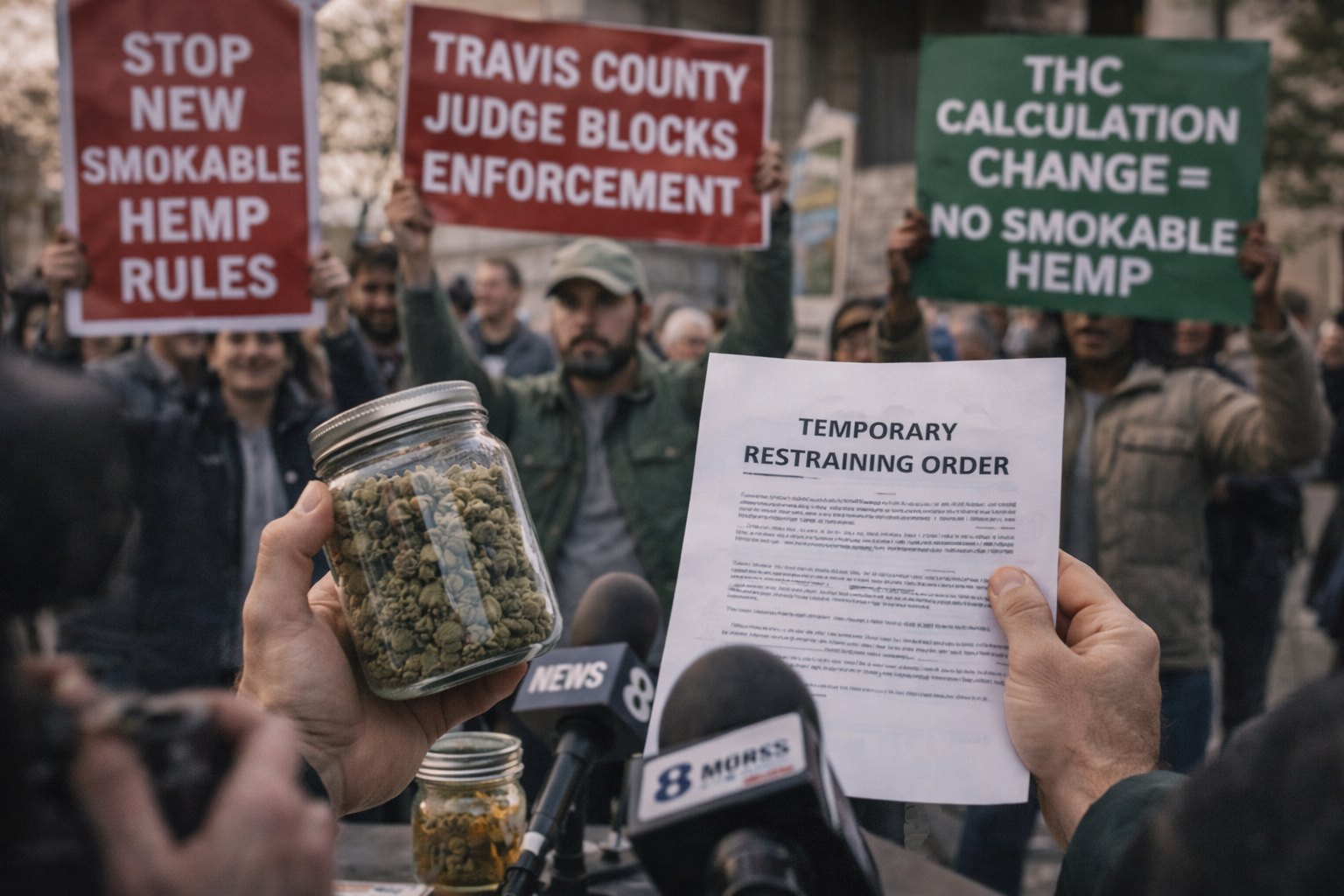
Texas hemp protest scene with court papers and smokable hemp products showing the legal fight over the state’s total THC rule change.
Texas smokable hemp rules just ran into a serious legal speed bump. A Travis County judge granted a temporary restraining order that blocks enforcement of part of the state’s new hemp rules that took effect March 31, after businesses argued the state changed the legal testing standard from a delta 9 approach to a total THC approach that includes THCA. That matters because the rule change effectively pushed many smokable hemp products such as flower, pre rolls, and certain concentrates out of the legal Texas market. For operators, the bigger lesson is simple. When compliance math changes, the shelf changes with it.
Quick facts
• Texas says the adopted consumable hemp rules took effect March 31, 2026.
• The official rule text includes THCA in the total THC formula and requires testing for delta 9 THC, total delta 9 THC, and total THC.
• TPR and KUT reported that Judge Maya Guerra Gamble blocked enforcement of the rules that prohibit the sale of smokable hemp, but did not block the higher annual fees.
• TPR reported the restraining order runs for two weeks and that a temporary injunction hearing is set for April 23.
• The adopted rules still set retailer registration fees at $5,000 per location and manufacturer license fees at $10,000 per facility.
If these Texas hemp rules are affecting your inventory or sales strategy, Start with our quick Cannashield intake form so you can map testing, labeling, and sell through exposure before enforcement pressure makes the decision for you.
What the judge actually blocked
The court did not freeze the entire Texas hemp rule package. According to TPR and KUT, the judge blocked enforcement of the part of the rules that effectively banned smokable hemp by changing how THC is calculated. That matters because Texas had moved from a market where many operators relied on delta 9 based compliance language to one where THCA now counts toward the compliance threshold. In plain English, the state tried to change the chemistry that determines whether a popular product can stay on the shelf.
The official rule text shows why the dispute is so important. Texas defines total THC using a formula that combines THC and THCA, and it requires testing before products are sold at retail, distributed, or otherwise introduced into commerce in Texas. The same rules say a consumable hemp product that exceeds the acceptable hemp THC level must not be sold at retail or otherwise introduced into commerce in the state. That is why operators saw this as more than a technical revision. It changed what could legally be sold.
What did not get blocked
The state still kept a lot of the new framework in place. TPR and KUT reported that the judge declined to block the higher annual fees, which means the financial pressure side of the March 31 rule package remains live for now. The Texas Register shows those fees at $5,000 per retail location and $10,000 per manufacturing facility. That means businesses may have won breathing room on smokable products without winning relief on operating cost.
The broader rule package also includes packaging, labeling, testing, and recordkeeping changes. TPR reported the lawsuit does not try to undo everything. It focuses on the total THC formula, higher fees, and rapidly escalating penalties, while leaving many product safety measures untouched. That is an important detail because it shows the fight is not really about whether hemp should be regulated. It is about how far agencies can go when they reshape a product category by rule.
If you want to pressure test how your COAs, labels, and margins would look under a strict total THC review, Complete our quick Cannashield intake form and request a hemp rule impact review.
Why this matters beyond Texas flower and pre rolls
Texas is a big signal state, so this matters outside Austin too. The operator lesson is not only about THCA flower. It is about rulemaking power, compliance math, and timing risk. When a state agency changes testing definitions, raises fees, and increases penalty pressure all at once, the commercial effect can be immediate even before a court decides who is right. Texas Tribune reported that the judge also temporarily unblocked interstate sales of smokable hemp while leaving fee issues for the April 23 hearing. That tells you the court saw enough risk to pause part of the rollout, but not enough to stop everything.
That is the universal operator lesson. If your revenue depends on a permissive testing interpretation, that revenue is not stable. It is conditional. That is an inference based on the adopted rule text, the temporary restraining order coverage, and the fact that the market changed as soon as the state changed the formula.
If uncertainty around Texas testing rules, fee pressure, or product mix is affecting your next move, Complete our quick Cannashield intake form so you can identify weak spots before the court or the state forces the issue.
You might also like


Conclusion
Texas hemp businesses got a short term win, but not a final one. The temporary restraining order slows the most disruptive part of the March 31 rollout by blocking enforcement of the total THC change that effectively knocked smokable hemp off the shelf. But the fee increases remain in place, and the next real checkpoint is the April 23 injunction hearing. For operators, the takeaway is simple: a court pause is breathing room, not certainty.
Educational note: This article is for education only and is not legal, regulatory, tax, or insurance advice.
What To Do This Week
• Pull every smokable hemp SKU and review the latest COA for delta 9 THC, total delta 9 THC, and total THC.
• Separate products that depend on THCA heavy formulations from lower risk inventory. This is practical guidance based on the adopted formula and the current lawsuit.
• Rework your fee assumptions using the current $5,000 retail and $10,000 manufacturing numbers.
• Review whether any out of state product flow could still create Texas compliance exposure.
• Track the April 23 hearing closely before making big inventory commitments.
• Build one clean file for each high risk SKU with label, COA, supplier record, and intended channel. This is practical guidance based on the testing and enforcement structure in the adopted rules.
FAQ
What did the judge block?
TPR and KUT reported that the judge blocked enforcement of the part of the rules that prohibited the sale of smokable hemp products.
What part of the rules is at the center of the fight?
The official rule text includes THCA in total THC and total delta 9 THC calculations, which changed how compliance is measured.
Did the court block the new fees too?
No. TPR and KUT reported that the judge declined to block the higher annual fees.
When is the next hearing?
TPR reported that the temporary injunction hearing is scheduled for April 23.
Are all the new Texas hemp rules gone now?
No. The adopted rules remain broader than the part blocked by the TRO, including testing, labeling, recordkeeping, and fee provisions.
What is the operator lesson here?
Do not assume a profitable hemp category is secure just because it was legal last month. If the testing formula changes, the commercial lane can change with it. This is an inference based on the March 31 rule rollout and the temporary restraining order.

Trulieve and Cronos have each gained roughly 27 percent in 2026 while reporting stronger operating results. The broader signal is that public market attention is increasingly rewarding cash generation, improving margins, liquidity, and measurable revenue growth.