
Texas Medical Cannabis Expansion Tightens the Lane
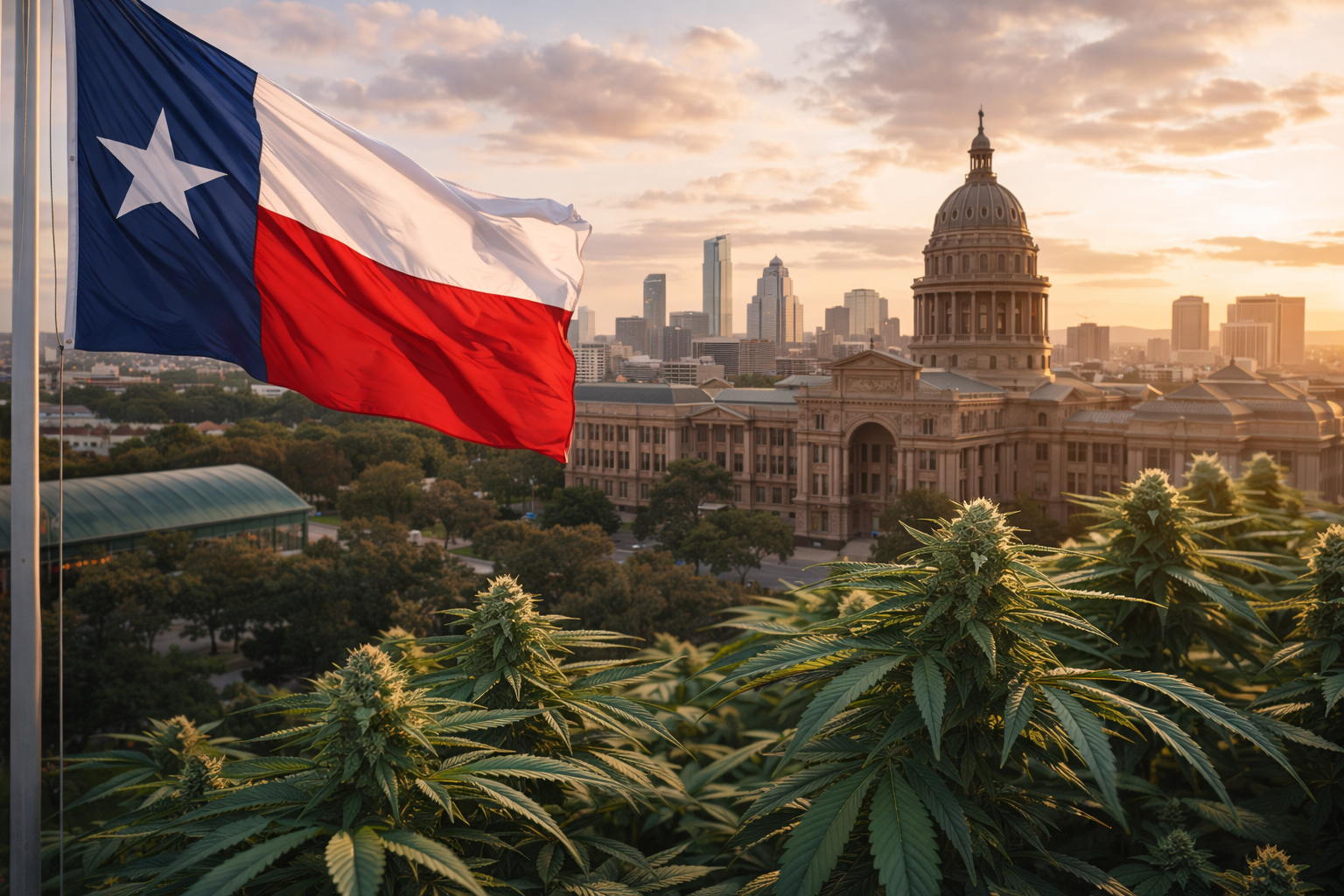
Texas medical cannabis scene with state symbols and cannabis plants illustrating new conditional licenses and program growth.
Texas medical cannabis licenses just became a bigger story than a routine state award notice. On April 1, the Texas Department of Public Safety said GTI Texas, doing business as RISE Dispensaries, Texas Medica Collective, and Cresco Labs Texas were selected to move forward for more due diligence in Phase Two of the Texas Compassionate Use Program expansion. That adds to the nine businesses conditionally selected in Phase One in December 2025. HB 46 set this expansion in motion, but it did not open Texas into a free for all. It kept the market limited, competitive, and heavily controlled, which makes every conditional license more valuable than it looks at first glance.
Quick facts
• DPS announced three Phase Two conditional selections on April 1, 2026: GTI Texas, Texas Medica Collective, and Cresco Labs Texas. Conditional status does not allow cultivation, manufacturing, distribution, or sales until final approval.
• HB 46 requires Texas to issue 15 total dispensing organization licenses, and DPS structured the expansion around 12 new licenses across two phases, which effectively grows the field beyond the small legacy group already operating in the program.
• Phase One added nine conditional selections in December 2025, and Phase Two added three more by April 1, 2026.
• HB 46 requires newly licensed businesses to begin dispensing within 24 months of licensure and continue operating or risk losing the license.
• HB 46 expanded qualifying access to include chronic pain, traumatic brain injury, Crohn’s disease and other inflammatory bowel disease, and terminal illness or hospice or palliative care.
• Texas now defines low THC cannabis at not more than 10 milligrams of tetrahydrocannabinols in each dosage unit, limits packages to one gram total, and allows pulmonary inhalation when medically necessary.
If Texas market entry or expansion timing is affecting your growth plan, Start with our quick Cannashield intake form so you can map licensing, operational, and distribution exposure before the lane gets tighter.
This is a scarcity story, not just a growth story
The biggest lesson here is that Texas is broadening access without giving up control. HB 46 says licenses must be issued in a way that ensures access in each public health region, but the law also keeps the program inside a competitive licensing structure. That means Texas is trying to solve access with a small number of serious operators, not by throwing open the doors. For companies looking at Texas, that matters more than the headlines. This is a limited license market where scarcity is still part of the business model. [Texas Medical Cannabis Compliance Checklist] [Limited License Market Entry Review]
There is another layer to it. Texas health officials also say new consumable hemp rules became effective on March 31, 2026. That does not make TCUP the only THC lane in the state, but it does mean the state is tightening the broader compliance environment at the same time it expands a narrow medical one. The practical read is simple: compliant access is getting more valuable.
Why these awards matter for patient access
The Texas story is not just about who won. It is also about where the state is trying to place capacity. DPS assigned the new Phase Two selections to Public Health Regions 9, 4, and 5, while the Phase One selections were spread across other regions. That fits HB 46’s requirement that licenses be issued and renewed in a way that ensures adequate access across Texas. In a state this large, geographic access is not a side issue. It is part of whether the program feels real to patients or stays stuck on paper.
If you want to pressure test whether your operating model fits a Texas style limited license market, Complete our quick Cannashield intake form and request a market entry review.
What Texas is really rewarding
Texas dispensing organization licenses are not light permits. The law requires applicants to show they can cultivate and produce low THC cannabis, secure the resources and personnel needed to operate, maintain accountability over materials and finished product, and financially support operations for at least two years. That is why these permits are effectively vertically integrated and compliance heavy. Texas is not rewarding casual participation. It is rewarding operators that can build a full stack medical platform and survive scrutiny. [Cannabis Documentation Controls] [Texas Patient Access Risk Map]
That is the universal operator lesson here. When a state expands through a small number of full responsibility licenses, the moat gets wider. Winners do not just get access to patients. They get a legal position that is harder to copy late, harder to undercut casually, and more valuable as the state tightens everything around it. That is an inference based on the law’s competitive structure, the limited number of licenses, and the operational requirements written into the program.
Conclusion
Texas is expanding medical cannabis, but it is doing it with discipline, not chaos. GTI and Cresco entering through conditional awards is a major signal because it shows Texas wants more patient access without giving up a tightly managed structure. For operators, the lesson is clear: when a big state expands through scarce, full responsibility licenses, compliance becomes a moat, not a chore
If uncertainty around Texas licensing, patient access, or competitive positioning is affecting your next move, Complete our quick Cannashield intake form so you can identify weak spots before time and capital get wasted.
Educational note: This article is for education only and is not legal, regulatory, tax, healthcare, or insurance advice.
What To Do This Week
• Map whether your Texas strategy depends on a license, a partnership, or a later acquisition path.
• Review how your product, staffing, and compliance model would hold up in a vertically integrated program.
• Separate hype from hard timelines by tracking final approval, not just conditional awards.
• Rework patient access assumptions around geography, delivery, and regional coverage.
• Pressure test your documentation stack for cultivation, manufacturing, dispensing, and reporting controls.
• Build a real view of how Texas policy shifts may change the value of compliant market access.
FAQ
Who received the new Texas conditional licenses?
DPS said GTI Texas, Texas Medica Collective, and Cresco Labs Texas were selected in Phase Two on April 1, 2026.
Are these companies allowed to operate right now?
No. DPS said conditional licenses do not authorize cultivation, manufacturing, distribution, or sales until final approval is granted.
How many total licenses is Texas aiming for?
HB 46 requires 15 total dispensing organization licenses statewide.
What changed for patients under HB 46?
The law expanded qualifying access to include chronic pain, traumatic brain injury, Crohn’s disease and other inflammatory bowel disease, and terminal illness or hospice or palliative care.
What makes these licenses so valuable?
Texas requires dispensing organizations to handle the full operating stack, including cultivation, production accountability, staffing, and long term operational capacity.
Why does this matter beyond Texas?
Because it shows how a large state can widen access while still protecting scarcity and compliance discipline. That is an inference based on the structure of HB 46 and the phased award process.