
Cannabis Automation Is Growing, But Budtenders Still Matter
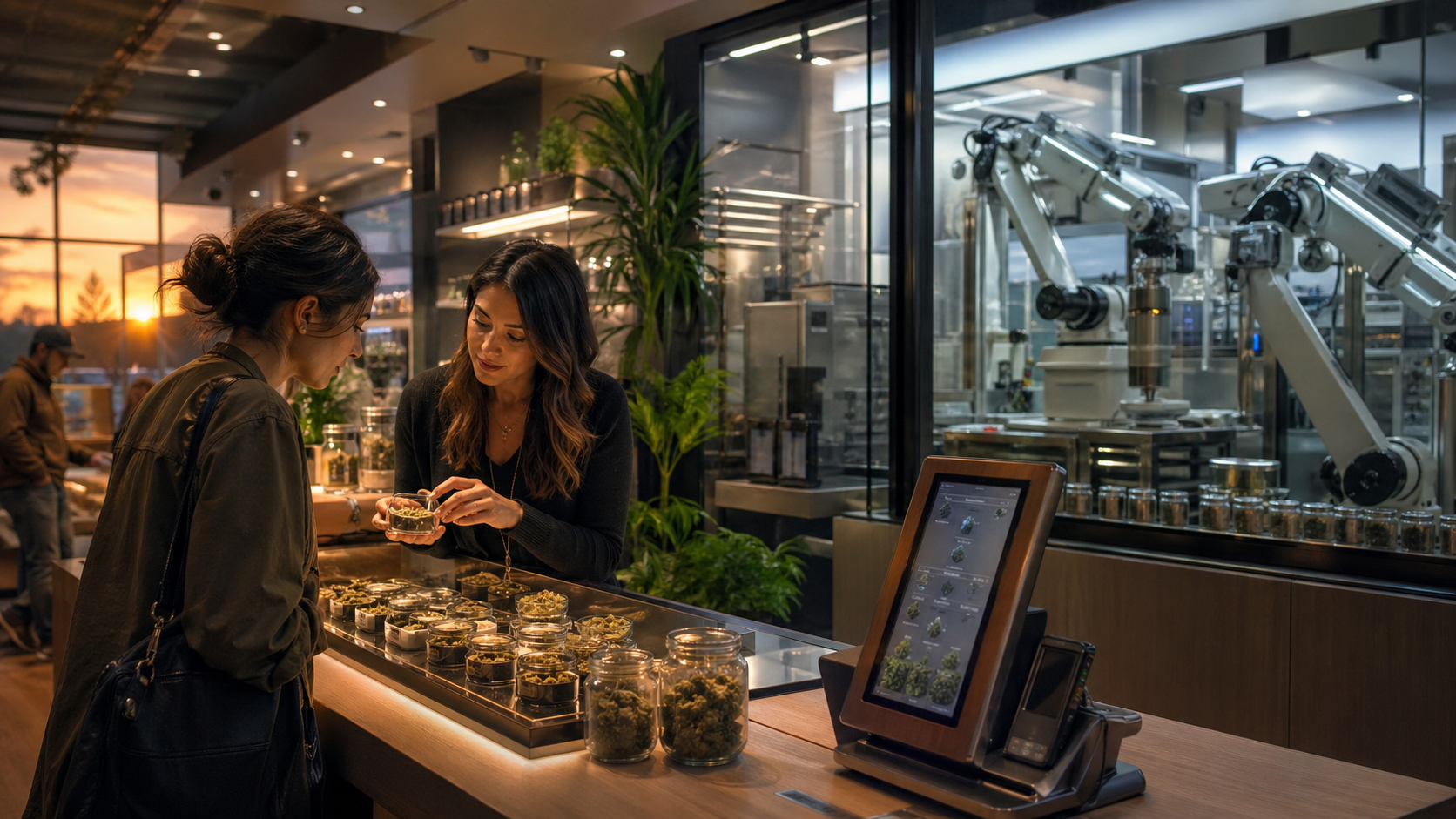
Budtender showing cannabis products to a customer as robotics and digital tools expand inside the dispensary.
Cannabis automation and AI adoption are moving deeper into daily operations, from cultivation and packaging to retail checkout and inventory workflows. What used to feel like a future conversation is becoming a present one, especially as operators look for ways to cut labor friction, improve consistency, and scale with tighter margins. But the shift is not as simple as replacing people with machines. Regulatory uncertainty has slowed some rollouts, and on the retail side, human guidance still plays a major role because budtenders continue to shape a large share of customer buying decisions.
Quick facts
• Automation is expanding across cannabis cultivation, packaging, and retail
• AI tools are helping operators improve workflow speed, consistency, and data visibility
• Regulatory uncertainty is still slowing full scale tech rollout in parts of the market
• Kiosks and robotics are gaining ground, especially in repetitive or labor heavy tasks
• Budtenders still influence many customer decisions at the point of sale
• The universal operator lesson is clear: use technology to remove friction, not human trust
If you are weighing automation against staffing, Start with our quick Cannashield intake form so you can map operational exposure and plan for growth without creating blind spots.
Why automation is picking up now
The pressure behind cannabis automation is easy to understand. Operators are dealing with tighter margins, heavier compliance demands, and a growing need for consistency across locations and workflows. That makes repetitive tasks a natural target for automation. Packaging, labeling, inventory tracking, cultivation monitoring, and self service retail tools all promise one thing operators want more of: efficiency.
That said, automation is not arriving in a clean straight line. Cannabis businesses still operate inside a patchwork of state rules, local requirements, and licensing conditions that can complicate new technology adoption. A workflow that makes sense in one market may need a different compliance structure in another. That means tech rollout is not just a buying decision. It is an operating decision tied to regulation, training, and execution.
The real opportunity is not just labor savings
A lot of people talk about automation as if the whole point is replacing labor. That is too narrow. The real opportunity is consistency and visibility. Machines do not get tired during packaging runs. AI systems can help identify inventory patterns faster than manual review. Digital screens and guided retail tools can support better product education, more accurate menus, and cleaner customer flow.
For cultivation and production teams, that can mean tighter process control. For retailers, it can mean smoother traffic handling and better product organization. For leadership, it can mean clearer data and fewer operational bottlenecks. In a market where small inefficiencies stack up fast, those gains matter.
But this is where operators need discipline. Buying software or robotics does not automatically create a better business. If the workflow is messy before automation, technology can simply make the mess faster. The best automation strategy starts with understanding where friction lives today.
If your operation is growing but your workflow still feels manual and inconsistent, Complete our quick Cannashield intake form to pressure test where automation can help and where human oversight still needs to lead.
The operator lesson
The biggest lesson is simple: automate for precision, not ego. Some tasks should be faster and more standardized. Some moments should stay human. Cannabis is still a relationship driven business, especially in retail. Operators who chase efficiency without protecting the customer experience can create a colder business at the exact moment they need more loyalty, not less.
The businesses that will likely win this next phase are the ones that treat automation like a support system. Not the star of the show. Not a gimmick. A support system that helps teams move faster, stay cleaner, and serve customers better.
If you are trying to scale operations without losing the human layer that drives trust and sales, Complete our quick Cannashield intake form so you can benchmark workflow, staffing, and growth exposure.
You might also like
Conclusion
Automation and AI are becoming a bigger part of cannabis operations for a reason. They can improve consistency, reduce friction, and help operators scale in a tougher market. But the rise of kiosks and robotics does not erase the value of a good budtender. In cannabis retail, human trust still closes a lot of sales. The real edge is not choosing people or technology. It is knowing where each one belongs.
Educational note: This article is for education only and is not legal, regulatory, technology, or insurance advice.
What To Do This Week
• Identify three repetitive tasks in your operation that slow people down
• Review whether those tasks are better solved with software, machinery, or training
• Audit your retail workflow to see where digital tools help and where budtender guidance matters most
• Check whether your current tech stack creates compliance risk or reduces it
• Train retail staff on how to work with digital tools without losing personal service
• Build one simple automation roadmap instead of adding disconnected tools
FAQ
Is automation replacing jobs in cannabis?
Not completely. It is reducing friction in repetitive tasks, but human roles still matter, especially in retail and customer guidance.
Where is automation showing up most?
It is growing across cultivation, packaging, inventory handling, and dispensary operations.
Why has rollout been slower in cannabis than in other sectors?
Regulatory uncertainty and compliance complexity make technology adoption more difficult.
Do kiosks reduce the need for budtenders?
They can reduce some routine interactions, but budtenders still play a major role in helping customers choose products.
What is the best use of AI in cannabis right now?
AI is most useful where it improves visibility, consistency, and operational decision making.
What is the main operator takeaway?
Use technology to improve workflow and consistency, but protect the human guidance that still drives trust and sales.
SOURCES
MJBizDaily, AI and robotics are taking over the cannabis industry. Are they replacing jobs?
https://mjbizdaily.com/news/ai-and-robotics-are-taking-over-the-cannabis-industry-are-they-replacing-jobs/615663/
National Institute of Standards and Technology, AI Risk Management Framework
https://www.nist.gov/itl/ai-risk-management-framework
U.S. Small Business Administration, AI for small business overview
https://www.sba.gov/business-guide/manage-your-business/ai-small-business

Minnesota surpassed $250 million in cannabis sales during its first full year of statewide licensed retail, while cultivation capacity and social equity participation expanded rapidly. The next test is whether rising supply can improve product availability without putting unsustainable pressure on smaller operators and margins.