
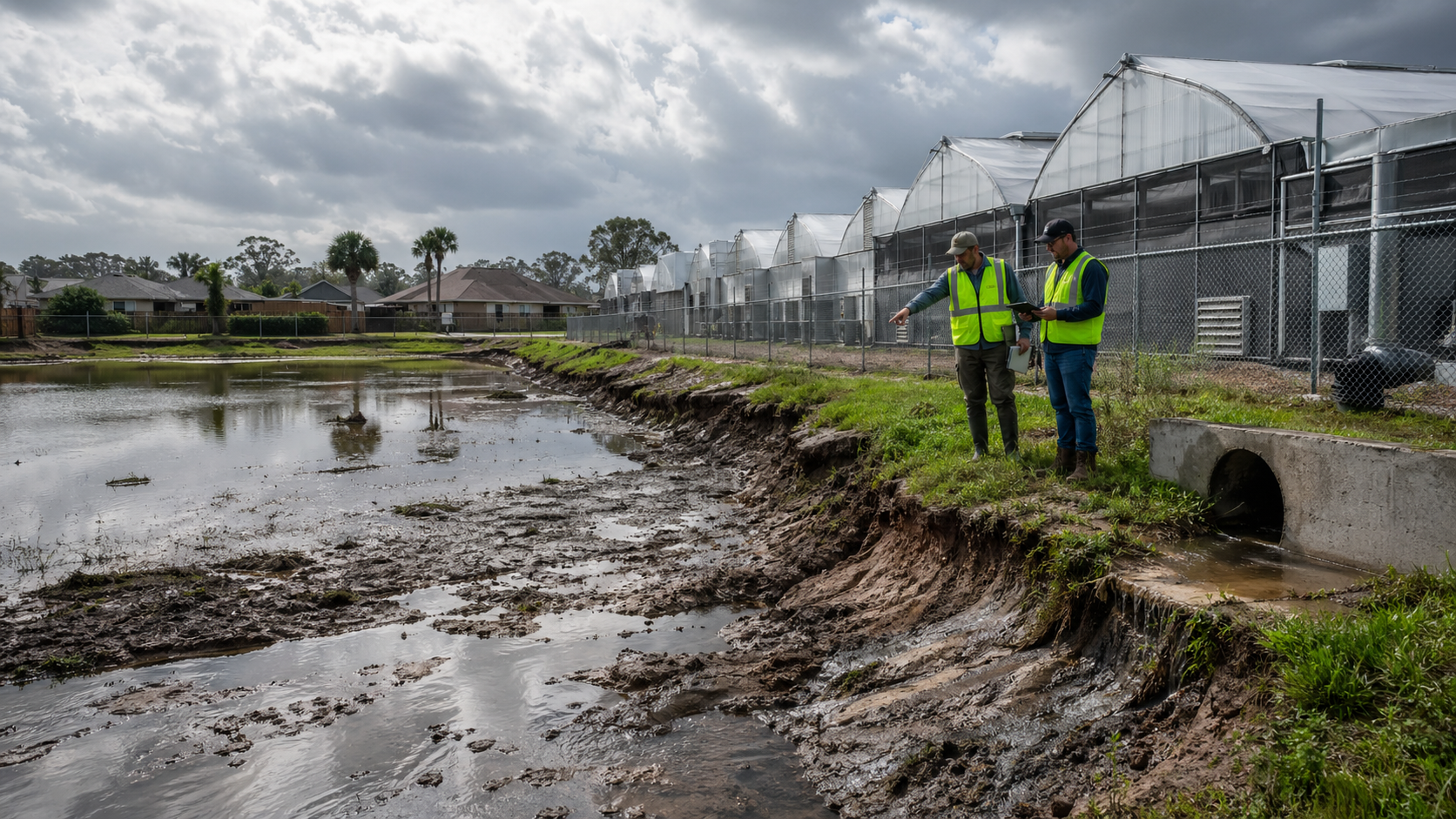
Inspectors reviewing erosion and stormwater runoff near a Florida cannabis greenhouse facility in Jefferson County.
Florida cannabis environmental compliance risk is no longer just a back office issue. It is now part of how operators protect licenses, relationships, financing, insurance conversations, and local credibility. The recent allegations involving Trulieve’s Jefferson County cultivation facility show how quickly site conditions can turn into regulator attention, neighbor complaints, public reporting, and operational pressure.
Quick facts
• Florida authorities cited Trulieve for alleged environmental violations at its Jefferson County cultivation facility
• The reported issues included standing water in stormwater ponds and erosion tied to prolonged water discharge
• The Suwannee River Water Management District issued a notice of apparent violations
• The district requested a corrective action plan
• Local residents raised water quality and odor concerns
• The universal operator lesson is simple: property conditions, site records, and response planning are now part of cannabis risk management
If stormwater or site compliance affects your growth plan, Start with our quick Cannashield intake form so you can map property, operational, and insurance exposure before the issue becomes harder to control.
What happened in Florida
According to MJBizDaily, Florida authorities cited Trulieve for multiple alleged environmental violations at its Jefferson County cultivation facility. The report said the issues included unpermitted impervious surfaces, standing water in stormwater ponds, erosion caused by prolonged water discharge, and tests showing excessive pollutants leaving the site during a pumping event.
The Suwannee River Water Management District reportedly issued a notice of apparent violations and requested that Trulieve create a corrective action plan. Local residents also raised concerns about water quality and persistent odors they believed were connected to runoff from the facility.
The important point is not to treat a public report as a final legal conclusion. The important point is that the business impact can begin long before anything is fully resolved. Once regulators, neighbors, local officials, and media are all paying attention, the operator is already dealing with a much bigger issue than basic maintenance.
Why stormwater is a cannabis business issue
Cultivation facilities are not just grow rooms. They are physical properties with ponds, drainage systems, impervious surfaces, irrigation demands, odor concerns, traffic patterns, waste handling, and neighbors nearby. When water moves across a site, sits too long, flows off property, or causes erosion, the issue can become a regulatory and public trust problem.
Florida’s Environmental Resource Permit process exists in part to reduce increased flooding, protect water quality from stormwater pollution, and protect wetlands and surface waters. That matters because cannabis facilities with large cultivation footprints can create real site management challenges.
This is the universal lesson for every high impact state and emerging market. A clean license does not mean the property is clean from a risk standpoint. Operators need to understand how the site actually behaves after rain, construction changes, discharge events, and daily operations. Paper compliance and physical reality have to match.
If uncertainty around property conditions, runoff, or community complaints is affecting how you plan or negotiate, Complete our quick Cannashield intake form to pressure test your exposure before renewal, expansion, or financing conversations.
The neighbor factor matters
One of the biggest lessons from the Florida story is the role of local concern. Residents reportedly raised water quality and odor issues. Whether every concern is ultimately confirmed or not, neighbor complaints can create pressure fast.
Cannabis operators sometimes think compliance is only about regulators. That is too narrow. Local residents, landlords, county officials, environmental agencies, and media coverage can all shape the story. A drainage concern that stays inside an operations meeting is one thing. A drainage concern that nearby residents believe is affecting water or air quality is something else entirely.
That is why operators need a complaint response process. Not a public relations script. A real process. Who receives complaints? Who logs them? Who investigates? Who takes photos? Who communicates with counsel, landlords, engineers, or regulators? Who confirms that corrective action was actually completed?
When there is no process, the business looks reactive. When there is a process, the operator has a better chance to show discipline, accountability, and control.
Documentation is part of the defense
The reported notice requested corrective action and updated planning from the facility side. That detail matters because regulators usually want more than a verbal explanation. They want records, plans, engineering support, timelines, and proof that the issue is being addressed.
For cannabis operators, this is where risk management becomes practical. Keep current site plans. Track maintenance. Preserve inspection records. Document drainage issues. Photograph standing water and erosion. Review whether new surfaces, added structures, or operational changes affected runoff assumptions.
The operator who can show records, timelines, ownership, and corrective action is in a stronger position than the operator trying to rebuild the story after a notice arrives.
The operator lesson
The temptation is to treat this as a Florida story. It is bigger than that. Every cannabis operator with cultivation, manufacturing, warehousing, distribution, or major facility exposure should see this as a warning. Environmental issues are not always dramatic at first. Sometimes they start as standing water, a blocked drain, a pond that stays full too long, a neighbor complaint, or a site change nobody tied back to the permit file.
That is how small site problems become business problems.
If you need to organize your property, compliance, and insurance documents before your next renewal or expansion meeting, Complete our quick Cannashield intake form to identify weak points and build a cleaner risk picture.
You might also like

Conclusion
The Trulieve environmental allegations are a reminder that cannabis compliance does not stop at licensing, product testing, inventory tracking, or employee training. The property matters. Water matters. Neighbors matter. Documentation matters.
The best operators do not wait for a regulator or a headline to tell them where the weak points are. They look first, document early, and fix what needs attention before the story gets written for them.
Educational note: This article is for education only and is not legal, regulatory, environmental, or insurance advice.
What To Do This Week
• Review your current site plan against what actually exists on the property
• Confirm who owns stormwater, erosion, odor, and maintenance documentation internally
• Photograph and log standing water, pond conditions, erosion, blocked drains, and discharge points
• Ask your engineer, landlord, or property manager whether recent site changes affected runoff assumptions
• Organize permits, inspection records, maintenance logs, contractor records, and corrective action notes
• Create a simple response process for neighbor complaints and regulator inquiriespublic problems.
FAQ
What happened in Florida?
Florida authorities cited Trulieve for alleged environmental violations at its Jefferson County cultivation facility.
What issues were reported?
The reported issues included standing water in stormwater ponds, erosion tied to prolonged discharge, unpermitted impervious surfaces, and pollutant concerns.
Was Trulieve found legally responsible?
The public reporting describes alleged or apparent violations and requested corrective action, not a final legal conclusion.
Why does this matter to other cannabis operators?
Because runoff, site maintenance, odor complaints, and weak documentation can create risk in any regulated cannabis market.
Can environmental issues affect insurance conversations?
They can. Underwriters may ask about site conditions, prior incidents, compliance history, permits, maintenance, and operational controls.
What is the biggest operator takeaway?
Do not wait for a complaint or notice. Review the property, document conditions, and fix weak points before they become public problems.
SOURCES
MJBizDaily, Florida spars with cannabis MSO Trulieve over alleged pollution at cultivation site
https://mjbizdaily.com/news/florida-spars-with-cannabis-mso-trulieve-over-alleged-pollution-at-cultivation-site/615712/
ECB Publishing, Water management district finds possible violations at Trulieve
https://ecbpublishing.com/water-management-district-finds-possible-violations-at-trulieve/
Suwannee River Water Management District, Environmental Resource Permit
https://www.mysuwanneeriver.com/91/Environmental-Resource-Permit

Trulieve and Cronos have each gained roughly 27 percent in 2026 while reporting stronger operating results. The broader signal is that public market attention is increasingly rewarding cash generation, improving margins, liquidity, and measurable revenue growth.