
Illinois Cannabis Reform Bill Targets Licensing Gap And Hemp Rules
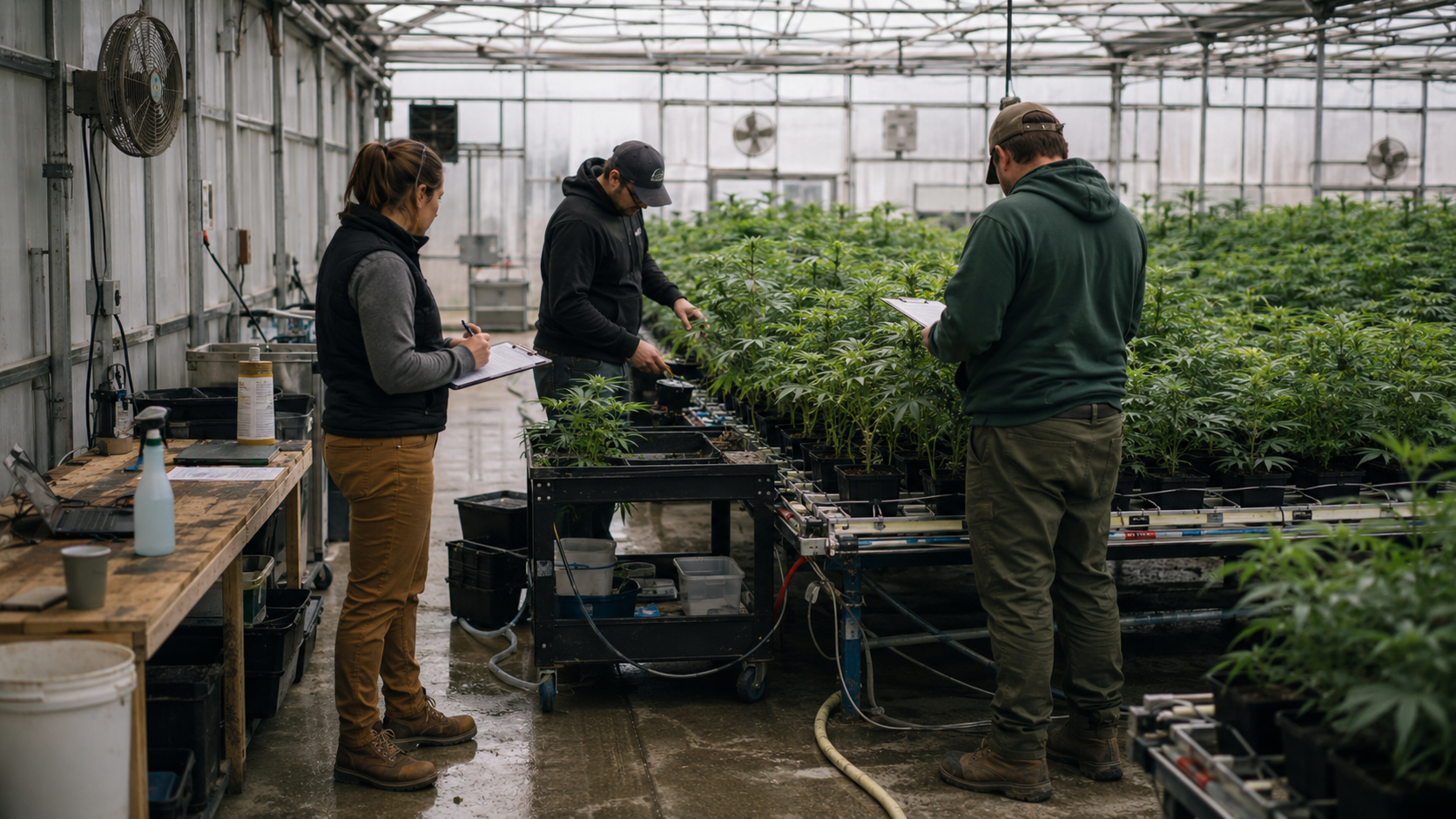
Cannabis cultivation team reviewing greenhouse operations in Illinois.
Illinois cannabis reform is moving into a more serious phase as lawmakers try to connect adult use licensing, medical access, hemp regulation, and future federal positioning. MJBizDaily reports that Senate Bill 3222 is headed to Gov. J.B. Pritzker and would allow adult use only cannabis operators to obtain medical cannabis licenses. The bill also includes changes for Illinois’ $1.5 billion cannabis industry, including intoxicating hemp rules and a canopy increase for craft growers from 5,000 square feet to 14,000 square feet.
Quick facts
• Illinois Senate Bill 3222 passed both chambers and is headed to Gov. J.B. Pritzker
• The bill would allow adult use only operators to seek companion medical cannabis licenses
• That change may help some operators position for DEA registration under the new federal medical cannabis framework
• Craft growers could increase canopy from 5,000 square feet to 14,000 square feet
• The bill would regulate hemp cannabinoid products and cap certain final consumer hemp products at 0.4 milligrams of total THC per container
• The bill also includes drive through and curbside pickup, fee relief for small operators, and social equity transporter requirements
• The universal operator lesson is simple: state licensing strategy now has to account for federal readiness, not just local market access
If Illinois licensing changes are affecting your growth plan, complete our quick Cannashield intake form so you can map licensing, hemp, cultivation, and insurance exposure before the rules move again.
Why the medical license change matters
When Illinois launched adult use sales, medical cannabis operators had a built in path into the adult use market. Later licensing rounds created adult use operators that did not have the same medical component. Senate Bill 3222 appears designed to close that gap by giving adult use only operators a path toward medical cannabis licensing.
That matters because medical cannabis is now part of the federal conversation. If an adult use operator can obtain a medical companion license, that operator may have a clearer path to DEA registration if the federal Schedule III framework continues developing. That does not mean instant federal access. It means the state is trying to create a cleaner bridge between state licensing and future federal compliance.
Why craft growers should watch the canopy increase
The craft grower canopy change is one of the most practical business pieces in the bill. Moving from 5,000 square feet to 14,000 square feet could give smaller cultivators more room to scale production, improve consistency, and compete more effectively.
But more canopy also brings more responsibility. Larger production capacity means more capital needs, staffing pressure, crop risk, inventory planning, testing exposure, and insurance review. A canopy increase is only useful if the operator can manage the added operational load.
This is the universal operator lesson. Growth capacity is not the same as growth discipline. More square footage can help a business, but only if the business has the systems to support it.
If uncertainty around canopy expansion, cultivation planning, or medical license strategy is affecting how you plan, complete our Cannashield questionnaire to pressure test your exposure before expansion creates new risk.
Why hemp rules are part of the same story
The hemp portion of the bill may be just as important as the cannabis license changes. The enrolled bill defines final consumer hemp cannabinoid products with strict limits, including a 0.4 milligram total THC per container cap and restrictions on cannabinoids synthesized or manufactured outside the plant.
That signals a harder line on intoxicating hemp products that have operated outside the licensed cannabis system. The bill would create licensing and standards for hemp product manufacturers and create a path for hemp businesses to transition into the licensed cannabis market.
For hemp businesses, that means the compliance lane is getting narrower. For licensed cannabis businesses, it may reduce uneven competition from unlicensed or loosely regulated intoxicating products. For consumers, it could mean product availability changes fast once the rules take effect.
The federal readiness angle
The deeper story is that Illinois appears to be preparing for a federal future without waiting for every federal answer. DEA registration, Schedule III treatment, hemp restrictions, medical access, and product rules are all starting to connect.
That should get every operator’s attention. A company that only thinks about state licensing may miss the bigger shift. The next phase may reward businesses that can prove medical eligibility, product control, clean documentation, security readiness, and consistent compliance across multiple rule systems.
If you need to organize licensing, hemp product, cultivation, and insurance records before Illinois or federal rules become more active, use the Cannashield intake form to identify weak points and build a clearer compliance picture.
You might also like


Conclusion
Illinois Senate Bill 3222 is more than a cleanup bill. It is a signal that the state is trying to modernize cannabis access, regulate intoxicating hemp, support smaller operators, and prepare for a future where federal registration may matter.
For operators, retailers, cultivators, hemp companies, investors, and compliance teams, the message is simple. Watch this bill closely. The rules around market access, medical licensing, hemp products, and canopy expansion could reshape how Illinois operators prepare for the next phase.
Educational note: This article is for education only and is not legal, regulatory, tax, financial, or insurance advice.
What To Do This Week
• Review whether your Illinois license has a medical component or only adult use authority
• Track Gov. Pritzker’s action on Senate Bill 3222
• Review whether a companion medical license could affect DEA registration strategy
• Recalculate cultivation plans using the proposed 14,000 square foot craft grow canopy limit
• Audit hemp product lines against the 0.4 milligram total THC per container standard
• Build a short internal memo on licensing, hemp, canopy, and federal readiness risks
FAQ
What is Illinois Senate Bill 3222?
It is a cannabis and hemp reform bill that would update several parts of Illinois cannabis and hemp law.
What would the bill do for adult use operators?
It would allow adult use only cannabis operators to seek companion medical cannabis licenses.
Why does the medical license change matter?
A medical license may help some operators position for DEA registration if federal medical cannabis rules continue developing under Schedule III.
How would craft growers be affected?
Craft growers could increase canopy from 5,000 square feet to 14,000 square feet.
What would the bill do to hemp products?
It would create a regulatory framework for hemp cannabinoid products and restrict certain final consumer hemp products to 0.4 milligrams of total THC per container.
What is the biggest operator takeaway?
Illinois operators need to treat licensing, hemp rules, canopy planning, and federal readiness as one connected strategy.
SOURCES
MJBizDaily, Illinois cannabis reform bill targets licensing gap, eyes federal future
https://mjbizdaily.com/news/illinois-cannabis-reform-bill/616317/
Illinois General Assembly, Senate Bill 3222 Enrolled
https://www.ilga.gov/documents/legislation/104/SB/PDF/10400SB3222enr.pdf
Illinois Senate Democrats, Lightford passes landmark hemp and cannabis reform
https://www.illinoissenatedemocrats.com/caucus-news/47-senator-kimberly-a-lightford-news/6985-lightford-passes-landmark-hemp-and-cannabis-reform

Trulieve and Cronos have each gained roughly 27 percent in 2026 while reporting stronger operating results. The broader signal is that public market attention is increasingly rewarding cash generation, improving margins, liquidity, and measurable revenue growth.