
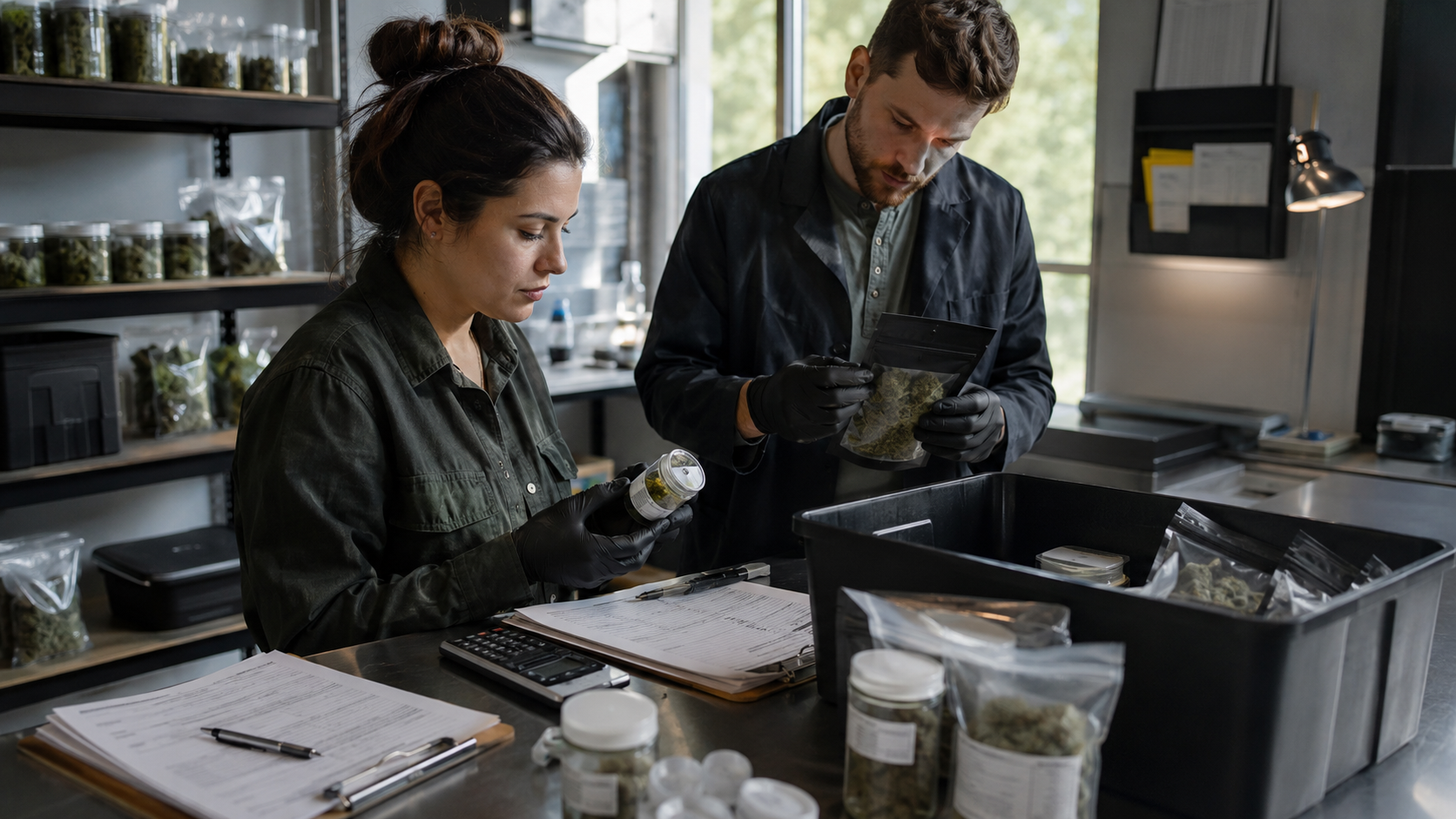
Cannabis staff inspecting product labels and batch records.
Massachusetts cannabis THC potency audit pressure is now moving from industry complaint to active regulatory review. Ganjapreneur reports that Massachusetts regulators will begin auditing THC potency levels for retail cannabis products, and products that test outside 75 percent to 125 percent of the potency listed on the label may be pulled from shelves. For retailers, cultivators, manufacturers, testing labs, investors, and compliance teams, the message is simple. Potency is no longer just a marketing number. It is becoming an enforcement issue.
Quick facts
• Massachusetts regulators will begin auditing THC potency levels for retail cannabis products
• Products that test outside 75 percent to 125 percent of the potency listed on the label may be removed from shelves
• The issue affects retailers, manufacturers, cultivators, and testing labs
• Potency accuracy is now part of product compliance, not just consumer messaging
• Batch records, storage controls, and vendor accountability may become more important during reviews
• The universal operator lesson is simple: if the label cannot be defended, the product becomes exposed
If potency accuracy is affecting your growth plan, Start with our quick Cannashield intake form so you can map testing, labeling, operational, and insurance exposure before a shelf pull creates a bigger problem.
What Massachusetts is really signaling
The real story is not just that the state wants to check numbers. It is that Massachusetts appears ready to treat potency claims as a measurable compliance issue. That changes the conversation for operators.
For years, THC percentages have carried obvious commercial weight. Higher numbers influence consumer behavior, pricing, and shelf appeal. But once regulators start auditing those numbers, the risk shifts. A product is no longer judged only by what sells. It is judged by whether the label can hold up against review.
That matters because a potency mismatch can touch multiple parts of the operation at once. It can create retailer exposure, pressure the manufacturer, raise questions about cultivation consistency, and put the testing lab under a microscope. In other words, this is not just a lab issue. It is a supply chain issue.
Why the 75 percent to 125 percent range matters
The reported threshold gives operators something concrete to plan around. If the audited result falls too far below or above the listed potency, the product may be pulled from retail shelves. That means a label is no longer just descriptive. It becomes an accountability point.
This is where businesses need to get serious about how potency moves from test result to final package. Was the batch sampled correctly. Was the right result attached to the right lot. Did product age or storage conditions affect the outcome. Was there internal review before release. Was there any pressure placed on the testing process itself.
This is the universal operator lesson. Product compliance problems often start long before enforcement shows up. They begin in weak process, rushed documentation, or assumptions that no one will look too closely.
If uncertainty around batch testing, label review, or vendor accountability is affecting how you plan or negotiate, Complete our quick Cannashield intake form to pressure test your exposure before an audit does it for you.
Why retailers and labs should care just as much as manufacturers
Manufacturers may be closest to the label, but retailers are the ones with product on shelves. If a state audit finds a problem, the retail location may be the first place the issue becomes visible. That means retailers need strong intake controls, accurate inventory tracking, and confidence in the vendors they buy from.
Testing labs also need to pay attention. Potency audits create a credibility question. If regulators see repeated gaps between label claims and audited results, they may start looking harder at lab methods, consistency, and whether operators are shopping for favorable results.
For cultivators, the issue is upstream. Inconsistent flower quality, weak post harvest controls, or unstable inputs can all contribute to potency drift. A product can leave the cultivation or manufacturing side looking clean and still become a compliance problem if the process behind it is sloppy.
The operator lesson
The temptation is to treat this as a Massachusetts only issue. That would be a mistake. Potency scrutiny is part of a larger market trend. As cannabis markets mature, regulators look beyond obvious problems and start testing the accuracy of the claims printed on the package.
That means operators should act now. Review labels. Review retention samples. Review testing files. Review storage and handling. Review who signs off before product is released. The businesses that treat potency as a system issue will be in better shape than the businesses that treat it like a lab number.
If you need to organize testing records, vendor files, and insurance documents before Massachusetts audits start creating enforcement pressure, Complete our quick Cannashield intake form to identify weak points and build a cleaner compliance file.
You might also like


Conclusion
Massachusetts is putting THC potency accuracy under real scrutiny, and that should get the industry’s attention. A label that cannot survive review is now a shelf risk, not just a branding problem.
For operators, the message is simple. Tighten the records, tighten the review process, and make sure the number on the package is something you can defend. In a maturing cannabis market, accuracy is becoming part of survival.
Educational note: This article is for education only and is not legal, regulatory, financial, scientific, or insurance advice.
What To Do This Week
• Review labels against current certificates of analysis for active retail products
• Confirm batch records clearly connect the tested lot to the packaged lot
• Check storage and handling controls for products that may drift over time
• Review vendor agreements for testing responsibility and product accuracy expectations
• Audit a sample of products internally before regulators do
• Build a short internal memo on your highest potency labeling risks
FAQ
What are Massachusetts regulators doing?
They are beginning audits of THC potency levels for retail cannabis products.
What happens if a product tests outside the allowed range?
Products that test outside 75 percent to 125 percent of the labeled potency may be pulled from shelves.
Who is most affected?
Retailers, manufacturers, cultivators, testing labs, and compliance teams all face exposure.
Why is this a bigger issue than labeling alone?
Because potency accuracy affects inventory, vendor accountability, lab credibility, and enforcement risk.
Can retailers rely only on vendor paperwork?
That is risky. Retailers should understand the documentation behind the products they carry.
What is the biggest operator takeaway?
Treat potency accuracy like a compliance system issue, not just a marketing issue.
SOURCES
Ganjapreneur, Massachusetts Regulators to Audit Cannabis THC Potency Levels
https://ganjapreneur.com/massachusetts-regulators-to-audit-cannabis-thc-potency-levels/
Massachusetts Cannabis Control Commission
https://masscannabiscontrol.com/
Massachusetts cannabis regulations and guidance
https://masscannabiscontrol.com/regulations/

Trulieve and Cronos have each gained roughly 27 percent in 2026 while reporting stronger operating results. The broader signal is that public market attention is increasingly rewarding cash generation, improving margins, liquidity, and measurable revenue growth.