
Thailand Cannabis Enforcement Rules Put Operators On Notice
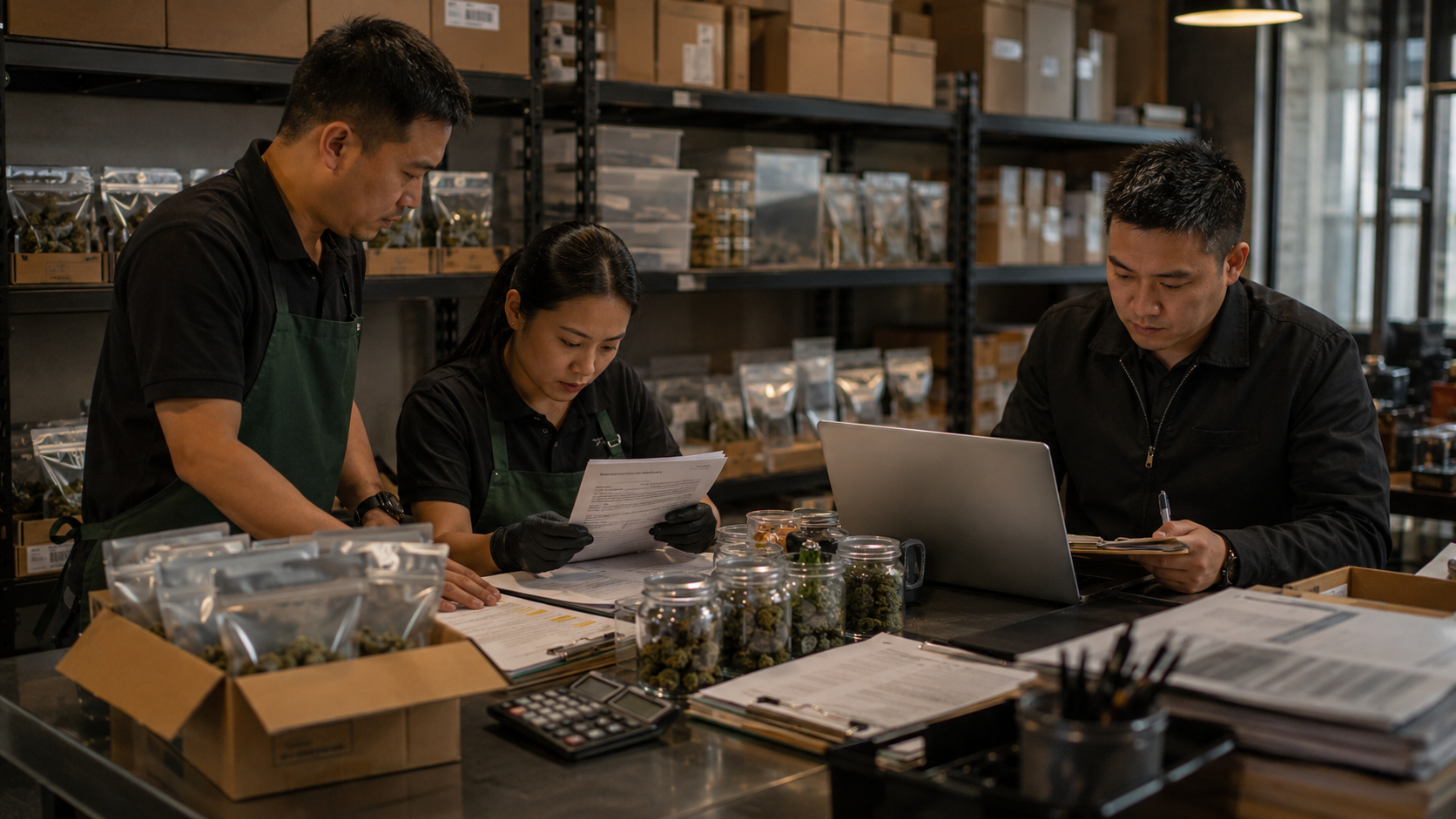
Cannabis compliance team reviewing paperwork in Thailand
Thailand is tightening control over one of the world’s most watched cannabis markets. International Cannabis Business Conference reports that Thailand’s Department of Thai Traditional and Alternative Medicine issued tougher enforcement guidelines for cannabis businesses that violate Public Health Ministry rules treating cannabis as a controlled herb. The new guidance includes 30 to 90 day license suspensions and possible revocation for repeat violations. For operators, retailers, cultivators, exporters, investors, and compliance teams, this is a clear warning that Thailand’s market is moving further away from loose retail activity and closer to a medical control model.
Quick facts
• Thailand issued tougher cannabis enforcement guidelines on June 22, 2026
• The rules apply to licensed operators involved in research, exports, sales, or commercial processing of controlled herbs
• License suspensions can run from 30 to 90 days
• Repeat violations may lead to license revocation
• Violations include missing reports, incomplete reports, failure to display licenses, and failure to show electronic licenses to inspectors
• Other violations include commercial advertising, export reporting failures, sales without a prescription, online sales, vending machine sales, on site consumption, and sales in prohibited places
• Prohibited places include temples, dormitories, and public parks
• The universal operator lesson is simple: Thailand is no longer a casual retail market, it is becoming an inspection and documentation market
If Thailand enforcement pressure is affecting your growth plan, complete our quick Cannashield intake form so you can map licensing, product, retail, export, and insurance exposure before an inspection becomes a suspension issue.
Why these guidelines matter
Thailand’s cannabis market has been unstable since the country removed cannabis from the narcotics list in 2022 and became one of Asia’s most visible cannabis markets. Thousands of shops entered the market quickly, especially in tourism areas. But the lack of a stable national framework created confusion around recreational use, medical claims, retail sales, exports, and enforcement.
The new guidelines matter because they give enforcement officers and operators a clearer penalty structure. That changes the risk calculation for businesses. A retailer that fails to display a license or keep proper reports may face a 30 day suspension. A business that sells without a prescription or fails to report exports may face a 90 day suspension. A business that repeats violations or sells through prohibited channels may lose its license entirely.
This is not just paperwork. In Thailand, documentation is becoming the difference between staying open and being forced out of the market.
Why prescriptions now sit at the center of the market
The most important signal is the prescription requirement. Thailand has been moving cannabis back toward a medical only framework, and the enforcement guidelines support that direction. Sales without a prescription from a qualified practitioner are treated as a serious violation that can trigger a 90 day suspension.
That changes the business model for shops that built revenue around walk in recreational customers. Operators now need to understand who qualifies as a patient, what counts as a valid prescription, how records must be kept, and how staff should verify purchases during inspections.
This is the universal operator lesson. When a market shifts from open retail to medical control, customer flow is no longer the main issue. Compliance flow is.
If uncertainty around prescriptions, reporting, or inspection readiness is affecting how you plan, complete our Cannashield questionnaire to pressure test your exposure before a small documentation gap creates a bigger penalty.
Why advertising and online sales are high risk
Thailand’s new rules also put pressure on marketing and sales channels. Commercial advertising can trigger suspension, while online sales and vending machine sales can lead to revocation. That is a major shift for operators that relied on social media, delivery, tourism marketing, or digital ordering.
For retailers, this means website language, menus, paid promotion, influencer activity, online ordering, delivery workflows, and sales channels need immediate review. For exporters and cultivators, it means reporting and quality standards matter just as much as customer demand. Sales or exports that do not meet GACP or equivalent standards can also trigger suspension.
The message is clear. Thailand is not only targeting illegal sellers. It is tightening the conduct of licensed businesses too.
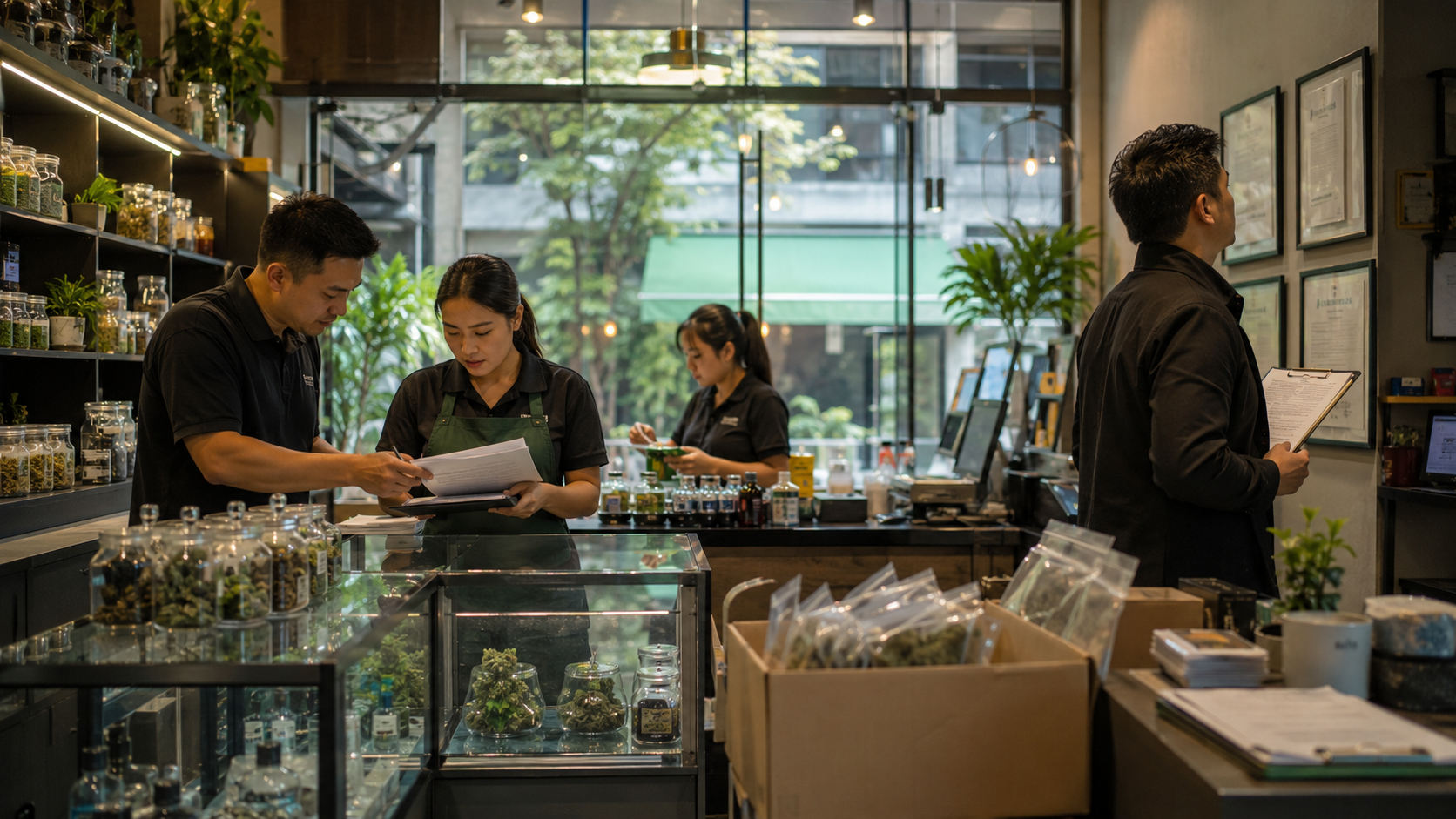
Cannabis retail inspection and license review in Thailand
What investors and exporters should watch next
Thailand still has long term potential because of its climate, cultivation capacity, tourism profile, and possible export relevance. But the risk profile has changed. A market with strong cultivation potential can still become difficult if operators face changing rules, license suspensions, advertising limits, prescription controls, and uncertainty around future narcotics classification.
Investors should watch whether enforcement reduces store counts, pushes operators into medical formats, or discourages new capital. Export focused businesses should track GACP compliance, reporting duties, inspection standards, and whether the government creates a more stable pathway for medical exports.
If you need to organize licensing, reporting, export, and insurance records before Thailand’s market contracts further, use the Cannashield intake form to identify weak points and build a cleaner operating file.
You might also like


Conclusion
Thailand’s new cannabis enforcement guidelines mark another tightening step in a market that has already seen major policy swings. The rules create clearer penalties for missing reports, prescription failures, advertising, online sales, on site use, vending machine sales, and sales in prohibited places.
For operators, retailers, cultivators, exporters, investors, and compliance teams, the message is simple. Thailand still has opportunity, but the easy access era is over. The businesses that survive will be the ones that treat licensing, prescriptions, reporting, product standards, and inspection readiness as core operating functions.
Educational note: This article is for education only and is not legal, regulatory, tax, financial, export, medical, or insurance advice.
What To Do This Week
• Review license display, electronic license access, and inspection response procedures
• Confirm that required business reports are complete, current, and kept at the premises
• Audit prescription verification procedures for every cannabis sale
• Review advertising, website language, social media, delivery, and online sales activity
• Check export reporting and GACP documentation for cultivation and harvesting standards
• Build a short internal memo on Thailand suspension risk, revocation risk, and market access exposure
FAQ
What did Thailand announce?
Thailand’s Department of Thai Traditional and Alternative Medicine issued tougher enforcement guidelines for cannabis businesses that breach controlled herb rules.
What penalties can operators face?
Operators can face 30 to 90 day license suspensions and possible license revocation for repeat or serious violations.
What can trigger a 30 day suspension?
Missing reports, incomplete reports, failure to submit reports, failure to display a license, failure to show an electronic license, commercial advertising, and some GACP related violations can trigger a 30 day suspension.
What can trigger a 90 day suspension?
Failing to report export details or selling cannabis without a prescription from a qualified practitioner can trigger a 90 day suspension.
What violations can lead to revocation?
False reports, repeat offenses, sales to protected groups without a prescription, on site consumption, vending machine sales, online sales, and sales in prohibited places can lead to revocation.
What is the biggest operator takeaway?
Thailand is moving toward tighter medical control, so operators need stronger records, prescription checks, license procedures, advertising controls, and inspection readiness.
SOURCES
International Cannabis Business Conference, Thailand Issues New Cannabis Enforcement Guidelines
https://internationalcbc.com/thailand-issues-new-cannabis-enforcement-guidelines/
The Nation, Thai DTAM tightens penalties for cannabis shop rule breaches
https://www.nationthailand.com/news/general/40067727
Associated Press, Thailand starts banning the sale of cannabis without a prescription
https://apnews.com/article/04b9dc73d43a172cac2da04f0117ab3b

Trulieve and Cronos have each gained roughly 27 percent in 2026 while reporting stronger operating results. The broader signal is that public market attention is increasingly rewarding cash generation, improving margins, liquidity, and measurable revenue growth.